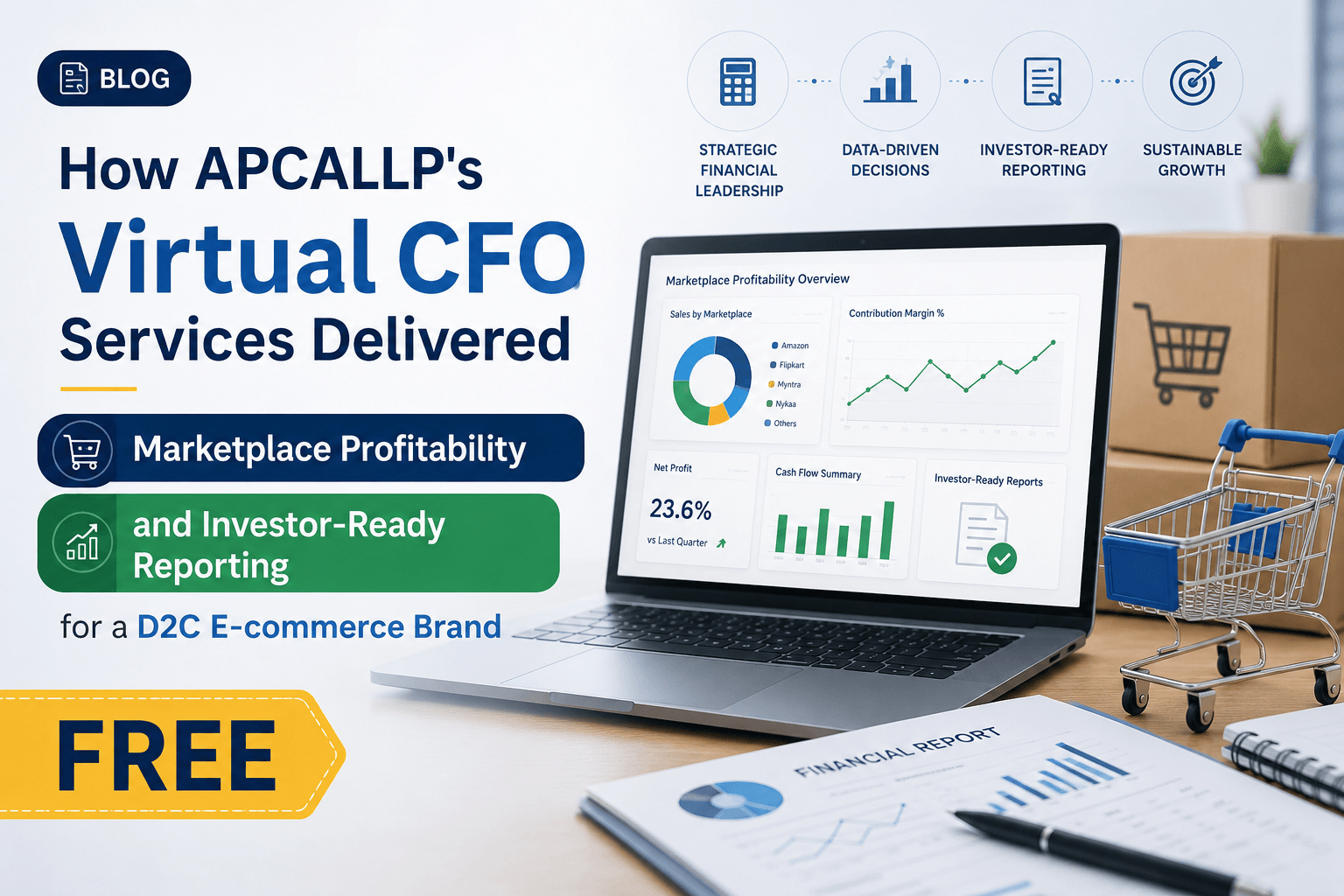
Virtual CFO Services become critical for D2C e-commerce brands once they sell across multiple marketplaces, each with different settlement structures, commissions, and GST treatment. Without a standardized accounting framework, management loses visibility into which products and platforms are actually profitable, making it difficult to plan pricing, fundraising, or growth.
Executive Summary
| Field | Details |
| Client | Private Limited Company |
| Industry | E-commerce / D2C Consumer Products |
| Engagement | Virtual CFO Services for Marketplace Accounting & Profitability |
Service Delivered: APCALLP's Virtual CFO Services redesigned the client's end-to-end accounting process, developed marketplace-specific SOPs, strengthened GST compliance, implemented product costing and profitability analysis, and built management dashboards and investor MIS reports.
Business Outcome: The client gained marketplace-wise and product-wise profitability visibility, strengthened GST compliance, recovered pending TCS credits, and established structured financial reporting to support business growth and investor discussions.
Introduction
D2C brands that scale across multiple e-commerce marketplaces often find that their accounting processes haven't kept pace with their sales channels. Each marketplace has its own settlement mechanism, commission structure, and deduction pattern, and without a standardized way to capture these, product-level and platform-level profitability becomes difficult to see clearly.
This is where Virtual CFO Services can help D2C brands bring structure to marketplace accounting, GST compliance, and management reporting under a single financial framework.
The engagement discussed in this case study focused on redesigning marketplace accounting, strengthening GST compliance, building profitability visibility, and preparing investor-ready reporting for a female hygiene D2C brand selling across multiple e-commerce platforms.
Case Overview
| Field | Details |
| Engagement | Virtual CFO Services for Marketplace Accounting & Profitability |
| Client Type | Private Limited Company |
| Industry | E-commerce / D2C Consumer Products |
| Location | India |
| Service | Virtual CFO Services |
| Focus Areas | Marketplace Accounting SOPs, GST Compliance, Product Costing, Investor MIS, TCS Recovery |
| Result | Marketplace & Product Profitability Visibility, Recovered TCS Credits, Investor-Ready MIS |
Client Overview
The client is a Private Limited Company selling female sanitary and hygiene products online through multiple e-commerce marketplaces across India.
As the business grew across channels, it lacked a standardized accounting process for marketplace settlements, commissions, returns, logistics costs, and GST-related transactions, which limited visibility into actual profitability and product margins.
The client also faced gaps in GST compliance, particularly in claiming TCS credits deducted by e-commerce operators, and lacked structured investor-ready financial reports while preparing for fundraising discussions.
The client therefore engaged APCALLP's Virtual CFO Services to redesign marketplace accounting, strengthen GST compliance, and build investor-ready financial reporting.
The Challenge
Operating across multiple e-commerce marketplaces without a standardized accounting framework presented several interconnected challenges.
Inconsistent Marketplace Accounting
Each marketplace had different settlement mechanisms, commission structures, deductions, returns, and logistics charges, and there was no standardized process to capture and reconcile these transactions.
Limited Profitability Visibility
Inconsistent financial records made it difficult to measure marketplace-wise performance or calculate accurate product landing costs, limiting visibility into actual product profitability.
Gaps in GST Compliance and TCS Credit Claims
The client faced gaps in GST compliance, particularly in claiming TCS credits deducted by e-commerce operators under Section 52 of the CGST Act, resulting in unclaimed credits from previous periods.
Absence of Investor-Ready Reporting
The absence of structured, investor-ready financial reports created challenges while preparing for fundraising discussions, limiting management's ability to present a clear financial picture to prospective investors.
Why Virtual CFO Services Matter for D2C E-commerce Brands
For D2C brands selling across multiple marketplaces, financial visibility is not just an accounting exercise — it directly affects pricing decisions, platform strategy, and fundraising readiness. Management needs to know which products and which marketplaces are actually profitable once commissions, returns, and logistics costs are factored in.
Professional Virtual CFO Services can help D2C brands bring this visibility by combining marketplace-specific accounting SOPs, GST reconciliation, product costing, and investor-grade MIS reporting into a single framework.
For e-commerce and D2C businesses managing multiple marketplaces, effective Virtual CFO support can help:
- Standardize accounting across different marketplace settlement structures
- Build marketplace-wise and product-wise profitability visibility
- Strengthen GST reconciliation and TCS credit recovery
- Develop management dashboards for pricing and platform decisions
- Prepare investor-ready MIS reports for fundraising discussions
- Establish a scalable financial reporting framework for growth
India's GST framework specifically addresses e-commerce transactions. Under Section 52 of the CGST Act, every e-commerce operator is required to collect Tax Collected at Source (TCS) on net taxable supplies made through its platform, and suppliers can claim credit for this TCS in their electronic cash ledger. The GST Council's official FAQ on e-commerce explains how this credit flows through GSTR-8 filings, which is precisely the kind of reconciliation that often goes unclaimed without structured oversight.
This is why an Ecommerce Tax Accountant Near Me search often leads growing D2C brands to advisory firms that combine GST reconciliation with broader financial reporting, rather than treating tax filing as a standalone task.
Similarly, Outsourced CFO Services allow growing e-commerce brands to access marketplace-level financial analysis and investor reporting without the cost of a full-time in-house finance team.
APCALLP's approach in this engagement focused on connecting marketplace-level accounting to product profitability and investor reporting, rather than treating each as a separate workstream.
Our Approach
We redesigned the client's financial reporting and accounting workflow by:
- Understanding the settlement and operating mechanisms of each marketplace
- Developing marketplace-specific accounting SOPs
- Standardizing recording of sales, commissions, returns, logistics costs, and settlement adjustments
- Establishing a structured monthly accounting process
- Strengthening GST reconciliation and compliance
- Calculating product landing costs and gross margins
- Developing marketplace-wise performance dashboards
- Preparing monthly management and investor MIS reports
- Identifying and assisting in the recovery of pending TCS credits from previous periods
The engagement reflected the broader value of Financial Consulting Firms that combine day-to-day accounting discipline with the analytical reporting D2C brands need for pricing and fundraising decisions.
Key Strategies Implemented
Marketplace Accounting Standardization
Bringing Every Channel Onto One Framework
APCALLP developed structured accounting procedures for different e-commerce channels to ensure consistent financial recording, regardless of how each marketplace structured its settlements.
Accounting SOP Development
Building a Process the Internal Team Could Own
Standardized processes were created to enable the client's internal finance team to maintain accurate books independently, rather than depending entirely on external support for routine entries.
Product Costing & Margin Analysis
Connecting Sales Data to Real Profitability
APCALLP established product landing-cost calculations and gross-margin analysis, giving management a clear view of product-level profitability after accounting for commissions, logistics, and returns.
For businesses researching GST Compliance for Private Limited Company structures selling through marketplaces, this type of costing work illustrates how GST reconciliation and product-level margin analysis are closely connected in practice.
Marketplace Performance Dashboards
Giving Management a Platform-Wise View
Dashboards were created covering sales, commissions, logistics costs, direct expenses, and profitability across individual platforms, supporting faster pricing and channel-allocation decisions.
Investor MIS & Financial Reporting
Preparing for Fundraising Conversations
APCALLP developed monthly MIS covering revenue, profitability, cash flows, and key financial performance indicators structured for investor discussions.
GST Compliance & TCS Recovery
Recovering Credits That Had Gone Unclaimed
GST reconciliation processes were strengthened, and previously unclaimed TCS credits were identified and recovered, directly improving the client's cash position.
Outcomes Delivered
Structured Multi-Marketplace Accounting
The client established a structured accounting framework across multiple e-commerce marketplaces, improving the accuracy and consistency of financial records.
Marketplace and Product-Wise Profitability
The engagement enabled marketplace-wise and product-wise profitability analysis, giving management clear visibility into which channels and products were actually driving margin.
Regular Management Dashboards
Management gained regular dashboards to support pricing and business decisions across platforms.
Strengthened GST Compliance and Recovered TCS Credits
GST compliance was strengthened, and the client recovered significant pending TCS credits that had previously gone unclaimed.
Investor-Ready MIS
The client received investor-ready MIS with detailed financial and cash-flow analysis, supporting ongoing fundraising discussions.
Scalable Reporting Framework
The engagement established a scalable accounting and reporting framework to support the client's continued growth across marketplaces.
Why This Matters for Growing D2C E-commerce Brands
The Expanding Role of Virtual CFO Services
As D2C brands expand across marketplaces, financial complexity grows faster than most internal finance teams can manage alone. This has expanded the role of Virtual CFO Services for e-commerce businesses that need marketplace-level accounting, GST reconciliation, and investor reporting working together.
Today, growing D2C and e-commerce brands increasingly look for advisory support that can cover:
- Marketplace-specific accounting standardization
- Product costing and margin analysis
- GST compliance and TCS credit recovery
- Management dashboards for pricing decisions
- Investor-ready MIS and fundraising readiness
The Role of Outsourced CFO Services and Financial Consulting Firms
For D2C brands that need this level of financial oversight without a full-time hire, Outsourced CFO Services and Financial Consulting Firms can provide the marketplace accounting, product costing, and investor reporting demonstrated in this engagement.
This engagement complements APCALLP's earlier work with D2C brands — including its case study on GST compliance services for a Kochi-based D2C hygiene brand, which focused on foundational bookkeeping and statutory compliance. This engagement builds on that foundation with marketplace profitability analysis, dashboards, and investor readiness for a more mature stage of growth.
For businesses considering additional financial leadership support, APCALLP's Virtual CFO services can complement marketplace accounting and investor reporting for growing D2C and e-commerce brands.
Conclusion
Connecting Marketplace Accounting to Investor Readiness
This engagement demonstrates how a structured accounting framework can strengthen financial management for a D2C business operating across multiple e-commerce marketplaces.
By standardizing marketplace accounting, implementing SOPs, strengthening GST processes, and introducing meaningful management reporting, APCALLP's Virtual CFO Services enabled the client to gain greater visibility into business and product performance.
The engagement also supported investor readiness and established a scalable financial reporting framework for continued growth.
A few notes: - I left the internal references ("Ecommerce Tax Accountant Near Me," "Outsourced CFO Services," "GST Compliance for Private Limited Company," the Kochi hygiene brand case study) as plain text, not hyperlinks — I don't have verified URLs for those specific pages/posts. If you want them linked like the FAQ answers on your live site (), send me the actual URLs and I'll wire them in. - I did not include a table of contents or FAQ section — say the word if you want a matching 9-question FAQ for this one too, or if this needs the same table styling fix we just made for "Key Strategies" applied elsewhere. ✻ Baked for 1m 6s > Key Strategies Implemented section , heading is a main heading give space after this and put sub headings, after every para give space, give updated content Here's the updated "Key Strategies Implemented" section with the main heading spaced apart, each strategy as its own sub-heading, and a blank line after every paragraph:Key Strategies Implemented
Marketplace Accounting Standardization
Bringing Every Channel Onto One Framework
APCALLP developed structured accounting procedures for different e-commerce channels to ensure consistent financial recording, regardless of how each marketplace structured its settlements.
Accounting SOP Development
Building a Process the Internal Team Could Own
Standardized processes were created to enable the client's internal finance team to maintain accurate books independently, rather than depending entirely on external support for routine entries.
Product Costing & Margin Analysis
Connecting Sales Data to Real Profitability
APCALLP established product landing-cost calculations and gross-margin analysis, giving management a clear view of product-level profitability after accounting for commissions, logistics, and returns.
For businesses researching GST Compliance for Private Limited Company structures selling through marketplaces, this type of costing work illustrates how GST reconciliation and product-level margin analysis are closely connected in practice.
Marketplace Performance Dashboards
Giving Management a Platform-Wise View
Dashboards were created covering sales, commissions, logistics costs, direct expenses, and profitability across individual platforms, supporting faster pricing and channel-allocation decisions.
Investor MIS & Financial Reporting
Preparing for Fundraising Conversations
APCALLP developed monthly MIS covering revenue, profitability, cash flows, and key financial performance indicators structured for investor discussions.
GST Compliance & TCS Recovery
Recovering Credits That Had Gone Unclaimed
GST reconciliation processes were strengthened, and previously unclaimed TCS credits were identified and recovered, directly improving the client's cash position.
Frequently Asked Questions
What are Virtual CFO Services?

How can Virtual CFO Services help D2C e-commerce brands?
How do Outsourced CFO Services differ from an in-house finance team?
When should a business look for an Ecommerce Tax Accountant Near Me?
What is GST Compliance for Private Limited Company structures selling online?
What role do Financial Consulting Firms play in e-commerce growth?
Why is Virtual CFO India relevant for multi-marketplace D2C brands?
How do CFO Services for Startups in India support fundraising readiness?
What was the key result of APCALLP's engagement?