Audit Firms in Bengaluru: What Businesses Should Look for in an Auditor
 General
An audit is the one piece of financial work your business does that is designed to be read by outsiders. Choosing between audit firms in Bangalore therefore matters more than the fee comparison suggests, because lenders, investors and acquirers all treat the audited statements as the version of the truth they can rely on. This guide covers what an auditor actually does, how independence restricts what else they can provide, how timelines and fees work in this market, and the questions worth asking before you appoint anyone.
Key Takeaways
- An auditor gives an opinion on your financial statements, which is a different service from preparing them, and the two cannot be performed by the same firm.
- Independence rules restrict what other services your audit firm may provide, so growing companies often split audit and advisory between two firms deliberately.
- Audit quality shows up in the questions asked during fieldwork, not in the length of the report, so judge firms on how they test rather than on what they charge.
What a Statutory Audit Actually Delivers
A statutory audit is an independent examination that results in an opinion on whether your financial statements give a true and fair view. The auditor does not prepare the accounts, and they do not guarantee that no fraud exists anywhere in the business. What they provide is reasonable assurance, tested through sampling, confirmation and analytical review across the year.
That distinction matters commercially because outsiders read the opinion rather than the underlying work. A clean opinion from a credible firm shortens lending conversations and reduces the amount of independent verification an investor will insist on. A qualified opinion, or a clean one from a firm nobody recognises, produces the opposite effect and usually costs time you did not budget for.
The audit also generates a second output that most businesses undervalue, which is the management letter. It sets out the control weaknesses the auditor found while testing, ranked by how serious they are. Companies that act on that letter each year build genuinely stronger finance functions, and companies that file it unread repeat the same findings indefinitely.
Above prescribed thresholds a tax audit also applies, which is a separate examination under a different law with a different scope. The two are often performed by the same firm for practical reasons, but they answer different questions and follow different timetables. Our note on tax audit readiness covers the second of these in detail.
The Institute of Chartered Accountants of India sets the auditing standards every firm must follow, so the framework itself is common across the profession. What differs between firms is how thoroughly those standards are applied in practice.
Independence and What Your Auditor Cannot Also Do
Independence is the entire basis on which an audit opinion carries weight, and Indian law restricts the other services an auditor may provide to the same client. Bookkeeping, internal audit, actuarial services, investment advisory and certain management functions all sit on the restricted list. The precise boundaries depend on the entity type and the service, so the sensible approach is to ask before assuming.
For a small private company this rarely creates a problem, because the audit is narrow and the advisory needs are modest. For a funded or foreign owned company it can create a real one, since the firm you most want advising on structure may be the firm auditing you. That is why many growing companies in Bengaluru deliberately appoint one firm for audit and another for advisory and compliance.
Splitting the work has a second benefit that is rarely discussed openly. An adviser who knows their work will be examined by a different firm tends to document positions more carefully than one who will effectively review themselves. The discipline that creates is worth more than the modest efficiency lost by using two firms.
If you do split, agree the information flow between the two firms in advance. The auditor will need working papers and explanations from the advisory firm, and an unmanaged relationship between them slows the audit considerably. One named contact on each side handling that exchange removes most of the friction.
Timelines and How Audits Actually Run in Bengaluru
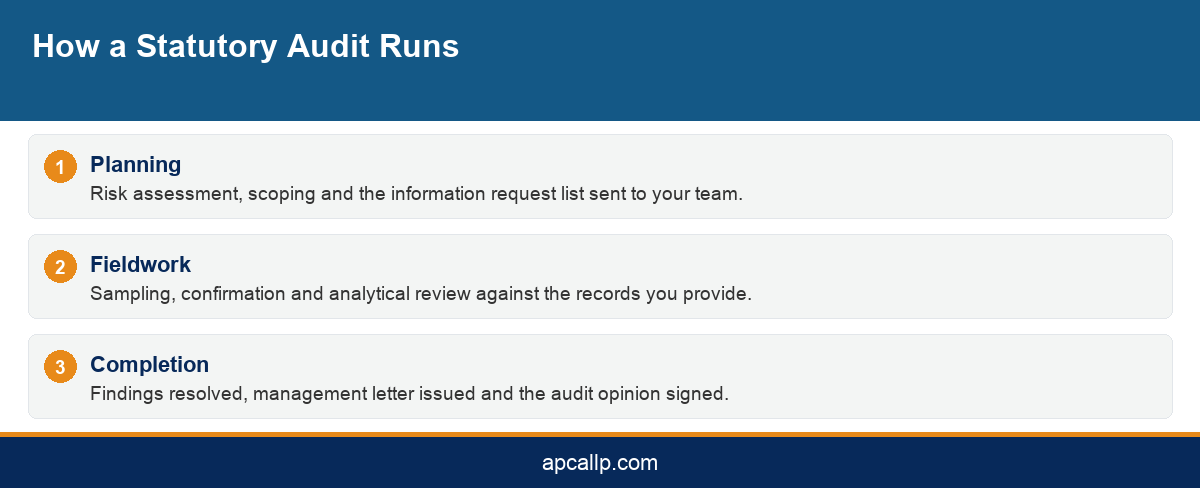
A statutory audit runs in three phases: planning, fieldwork and completion, and the compressed season between the financial year end and the filing deadline puts pressure on all three. Every firm in the city is busy at the same time, which is why appointment timing matters more here than in smaller markets. Businesses that appoint late find themselves scheduled into whatever window remains rather than the one that suits them.
The single biggest determinant of how long an audit takes is the state of your records when fieldwork begins. Reconciled ledgers, complete supporting documents and a responsive finance contact can turn a four week audit into a two week one. Incomplete records do not just extend the audit, they change what the auditor has to do, because gaps force additional testing.
Ask any prospective firm for their expected timeline and, more usefully, for the list of what they will need from you and when. A firm that provides a detailed information request list in advance has run the process many times and intends to run yours efficiently. A firm that cannot produce one until fieldwork starts is telling you something about how the engagement will go.
Agree the reporting deadline in writing alongside the fee, and build in a buffer before your statutory filing date. Audits routinely surface one issue that needs a decision from management, and that decision takes days rather than hours. A deadline with no slack turns an ordinary finding into an emergency.
How Audit Fees Are Set
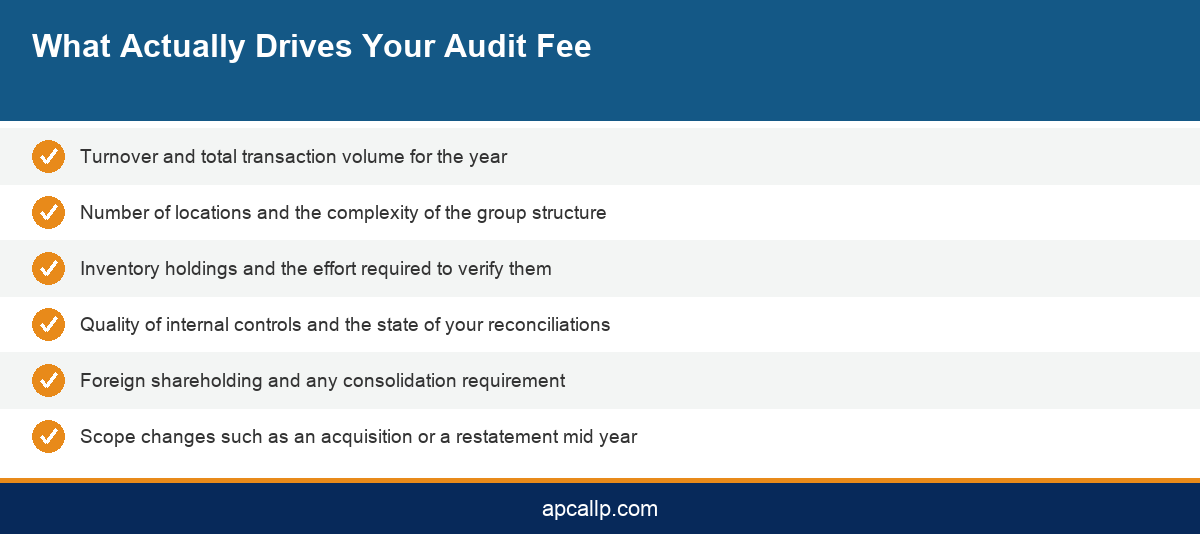
Audit fees are driven by the size and complexity of the entity rather than by any retainer you may have for other work. Turnover, transaction volume, number of locations, group structure, inventory and the quality of your internal controls all move the number. Foreign shareholding and consolidation requirements add further hours because additional standards and reporting apply.
Expect a fee quote to follow a scoping conversation rather than precede one. A firm that quotes before understanding your transaction volume and control environment is guessing, and the guess will be revised once fieldwork exposes the reality. That revision is a common and entirely avoidable source of friction.
Be cautious about audit fees materially below the Bengaluru range for your size of business. Audit hours are the direct cost of the assurance being provided, and a fee that does not support adequate hours produces an opinion of correspondingly limited value. Lenders and investors are aware of this and read the auditor's name and fee accordingly.
Finally, agree what happens if scope expands. A newly acquired subsidiary, a restatement or an unexpected control failure all add hours that were not in the original quote. Settling the mechanism for approving additional work at appointment prevents an awkward conversation in the middle of fieldwork.
Questions to Ask Before Appointing an Auditor
Ask who will actually be on site during fieldwork and how much experience they have in your sector. Audit quality is created by the person testing your transactions rather than by the partner signing the report. In a market with high staff turnover, that team composition is worth asking about explicitly.
Ask how many audits of similar size and sector the firm completed in the last year, and request a reference from one of them. Ask that reference a single question: how many surprises appeared late in the process. A well run audit produces its findings during fieldwork, not in the final week.
Ask what other services the firm provides to clients like you and where the independence boundary sits for your entity type. The answer tells you whether appointing them limits your options for advisory work later. It is much easier to plan around that at appointment than to discover it when you need transaction advice.
Finally, ask what they would expect to find in your first audit given what they have seen so far. A firm that answers specifically has already read your records. If you want to compare that against how our team scopes an engagement, the contact page lists our Bengaluru office in HSR Layout.
Conclusion
Choosing between audit firms in Bengaluru comes down to independence, capability during fieldwork and realistic scheduling. Understand what the audit opinion does and does not cover, and act on the management letter rather than filing it. Appoint early enough to secure a sensible window, and agree the timeline, the fee and the scope change mechanism in writing. If you are appointing an auditor for a funded or foreign owned company and want the independence boundary explained plainly, Talk To Us.
Frequently Asked Questions
What does a statutory auditor actually do?

Can my auditor also do my bookkeeping?
Should I use separate audit and advisory firms?
How long does a statutory audit take in Bengaluru?
How are audit fees calculated?
What is a management letter?
When should I appoint my auditor?
Is a tax audit the same as a statutory audit?
What if my records are incomplete when fieldwork starts?
What should I ask an audit reference?