Business Valuation Services in Bangalore: A Guide by Purpose
 investment readiness services
A valuation is always prepared for a purpose, and the purpose decides almost everything about it. A fundraise, a share issue to a foreign investor, an ESOP grant, a merger and a founder exit can each value the same company differently, and each may need a different signatory. Business valuation services in Bangalore therefore start with one question: what is this number for? This guide explains valuation by purpose, the methods used, who can sign which report, what drives the timeline, and how to choose a valuer.
Key Takeaways
- Business valuation services in Bangalore are commissioned for fundraising, regulatory pricing, ESOPs, mergers, disputes and exits, and the purpose sets the method and the signatory.
- Income, market and asset approaches are used together; a credible report explains why the chosen weights fit the business.
- Plan regulatory valuations alongside the commercial negotiation, so one transaction does not end up with conflicting numbers.
Why the Purpose of a Valuation Matters
Value depends on who is asking and why. An investor negotiating a round wants a price that leaves room for a return. A regulator wants assurance that a share issue is not below fair value. A tax officer wants to see that a transfer was not priced to shift income. Each perspective uses its own rules.
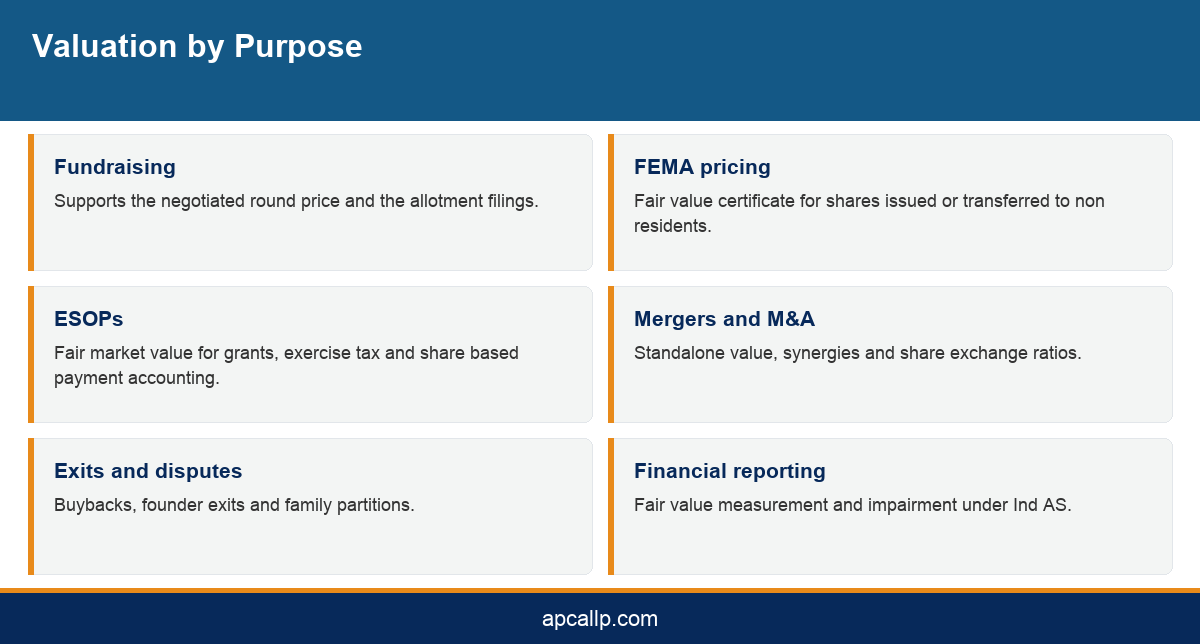
Valuation by purpose falls into a few groups: commercial valuations for fundraising and M&A, regulatory valuations under exchange control, company law and income tax, reporting valuations for financial statements, and dispute valuations for shareholder exits and partitions. Many transactions need more than one.
Good business valuation services in Bangalore plan all the valuations a transaction needs at the start, so the commercial price, the regulatory certificates and the accounting entries are consistent. Inconsistency is one of the commonest diligence findings.
For that reason, the engagement letter for any valuation should state the purpose, the standard of value, the valuation date and who may rely on the report. These four items prevent most later disputes about what the number was meant to show.
Price, Value and Fair Value
Price is what someone pays. Value is an estimate of what the business is worth. Fair value is a defined standard used by regulators and accountants. A negotiated price may sit above or below a fair value certificate, and the rules say which direction is allowed.
The Valuation Date
Every valuation is prepared as at a specific date. Events after that date, such as a new contract, a lost customer or a market fall, are not reflected unless the report is updated. Choosing the right date, and documenting what was known on it, is as important as choosing the method.
Valuation Methods: Income, Market and Asset Approaches
Three broad approaches are used worldwide, as summarised in the Wikipedia overview of business valuation. The income approach values future cash flows, most often through discounted cash flow. The market approach compares the business with similar listed companies or recent transactions. The asset approach values the net assets.
Discounted cash flow suits businesses with predictable cash generation. It is sensitive to the growth rate, margins, the discount rate and the terminal value, so the assumptions need evidence. Market multiples suit businesses with good comparables, such as SaaS companies priced on revenue or profit multiples. The asset approach suits holding companies, real estate and businesses in distress.
Early stage startups often have little history, so investors use methods such as the venture capital method and scorecard approaches. Our notes on the venture capital method for startups and the Berkus approach for early stage companies explain these in detail.
Comparable companies need care. Listed peers are often far larger and more liquid than the company being valued, and transaction multiples reflect the specific buyers involved. Adjustments for size, growth and marketability are normal, and the report should explain them.
Weighting More Than One Method
Most reports use two or three methods and weight them. The weights should reflect the business, for example more weight on market multiples for a mature SaaS company with good comparables, and more on discounted cash flow for a business with long contracts.
Testing the Assumptions
Sensitivity tables show how value moves with growth, margin and discount rate. A valuer who shows the range, not only a single number, gives the client a much better basis for negotiation.
The Discount Rate in Indian Valuations
The discount rate reflects the risk of the cash flows. For Indian private companies it usually builds up from a risk free rate, an equity risk premium, and adjustments for size, stage and company specific risk. Small changes in the rate move value significantly, so the basis for each component should be explained in the report.
Valuing Technology and SaaS Companies in Bengaluru
Bengaluru's technology companies raise particular valuation questions. Many have recurring revenue but limited profits, high growth but uncertain margins, and intangible assets that do not appear on the balance sheet. Traditional asset based methods say little about their value, and simple profit multiples often do not apply yet.
Revenue multiples are common, but the right multiple depends on growth, gross margin, net revenue retention, customer concentration and the quality of contracts. Two SaaS companies with the same revenue can deserve very different multiples. A careful valuer shows how these metrics compare with the peer set rather than applying a headline multiple.
Discounted cash flow still matters for these companies, especially when investors want to see the path to profitability. The forecast should link customer acquisition, retention and pricing to revenue, and hiring to costs. Our AI SaaS pricing model case study shows how a pricing model fed directly into investor readiness.
Metrics That Move the Multiple
Annual recurring revenue growth, gross margin, net revenue retention, payback period on customer acquisition, burn multiple and customer concentration. Prepare these consistently each month, so they are ready when the valuation and the investor conversation begin.
Intangibles and Intellectual Property
Software, data, brands and customer relationships drive value but rarely sit on the balance sheet. In an acquisition they may be valued separately for accounting. Make sure intellectual property is owned by the company, with assignments from founders and contractors.
Who Can Sign Which Valuation Report
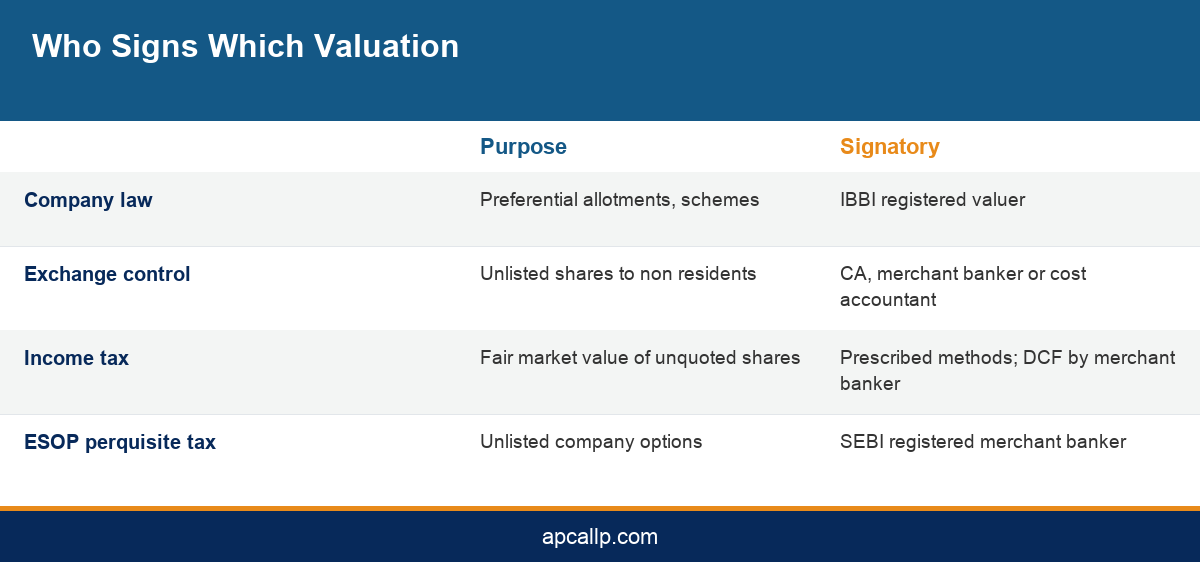
Indian law assigns valuations to specific professionals. Under company law, many valuations must be done by a registered valuer, registered with the Insolvency and Bankruptcy Board of India. These include preferential allotments, valuations for schemes of arrangement and certain other corporate actions.
Under exchange control law, fair value for unlisted shares issued or transferred to non residents can be certified by a chartered accountant, a SEBI registered merchant banker or a practising cost accountant. Under income tax rules, the fair market value of unquoted shares follows prescribed methods, and the discounted cash flow method requires a SEBI registered merchant banker.
ESOP valuations for employee perquisite tax in unlisted companies also need a merchant banker's report. One transaction may therefore need reports from different signatories, which is why planning matters.
For many transactions the practical answer is a coordinated set of reports. A chartered accountant firm with registered valuer and merchant banker relationships can manage the set, keep the assumptions aligned and explain any differences in value to investors and regulators.
Registered Valuers and Their Asset Classes
Registered valuers are registered for specific asset classes: securities or financial assets, land and building, and plant and machinery. A share valuation under company law needs a valuer registered for securities or financial assets. Check the registration before engaging.
When One Report Cannot Serve Every Purpose
A single report can sometimes serve more than one purpose, if the signatory qualifies and the standards align. Often they do not, and two reports are needed. The key is consistency: the reports should explain any difference in value rather than leave it unexplained.
Valuations for Fundraising and Investor Readiness
In a fundraise, the price is negotiated between founders and investors. The valuation report supports that negotiation and satisfies the regulatory requirements for the allotment. Investors will test the forecast, the market size and the unit economics behind it.
Investor readiness is about making the numbers defensible before the conversation starts. Clean accounts, a credible financial model, clear cohort and retention data and a reconciled cap table all support a higher and faster close. Our list of reasons investors delay funding decisions shows where weak preparation costs founders.
Bengaluru startups raising from foreign funds need a FEMA compliant pricing certificate on or near the allotment date, in addition to the company law valuation where applicable. Planning both together avoids two numbers that disagree.
Timing matters as well. Founders who commission business valuation services in Bangalore only after a term sheet is signed often find the regulatory valuation lagging the allotment date. Engaging the valuer while the round is being negotiated lets the report track the commercial terms and be signed on the right date.
What Investors Look for in the Model
Investors look for a model that links revenue drivers to hiring and cash, shows unit economics by cohort, and reconciles to the historical accounts. Our note on MIS reports investors actually read covers the reporting that supports it.
Pre Money, Post Money and Dilution
Founders should model dilution across the ESOP pool, convertible instruments and the new round before agreeing a pre money value. A headline valuation that ignores these items can overstate what founders actually keep.
Valuations for Mergers, Acquisitions and Group Restructuring
In an acquisition, valuation supports the price negotiation and the regulatory steps. Buyers value the target on a standalone basis and then consider synergies. Sellers should understand both numbers, because the gap between them is what the parties are negotiating over.
In a merger of two companies, valuers determine the share exchange ratio, which decides how many shares of the merged company each shareholder receives. For listed companies, a fairness opinion from a merchant banker supports the ratio. For unlisted groups, a registered valuer's report supports the scheme before the tribunal.
Our edtech valuation and merger case study shows how a valuation supported both a merger and a fundraise without conflicting numbers.
Buyers also commission purchase price allocations after completion, which value the acquired intangibles and goodwill for financial reporting. Planning for this during the deal avoids a scramble at the first year end audit.
Synergies Are Not Free
Synergies cost money to achieve and take time. A seller should not expect a buyer to pay away all the synergy value, and a buyer that does so leaves no margin for integration problems.
Group Restructuring and Holding Companies
Groups often simplify structures before a fundraise or sale by merging entities, transferring businesses or creating a holding company. Each step needs valuation support and tax analysis. Business valuation services in Bangalore increasingly work on these restructurings for founders preparing their companies for institutional investors.
ESOP, Exit and Dispute Valuations
ESOP valuations determine the fair market value used for employee taxation and for accounting under share based payment standards. They are needed at grant for accounting and at exercise for tax. Bengaluru technology companies with large pools need a regular cadence.
Exit valuations arise when a founder or shareholder leaves, when shares are bought back, or when a family business is partitioned. The shareholders' agreement often specifies the method, so read it first. If it is silent, the parties need an agreed and independent valuer.
Dispute valuations must be especially rigorous, because they may be tested in arbitration or court. Documentation of assumptions and sources becomes as important as the number itself.
Financial Reporting Valuations
Companies reporting under Ind AS may need fair value measurements for investments, acquired intangibles and impairment tests. The concepts follow the IFRS 13 fair value standard, which Ind AS 113 mirrors closely.
Shareholder Agreements and Valuation Clauses
Many shareholders' agreements specify how shares are valued on an exit: fair market value by an independent valuer, a formula, or a price linked to the last round. Founders should review these clauses before signing a round, because they decide what an exiting shareholder receives and who chooses the valuer.
What a Good Valuation Report Contains
A good report is short enough to read and complete enough to defend. It states the purpose, the valuation date, the standard of value, the signatory's qualification and independence, the information relied on, the methods considered and chosen, the key assumptions and the conclusion. It also states its limitations clearly.
The analysis section matters most. It should explain the business and its market, show the historical performance, set out the forecast and how it was tested, and walk through each method to a value. Where methods give different answers, the report should explain the weighting.
Investors, regulators and courts read valuation reports sceptically. A report that anticipates their questions, with sources, sensitivity tables and reconciliations, is far more useful than a template filled with numbers. That is the standard to expect from business valuation services in Bangalore, whatever the size of the company.
Valuation Standards in India
Chartered accountants follow valuation standards issued by their institute, and registered valuers follow the standards and code of conduct applicable to them. Ask which standards a report follows, because it signals the level of rigour and documentation you can expect.
Sensitivity and Scenario Tables
A sensitivity table shows value at different growth rates, margins and discount rates. A scenario table shows value under base, upside and downside cases. Both help founders and boards understand risk and give them a firmer basis for negotiation.
Common Valuation Mistakes and How to Avoid Them
The first mistake is an unsupported forecast. A projection that doubles revenue every year with no link to pipeline, hiring or market data will be discounted heavily by investors and questioned by regulators. Build the forecast from drivers and show the evidence.
The second is a stale report. Using a valuation prepared months earlier for an allotment or transfer is a frequent diligence finding. The third is inconsistency, where the round price, the FEMA certificate and the tax valuation tell different stories with no explanation.
The fourth is ignoring the cap table. Convertible instruments, ESOP pools and liquidation preferences affect what each class of shareholder receives. A valuation of the whole company is only the start; founders need to see what their own shares are worth under different outcomes.
Preparing Information for the Valuer
Provide audited accounts, current management accounts, the financial model, the cap table, key contracts, customer and revenue data, and a list of material events since the last balance sheet. Complete information shortens the timeline and strengthens the report.
Timelines and What Drives the Effort
A straightforward regulatory valuation with good information can take one to two weeks. A full valuation for a transaction, with several methods, management meetings and sensitivity analysis, often takes three to six weeks.
The main drivers are the quality of the data, the complexity of the business, the number of methods and the number of purposes. Clean monthly accounts, a current financial model and clear documents shorten the timeline more than anything else.
Valuation reports also go out of date. A report prepared months before an allotment or transfer may no longer reflect fair value, so schedule valuations close to the transaction date and agree the date with your advisers early.
Costs follow the same drivers. A single purpose regulatory report is usually modest, while a multi method transaction valuation with several reports costs more. Ask for a fee estimate tied to defined deliverables, and confirm whether updates for a later date are included.
Planning Around a Transaction
Work backwards from the allotment, transfer or filing date. Allow time for information gathering, management discussions, draft review and signing, and agree the valuation date with the investor or counterparty so that every report uses the same reference point.
Choosing Business Valuation Services in Bangalore
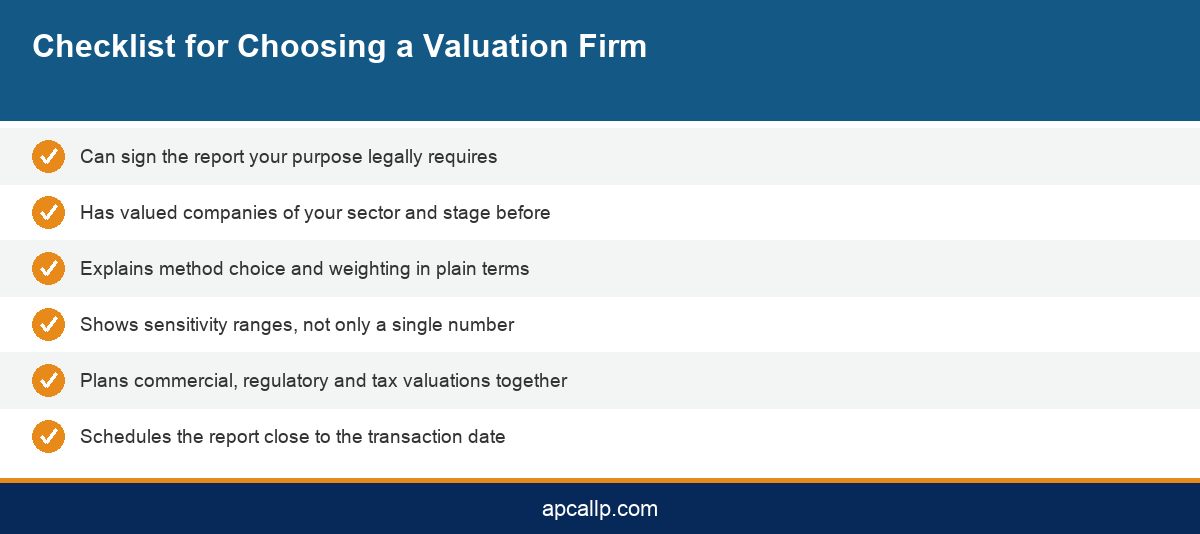
Start with the purpose and check that the firm can sign what you need: registered valuer, merchant banker relationships or chartered accountant certification. Ask for examples of reports for similar purposes and sectors.
Then check independence and method. A valuer should not simply confirm a number the client wants. Ask how the firm chooses methods, how it tests assumptions and how it presents ranges. Professional guidance from bodies such as the ICAI sets expectations for valuation work by chartered accountants.
Finally, think about continuity. Companies that raise money, grant ESOPs and plan an exit need consistent valuations over years. Our team that prepares founders for investors works with founders on that whole journey, from the first model to the exit.
Ask, too, how the firm handles disagreement. A good valuer listens to management, tests the evidence and changes its view when the evidence supports it, but will not move a number simply because the client prefers a different answer.
Comparing Valuation Firms in Bangalore
When comparing valuation firms in Bangalore, look beyond price. Compare the team's sector experience, the clarity of sample reports, how they handle assumptions you disagree with, and whether they can coordinate the regulatory reports your transaction needs. The cheapest report becomes expensive if an investor or regulator rejects it.
Conclusion
Business valuation services in Bangalore are most useful when they start with the purpose. Choose the method that fits the business, the signatory the law requires, and a date close to the transaction. Plan commercial, regulatory and accounting valuations together, and keep the assumptions evidenced so the number holds up under investor or regulator scrutiny. If a fundraise, ESOP grant, merger or exit is coming up, talk to APCALLP's Bengaluru team about a valuation plan.
Frequently Asked Questions
What do business valuation services in Bangalore cover?

Who can value shares issued to a foreign investor?
How long does a business valuation take?
Which valuation method is best for a startup?
Why do valuations for the same company differ?
Do ESOPs need a valuation every year?
How long is a valuation report valid?
What is a share exchange ratio?
Can APCALLP value businesses outside Bengaluru?