CFO Services for Startups: ESOP Structuring and Revenue Recognition in 2026
 Business General
 Introduction
When Talent Strategy Meets Accounting Complexity
Most startup founders are confident in their product few are confident in their accounting. As Bangalore's startup ecosystem matures, two financial challenges have moved to the top of every investor's due diligence checklist: ESOP structuring and revenue recognition. Get either wrong, and a funding round can unravel weeks before the term sheet arrives. That is precisely where cfo services in Bangalore deliver transformational value. A skilled CFO bridges the gap between regulatory complexity and business strategy, giving founders the structured financial foundation that sophisticated investors demand before committing capital.
Key Takeaways
Three Things Every Startup Founder Must Know
ESOP structuring requires careful decisions on pool size, exercise price, vesting schedules, and compliance with the Companies Act 2013 — all of which directly affect investor dilution and employee tax outcomes.
Revenue recognition under Ind AS 115 determines when income is recorded, not just when cash is collected — a distinction that materially affects gross margin, ARR, and the financial ratios investors benchmark.
CFO services in Bangalore combine business financial advisory expertise with startup accounting services Bangalore founders rely on to maintain financial compliance for startups at every growth stage.
ESOP Structuring: Why the Design Decisions Matter More Than the Grant
A poorly designed ESOP can create tax liabilities, dilution surprises, and compliance gaps that surface at the worst possible moment your next investor due diligence.
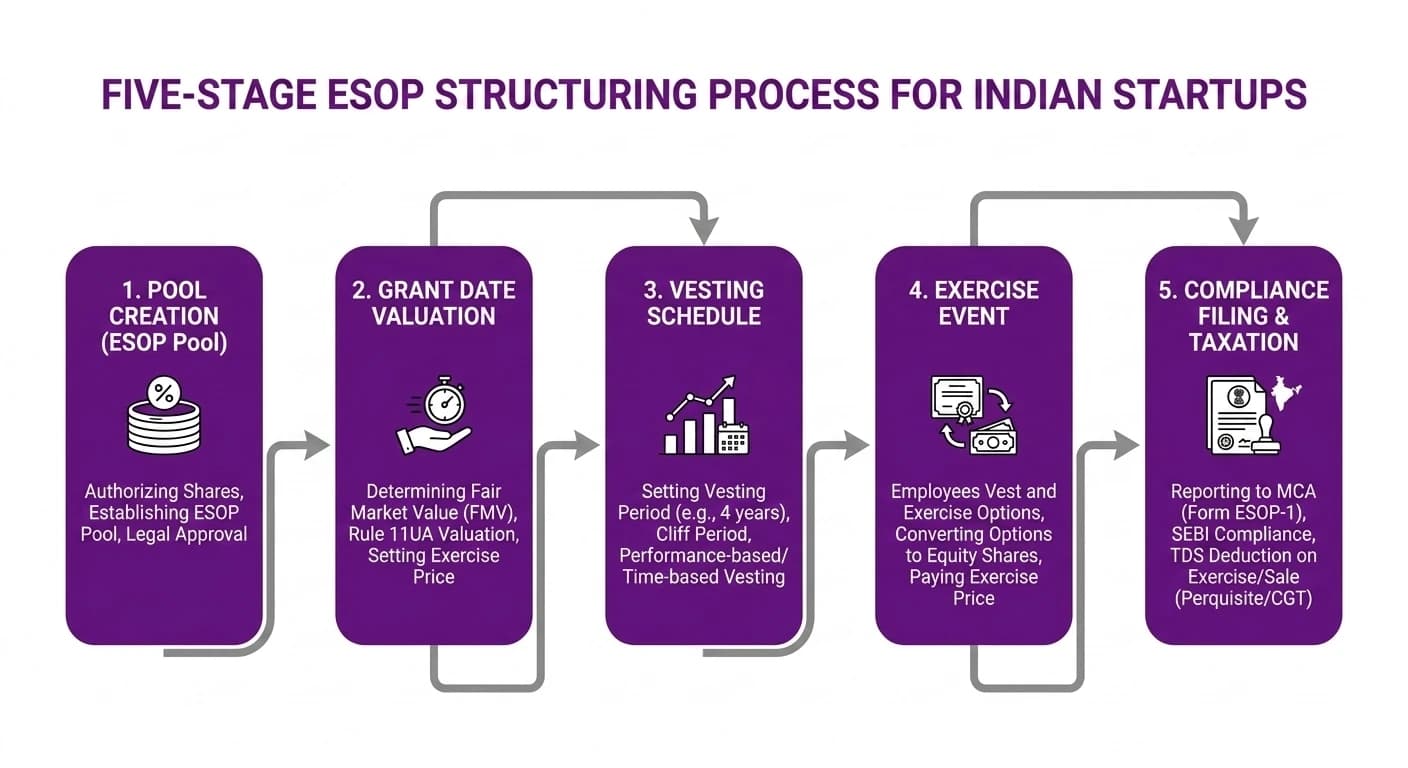
Employee Stock Option Plans give employees the right to acquire company equity at a predetermined exercise price after a defined vesting period. When designed with care, ESOPs align employee incentives with long-term company success and help startups attract senior talent they could not otherwise afford. When designed poorly, they create perverse outcomes: options granted at incorrect valuations, vesting schedules that do not match employment cycles, or pool sizes that leave no room for future hires.
Key structuring decisions include determining the appropriate ESOP pool percentage before each funding round, setting the exercise price in line with fair market valuation certified under the Income Tax Act, defining a vesting schedule that balances retention with fairness, and ensuring full compliance with the Companies Act 2013 and MCA regulations for private companies. For startups with international investors or cross-border structures, additional FEMA and SEBI compliance considerations apply.
The ESOP implementation case study for a foodtech startup illustrates how performance-linked ESOP design, when built on a compliant and well-documented structure, delivers measurable outcomes in talent retention and employee motivation across early-stage Indian companies.
Revenue Recognition Under Ind AS 115: The Standard That Trips Startups
Revenue recognition errors are among the most common triggers for financial restatements during investor due diligence and most founders do not discover the problem until it is too late.
Ind AS 115, India's revenue recognition standard aligned with IFRS 15, requires companies to recognise revenue only when performance obligations are satisfied, not when contracts are signed or cash is received. This matters enormously for SaaS companies collecting annual subscriptions, product companies bundling hardware and software, and professional services firms delivering multi-phase contracts. A single misstep in how revenue is allocated or timed can materially misrepresent the company's gross margin, ARR, and profitability.
Common errors include recognising the full value of a multi-year subscription upfront rather than spreading it over the contract period, misallocating the transaction price across bundled service elements, and applying incorrect methods for percentage-of-completion revenue in long-cycle projects. Each error affects the financial metrics that investors rely on to benchmark your business against sector comparables.
Virtual CFO services in Bangalore help startups implement Ind AS 115-compliant revenue recognition policies from the outset, preventing the costly restatements and audit qualifications that arise when institutional investors conduct their own independent financial reviews. The ICAI's technical guidance on Ind AS 115 identifies revenue recognition as one of the highest-frequency adjustment areas during audits of Indian technology companies — making early compliance a strategic imperative rather than an administrative detail.
ESOP Accounting Under Ind AS 102: Getting the Numbers Right
ESOP grants are not just HR documents they are financial instruments that must be measured, expensed, and disclosed with precision under India's accounting standards.
Ind AS 102 governs share-based payment accounting. Under this standard, startups must record the fair value of ESOP grants as an employee expense, amortised over the vesting period. This directly affects the profit and loss statement, reduces reported profitability, and requires detailed note disclosures in the annual financial statements. Many early-stage companies omit or understate this expense, creating a compliance gap that auditors and investors will flag.
The fair value of each option grant must be calculated at the grant date using an accepted valuation model such as Black-Scholes, with inputs including the current share price, exercise price, expected volatility, risk-free interest rate, and expected option life. These calculations require financial modelling expertise and documentation that withstands scrutiny from statutory auditors and due diligence advisors. Incorrect fair value assumptions or inconsistent amortisation schedules can trigger material audit findings.
APCALLP's financial compliance services for startups include full Ind AS 102 implementation support — covering grant date valuation, expense amortisation schedules, deferred tax calculations, and the financial statement disclosures that statutory auditors and due diligence teams require. Integrating this with specialist tax consulting services ensures that perquisite tax treatment for employees and deductibility positions for the company are handled correctly from the first grant cycle.
Building Financial Compliance Infrastructure That Scales
The right CFO does not just resolve today's compliance gaps they architect financial systems designed to withstand tomorrow's investor scrutiny and regulatory examination.
Building investor-grade financial compliance infrastructure involves three layers working in concert. The first is the accounting framework: a chart of accounts designed for startup-stage reporting, revenue recognition policies documented per Ind AS 115, ESOP accounting treatment aligned with Ind AS 102, and deferred tax calculations maintained on a rolling basis. The second layer is the reporting infrastructure: monthly management accounts, board packs, and investor MIS reports that surface revenue, ESOP expense amortisation, gross margin, and cash metrics in one coherent, audit-ready view.
The third layer is the process infrastructure: approval workflows, segregation of duties, financial controls, and audit trails that signal operational maturity to external stakeholders. Startups that build all three layers early gain a decisive advantage during fundraising. The difference between a due diligence process that closes in six weeks and one that drags for six months often comes down entirely to the quality of financial infrastructure already in place.
For startups preparing for institutional fundraising, APCALLP's startup advisory services extend CFO support into investor readiness preparation helping founders align financial strategy, compliance documentation, and investor narratives into a coherent and defensible fundraising package.
Startup Accounting Services Bangalore: Why Local Expertise Creates a Real Advantage
Bangalore's startup ecosystem is uniquely complex — with a dense concentration of global investors, cross-border fund structures, and sector-specific regulations that require financial advisors who understand this environment from the inside.
Startup accounting services Bangalore founders need go well beyond standard bookkeeping. Advisors must understand how international VC term sheets interact with Indian company law, how transfer pricing affects startups with Singapore or US holding structures, how ESOP grant disclosures must be framed for foreign investors, and how revenue recognition interacts with GST treatment for SaaS subscriptions. A business financial advisory Bangalore firm without deep startup sector experience cannot provide this level of contextual guidance.
APCALLP's engagement model for Bangalore-based startups combines virtual CFO oversight with on-ground compliance management. Strategic financial decisions and day-to-day accounting requirements both receive expert attention, allowing early-stage companies to access CFO-level guidance without a full-time hire. Founders who engage our team consistently report sharper investor conversations, faster due diligence clearance, and greater confidence navigating the financial and regulatory complexity that Bangalore's startup environment demands.
The most important investment any Bangalore startup can make before its next funding round is building financial systems that require no apology in any investor meeting.
Conclusion
Start Building Investor-Ready Financials Before the Investor Asks
ESOP structuring and revenue recognition are not administrative formalities. They are strategic financial decisions that shape how investors read your business, price your risk, and decide whether to write a cheque. Founders who address both areas proactively with compliant accounting systems, investor-grade disclosures, and documented financial policies walk into every funding conversation from a position of strength. CFO services in Bangalore from APCALLP give startups the business financial advisory expertise to get these fundamentals right the first time.
Whether you are designing your first ESOP pool, implementing Ind AS 115 revenue recognition policies, or preparing for a Series A audit, APCALLP's team of experienced financial advisors is ready to help. Connect with our team to build the financial foundation your startup needs to grow with confidence.
Frequently Asked Questions
What are CFO services for startups in Bangalore?

How does a CFO help startups structure an ESOP plan?
What is Ind AS 115 and why does it matter for startups?
Why is financial compliance critical for startups seeking investment?
How is ESOP expense accounted for under Ind AS 102?
What does business financial advisory in Bangalore include for startups?
How do CFO services in Bangalore support startup accounting?
What are the most common revenue recognition mistakes startups make?
When should a startup establish its ESOP pool?
How does accurate revenue recognition help during investor due diligence?