Compliance Advisory for Financial and Investment Advisors in India
 General
Advisers spend their working lives on other people's compliance and routinely neglect their own. Financial advisor compliance in India is a defined set of obligations that begins at registration and never stops. Registration conditions, disclosure requirements, record retention, periodic audit and reporting all continue for as long as the registration remains live. This guide sets out what applies, what regulators actually examine in practice, and how an advisory firm builds a compliance routine that survives growth rather than breaking under it.
Key Takeaways
- Investment adviser obligations are continuing conditions of registration rather than a one time approval process to be completed and forgotten.
- Segregation between advisory and distribution activity, and the disclosure that supports it, is the area regulators examine most closely.
- Record retention and a periodic compliance audit are what turn a defensible practice into a demonstrable one when questions are asked.
What Registration Actually Commits You To
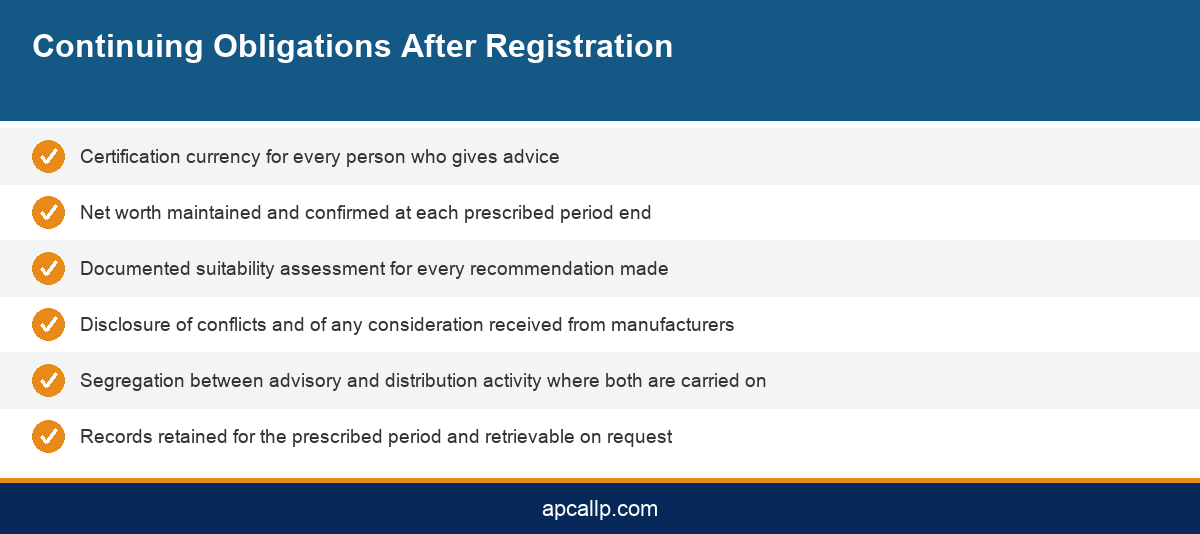
Registration as an investment adviser brings qualification and certification requirements, net worth conditions, and an obligation to maintain both continuously rather than only at the point of application. Falling below a condition is not a filing error. It is a breach of the registration itself, with consequences that scale accordingly.
The SEBI regulations library holds the current framework together with the amendments that change it from time to time. Reading it once at registration is not sufficient, because conditions are revised more often than most practices review them.
The practical implication is monitoring rather than paperwork. Certification expiry dates, net worth as at each period end, and the qualifications of every individual giving advice all need a defined review cycle with a named owner. Firms that treat these as annual events routinely discover lapses only when a regulator asks a question they cannot answer immediately.
Registration also fixes the scope of what you are permitted to do. Advising on categories outside that scope, or advising clients the registration does not contemplate, is a breach even where the advice itself is sound. Practices that expand organically into adjacent services rarely stop to check whether the registration followed them, and that gap is usually discovered by somebody other than the firm.
Client Facing Obligations: Suitability and Disclosure
Advice must be suitable for the client, and suitability must be documented rather than merely intended. That means a recorded risk profile, a written rationale linking the specific advice to that profile, and evidence that the client actually received it. Verbal suitability is not demonstrable, and an undocumented recommendation is indistinguishable from an unsuitable one after the fact.
Conflicts of interest must be disclosed clearly, and any consideration received from a product manufacturer has to be transparent to the client. Disclosure buried in a lengthy standard document rarely satisfies the intent of the requirement.
Where a firm carries out both advisory and distribution activity, segregation rules apply and the boundary has to be visible to the client. This is the single most examined area in practice. Firms keeping advisory and distribution under one undocumented roof carry the largest exposure by a wide margin, and it is the issue our compliance advisory work most frequently has to unwind after the fact.
Fee transparency sits alongside this. Clients should be able to see what they pay, on what basis it is calculated, and whether any part of the firm's income depends on the product recommended rather than on the advice given. Firms that present this clearly at onboarding face far fewer complaints later, because the expectation was set correctly at the start rather than being reconstructed during a dispute.
Records, Retention and the Compliance Audit
Advisers must maintain records of client agreements, risk profiles, advice given, the rationale behind it, consideration received and client communications, and retain all of it for the prescribed period. Records must be retrievable on request, not merely stored somewhere.
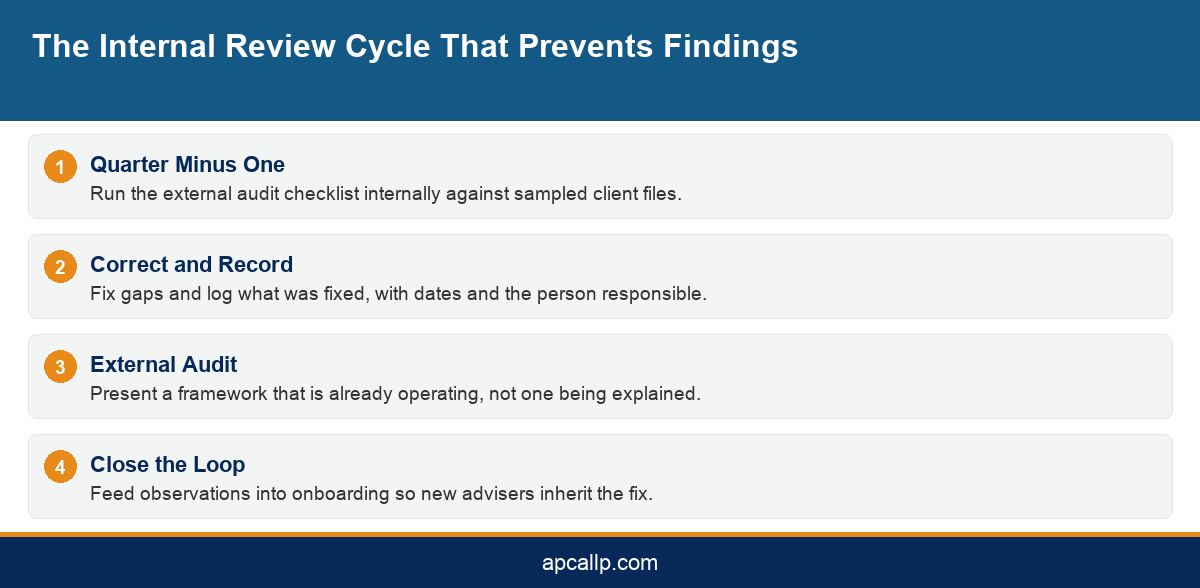
A periodic compliance audit tests whether the framework is actually operating rather than whether it exists on paper. Auditors sample client files and follow individual recommendations back to the risk profile that supposedly supported them.
The efficient approach is to run an internal review one quarter before the external audit, using the same checklist the auditor will use. Findings raised internally are simply corrected. The identical findings raised externally become observations on record that follow the firm forward. Advisory firms that adopt this rhythm rarely receive the same adverse observation twice, which is the practical measure of a working framework.
Storage arrangements need thought as well as intent. Client records held only in personal email accounts or on individual laptops are neither retrievable nor secure, and both failings are findings in their own right. A single system that every adviser uses, with access controls and a retention rule applied automatically, removes an entire category of risk for a modest cost.
Building a Routine That Scales With the Firm
A single adviser can hold the entire framework personally and usually does. A firm with several advisers cannot, because consistency between advisers becomes the risk rather than the competence of any individual.
At that point you need a named compliance officer, a documented onboarding process for every new adviser, and a calendar covering certifications, net worth confirmation, audit and reporting with owners against each item.
Growth also changes the risk profile in ways that are easy to miss. New product categories, new client segments and any move into portfolio activity each bring conditions the existing registration may not cover. Review registration scope whenever the business model changes, not annually. Our secretarial compliance services cover the entity level filings that sit alongside these adviser obligations, so both calendars live in one place with one owner rather than being tracked separately and inconsistently.
Finally, build the framework so that it survives the departure of the person who wrote it. Templates, a written onboarding checklist and a documented review calendar mean a successor can run the same process from day one. Practices that depend on one person's memory face a compliance gap the moment that person leaves, and regulators do not adjust their expectations for staff turnover.
What Examiners Look at First
Examiners start with the client file, not the policy document. They select a small number of clients, read the risk profile, then read the advice that followed it and test whether the two connect. A firm with excellent written procedures and disconnected client files will be marked down, because procedures that are not visible in the files are treated as aspirational rather than operational.
The second area is disclosure. Examiners look for what the client was told about conflicts, about fees, and about any relationship between the firm and the products recommended. They are less interested in whether a disclosure document exists than in whether the client could reasonably have understood it.
The third area is currency. Certifications, net worth confirmations and registration scope are checked against dates rather than intentions. A lapse of a few weeks is treated as a lapse, and explanations about renewal being in progress carry limited weight.
The fourth is consistency between advisers. Where two advisers in the same firm give materially different advice to clients with similar profiles, examiners ask why. The answer is usually that supervision exists on paper but not in practice, which is exactly the gap a named compliance officer and a sampling routine are meant to close.
Conclusion
Financial advisor compliance is a continuing condition of doing business, not a licence obtained once and filed away. Monitor certification and net worth on a defined cycle. Document suitability and disclose conflicts in writing. Keep records retrievable for the full retention period. Run an internal review before every external audit. Advisory firms that build this routine early scale without having to re engineer it under pressure later. If your practice has grown past what one person can hold in their head, Talk To Us.