Financial Due Diligence Report: What It Contains and How to Read It
 Due Diligence
A financial due diligence report is often the most influential document in a deal, yet many founders see one for the first time when a buyer's adviser sends it across with a list of price adjustments. Buyers use it to decide what to pay and which protections to demand. Sellers who understand its structure can anticipate its findings. This guide walks through what the report contains, section by section, and explains how to read it critically, whichever side of the table you sit on.
Key Takeaways
- A financial due diligence report normally covers quality of earnings, net debt, working capital, cash conversion and a review of the forecast.
- The adjusted EBITDA bridge, the list of debt like items and the working capital analysis usually drive the price discussion.
- Read the scope and limitations first; a finding is only as strong as the information the reviewers were given.
What a Financial Due Diligence Report Is For
This kind of report tells a buyer or investor whether the numbers they are being asked to pay for are real, repeatable and complete. It sits alongside tax, legal and commercial reviews, and the general concept is summarised in the Wikipedia overview of due diligence.
Unlike an audit, it gives no opinion on whether the accounts comply with accounting standards. Instead it analyses earnings, cash, debt and working capital for the purpose of a transaction. It focuses on the past two or three years and the current trading period, and it often tests the forecast as well.
Buyers commission most reports, but sellers increasingly commission their own before going to market. Either way, the report is written for decision makers who need to understand value quickly, so its structure is fairly standard across advisers.
In Bengaluru transactions the report is often read by several audiences at once: the buyer's investment committee, its lenders, its lawyers drafting the share purchase agreement and, increasingly, warranty insurers. Each reads it for a different purpose, which is why the findings are presented both as numbers and as recommended deal protections.
The Main Sections, One by One
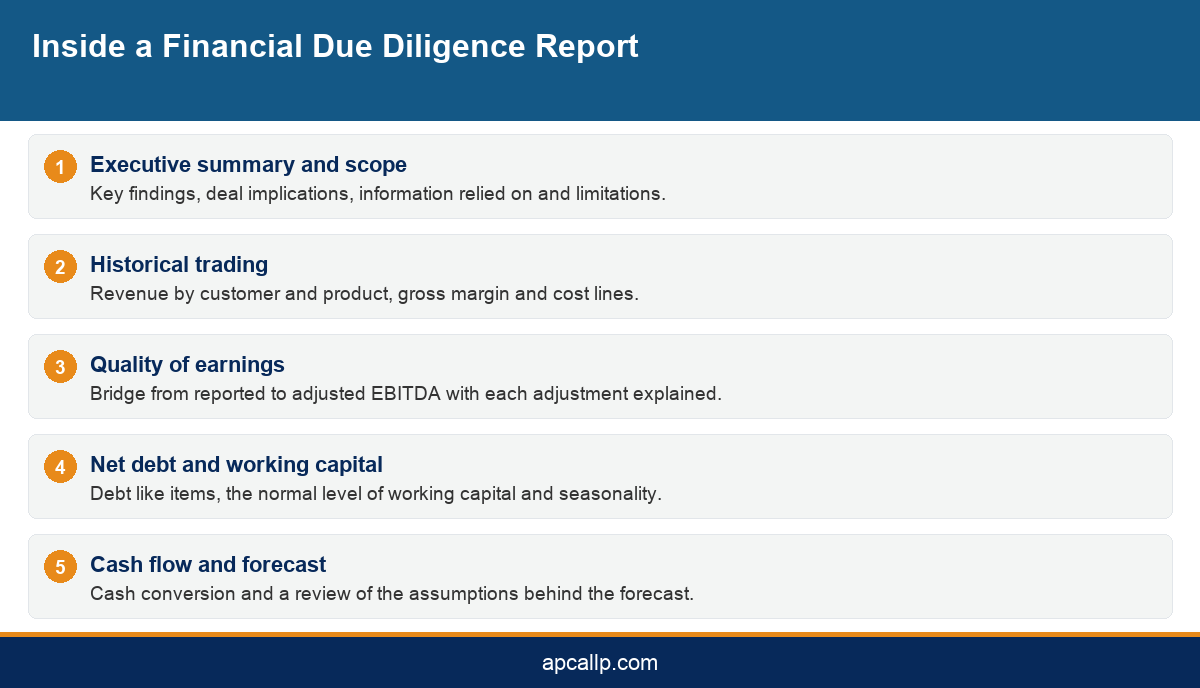
Most reports open with an executive summary of key findings and their deal implications, followed by the scope, the information relied on and the limitations. Read these first, because they tell you how far the findings can be trusted.
The business overview and historical trading section explains revenue by customer, product and channel, gross margin and the main cost lines. The quality of earnings section then builds from reported EBITDA to adjusted EBITDA, removing one off items and normalising owner costs and related party arrangements.
The balance sheet sections cover net debt and debt like items, net working capital and its seasonality, and other assets and liabilities that matter to the price. Further sections cover cash flow and cash conversion, the forecast and, where in scope, a tax summary.
Many reports end with an appendix of detailed schedules and a list of open information requests. That list is worth reading closely, because questions the reviewers could not close often become warranties or conditions in the final agreement.
Treat the open requests as a to do list for the next stage of the deal.
How to Read the Adjusted EBITDA Bridge
The adjusted EBITDA bridge is the heart of most reports. It starts from reported EBITDA and lists each adjustment with an amount and a reason. Because buyers often apply a multiple to adjusted EBITDA, every adjustment moves the price by that multiple.
Typical adjustments include one off legal or restructuring costs, founder salaries below or above market, related party rent at non market rates, revenue that will not recur, capitalised costs that should be expensed and the full year effect of recent changes.
Read each adjustment and ask whether it is supported by evidence and whether it truly will not recur. Sellers should prepare their own version of this bridge before the buyer's team arrives. The list of common financial red flags in deals is a good starting point for that self review.
Pay attention to the direction of the adjustments, not only their size. A report in which every adjustment reduces earnings may reflect a cautious reviewer, or it may reveal accounting choices that flattered past results. Understanding which is true is the first step in responding to it.
Finally, check the arithmetic and the periods. Adjustments are sometimes applied to one year but not another, or annualised in ways that overstate their effect. A careful reader reconciles the bridge back to the audited accounts for every period shown.
Net Debt, Debt Like Items and Working Capital
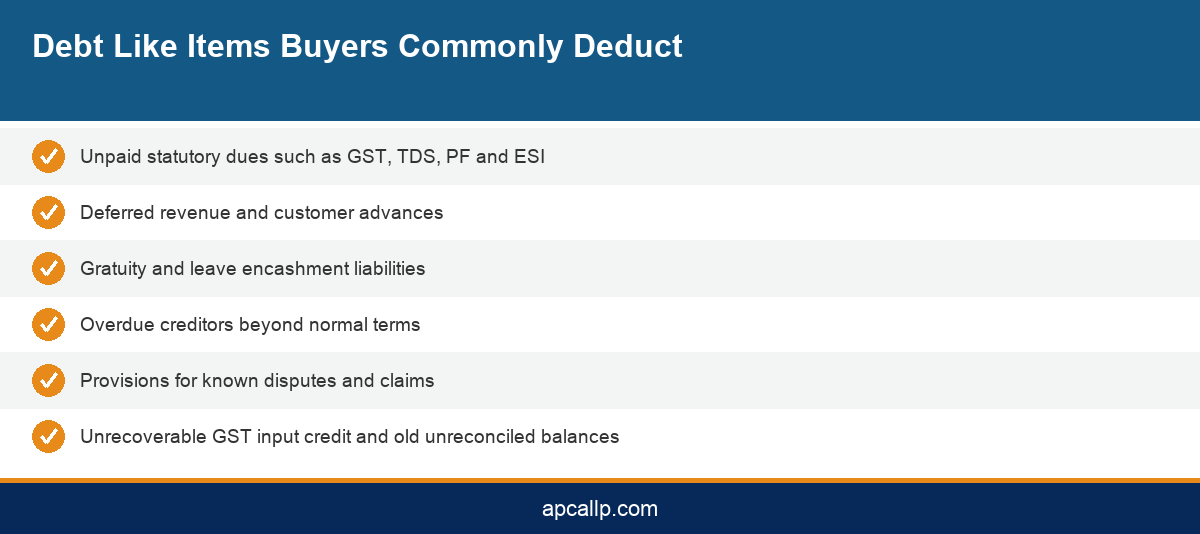
Buyers usually agree an enterprise value and then deduct net debt to reach the equity price. The report identifies borrowings and cash, and then the debt like items: unpaid statutory dues, deferred revenue, customer advances, gratuity and leave liabilities, overdue creditors and provisions for known disputes. Each one reduces the amount the seller receives.
The working capital analysis shows the normal level the business needs, adjusted for seasonality. The buyer will expect that level at completion, and the price moves if the actual level differs. The basic concept of working capital is simple, but the agreed target is one of the most negotiated numbers in a deal.
Indian businesses often carry specific items here: GST input credit that may not be recoverable, TDS receivables, advances to related parties and old balances that have never been reconciled. Expect the report to treat unsupported balances cautiously.
Red Flags and What to Do About Them
Certain findings recur. Revenue recognised before delivery, unreconciled receivables, heavy customer concentration, unexplained manual journals, related party transactions without agreements and cash conversion that lags reported profit all raise concern.
Each finding becomes a negotiation point: a lower price, a specific indemnity, an escrow, a condition before completion or a warranty. Sellers who understand the report can respond with evidence, propose proportionate protections and stop small issues growing into large price cuts.
The best defence is preparation. Our due diligence practice helps companies build the records buyers expect, and our list of documents investors expect to see shows what to assemble before the first request arrives. When the report lands, read it with your adviser, line by line, before any price discussion.
Finally, keep the report. A financial due diligence report prepared for one transaction is a useful baseline for the next, whether that is a later funding round, a refinancing or an eventual sale. Many of the issues it raised can be fixed permanently in the meantime.
Questions to Ask When the Report Arrives
The first question is about scope. Which periods, entities and topics were covered, and which were excluded? A report that covered only the operating company, for example, says nothing about liabilities in a sister entity that shares customers or staff.
The second is about evidence. For each adjustment and each debt like item, what was the source, and was it verified or taken from management's representation? Findings based on representations deserve a different weight from findings based on bank statements and contracts.
The third is about consequences. Which findings does the buyer intend to reflect in price, which in specific indemnities and which in warranties? Asking early turns the report into a negotiation agenda rather than a list of surprises, and it helps both sides focus on the few items that genuinely matter. Our note on why investor confidence drops during diligence explains how sellers lose ground when these conversations are left too late.
Conclusion
A financial due diligence report shapes price and protections more than almost any other deal document. Read the scope first, test the adjusted EBITDA bridge, examine every debt like item and understand the working capital target. Sellers should prepare their own analysis before buyers do, and buyers should treat the report as a basis for negotiation rather than a verdict. If a transaction is coming up, talk to APCALLP about diligence readiness.
Frequently Asked Questions
What is a financial due diligence report?

How is a financial due diligence report different from an audit?
What is quality of earnings?
What are debt like items?
How long does it take to prepare the report?
Should a seller commission its own report?
Who reads the financial due diligence report?
Can APCALLP prepare a report for a Bengaluru transaction?