How to Find the Right Tax Accountant Near You: A Practical Checklist
 Accounting Services
Searching for a tax accountant near me returns a long list of firms describing themselves in almost identical language. Proximity is genuinely useful in India because assessments and hearings benefit from someone attending in person, but it is a poor way to choose on its own. This checklist sets out what to verify, what to ask, how to test a firm before you commit, and the small number of signals that reliably separate a capable accountant from a well marketed one.
Key Takeaways
- Proximity matters for hearings and correspondence but is a weak selection criterion on its own, so verify credentials and capability first.
- Most disputes between clients and accountants are scope disputes, which makes a written engagement letter the single most valuable thing you can insist on.
- Test responsiveness with a real question before you appoint, because firms that are slow while selling almost never get faster afterwards.
Decide What You Actually Need First
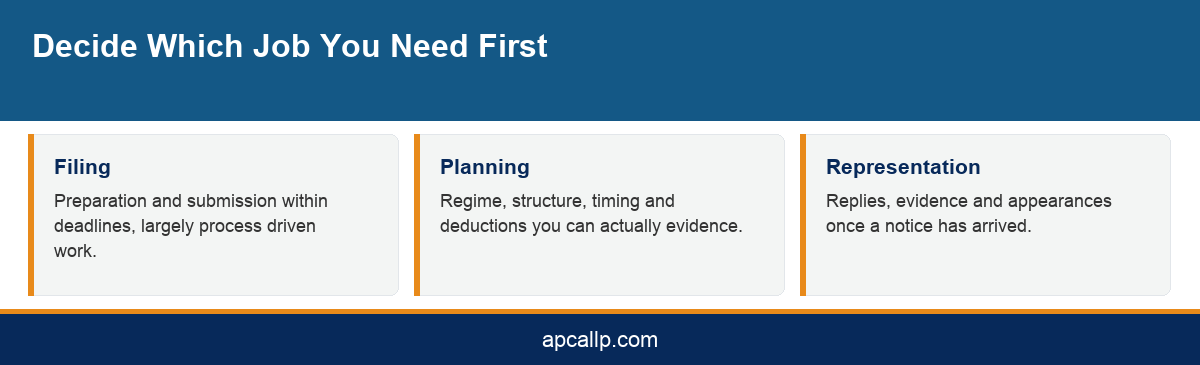
Tax work splits into three quite different jobs, and most people shop for one while needing another. Filing covers preparation and submission within deadlines and is largely process driven. Planning covers regime choice, structure, timing and the deductions you can actually evidence.
Representation covers what happens when a notice arrives, including drafting replies, assembling evidence and appearing before authorities. It is a genuinely specialised skill and many otherwise competent accountants have very little experience of it. It is also the job you cannot postpone once it becomes necessary.
Write down which of these you are likely to need over the next two years before you start looking. A salaried individual with a simple return needs reliable filing and nothing more. A business owner with multiple registrations and a growing payroll will need all three in sequence.
This single step changes the shortlist more than any other. Firms optimise for different jobs, and a practice built around high volume filing is not the practice you want defending a position under assessment. Asking for both from the same firm is reasonable, but you should confirm they genuinely do both.
The same logic applies to businesses choosing between a bookkeeper, an accountant and a full chartered accountancy firm. Each occupies a different point on the same scale, and paying for the wrong one is a common and avoidable error. Our guide to choosing a chartered accountant firm sets out where each option starts.
Verify the Basics Before Anything Else
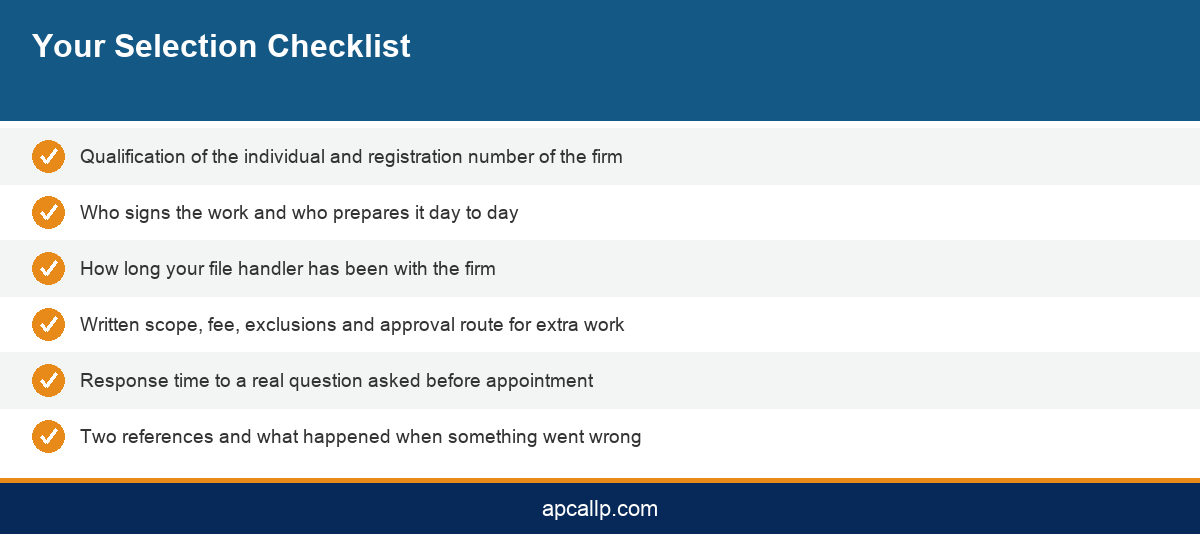
Confirm that the person or firm is qualified to do the work you need. Practising chartered accountants are members of the Institute of Chartered Accountants of India and firms carry a registration number. Certain certifications and audit reports can only be signed by a chartered accountant, so this matters for more than reassurance.
Ask who will sign your work and who will do it day to day, because these are frequently different people. A firm where the signing partner never sees the file until the final review is common and worth knowing about. There is nothing wrong with delegation provided somebody experienced reviews the output.
Ask how long the person handling your file has been with the firm. Tax work depends heavily on knowing the history of positions taken in earlier years, and every handover loses context that was never written down. Continuity is worth more here than in most professional services.
Finally, ask what happens if that person leaves. A written position file means a successor can pick up your matter in days rather than weeks. Where the knowledge sits only in one person's memory, every departure costs you real time and money.
Ask also whether the firm carries professional indemnity cover and at what level. It is a routine question that very few clients ask, and the answer tells you something about how seriously the practice is run. Established firms answer it immediately and without any defensiveness.
Get the Scope and the Fee in Writing
Almost every dispute between a client and an accountant is a scope dispute rather than a quality dispute. The client believed a question was covered and the firm believed a three week assignment was not. Both positions are reasonable, which is exactly why the boundary has to be written down.
Ask for an engagement letter that states what is inside the fee, what sits outside it, and how out of scope work gets approved. For businesses, confirm specifically whether bookkeeping is included, because it is the item most likely to make a quoted fee uneconomic and therefore renegotiated. For individuals, confirm whether capital gains, equity income and foreign asset reporting are included or extra.
Ask how much adviser time the fee includes each month or year. A defined allowance is far more useful than a vague promise of availability, and it prevents the awkward situation where you stop asking questions to avoid a bill.
Be cautious about quotes materially below the local range. The work has a genuine time cost, and a fee well under it usually means preparation by somebody junior with no review. The saving is small and the exposure from an unreviewed position is not.
Agree how the fee will be reviewed as your situation changes, because it will. A new registration, a second property or a change in employment status all add work, and settling the mechanism at appointment turns an awkward conversation into a routine adjustment.
Test the Firm Before You Commit
Send a genuine question from your own situation and time how long a considered answer takes to arrive. Two working days for something substantive is a reasonable benchmark. Firms that are slow during the sales process are almost never faster once the engagement letter is signed.
Listen to whether the answer is specific or generic. Specific answers come from people who have handled the situation before, and generic answers come from people who have not. This is a more reliable test than any credential list.
Ask for two references from clients of similar size and situation, and ask each of them one question. What happened the last time something went wrong. The answer tells you far more about the relationship than a proposal document ever will.
Finally, ask what the firm would refuse to do and who they would refer it to. A firm willing to name the limits of its own competence is unusual and worth taking seriously. Very few volunteer this without being asked.
How Much Proximity Actually Matters
For routine work, very little. Documents move electronically, meetings happen remotely, and the quality of the advice does not depend on the distance. Many businesses work successfully with firms in another city for years without difficulty.
For assessments and hearings, proximity matters a great deal. Attendance is often required, travel time becomes a real cost, and familiarity with the jurisdictional office genuinely helps. Ask which office your entity reports to and whether the firm appears there regularly.
Proximity also helps at the start of a relationship, when face to face time speeds up onboarding considerably. After the first few months this advantage largely disappears. Weight it accordingly rather than treating it as the primary criterion.
The practical answer for most businesses is a firm with a genuine office in your city inside a wider practice. That gives you local attendance when it matters and coverage when you expand. Our contact page lists our Kochi, Kozhikode and Bengaluru offices on that basis.
Conclusion
Finding the right tax accountant near you starts with deciding which of the three jobs you actually need. Verify the credential and the continuity of the person handling your file, then get the scope and the fee in writing before anything else. Test responsiveness with a real question, and weight proximity for hearings rather than for routine work. If you want a straight view of what your situation requires and what it should cost, Talk To Us.
Frequently Asked Questions
How do I choose a tax accountant near me?

Does my accountant need to be local?
What credentials should I check?
What should an engagement letter include?
How can I test a firm before appointing?
Why does continuity matter so much?
Are cheap quotes a problem?
What is representation and why does it matter?
Should individuals and businesses use the same accountant?
What should I ask a reference?