Transaction Advisory Services in Bangalore: A Complete Deal Guide
 Due Diligence
Transaction advisory services in Bangalore have moved from a big city luxury to a practical necessity. Founders sell to strategic buyers, family companies bring in private equity, and foreign groups buy Indian teams. Each deal turns on a few numbers that somebody has to prepare, test and defend. This guide explains what transaction advisory covers, how diligence and valuation shape the price, what a mid market engagement looks like week by week, and how to choose an adviser for a deal run from Bengaluru.
Key Takeaways
- Transaction advisory services in Bangalore cover preparation, due diligence, valuation, structuring and completion support, and the price is decided in all five.
- Buyers rarely walk away over diligence findings; they move value through price adjustments, indemnities and escrow, so preparation pays directly.
- Choose an adviser for the deal you are doing: sector depth, the team that will actually work on it, and experience on your side of the table.
What Transaction Advisory Covers in a Bengaluru Deal
Transaction advisory is the professional support around buying, selling, merging with or investing in a business. In Bengaluru the counterparties are often venture funds, global technology groups and listed Indian acquirers, and all of them arrive with experienced teams. The side with weaker preparation usually concedes value.
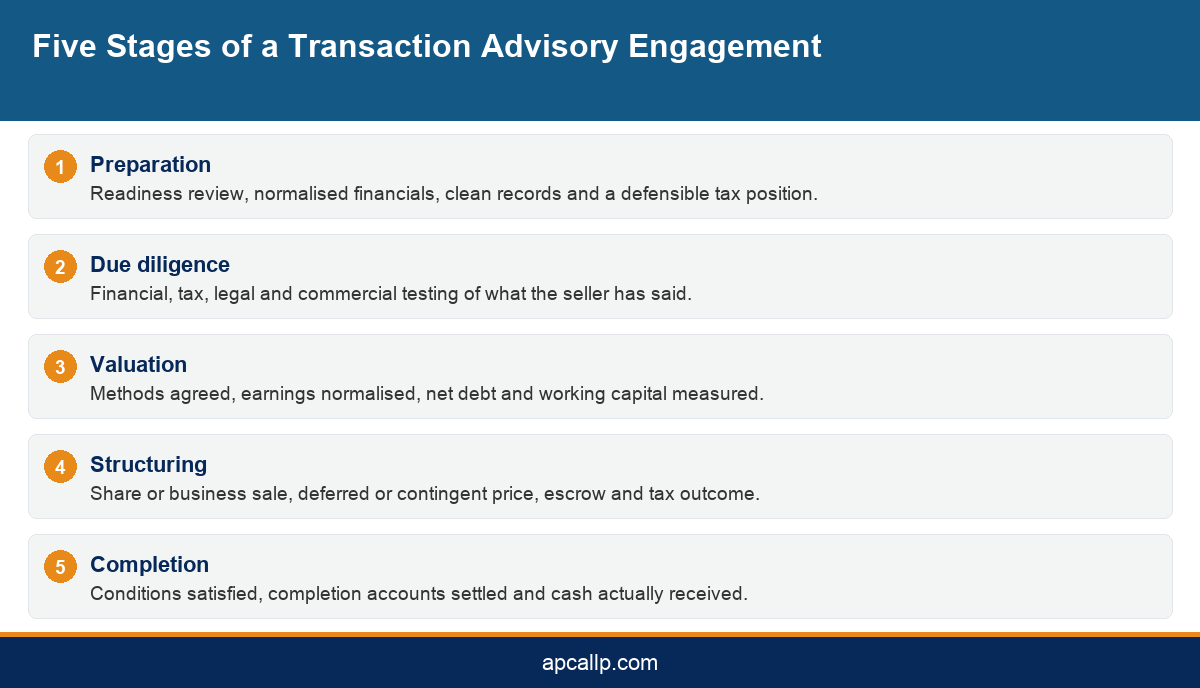
The work falls into five stages. Preparation gets the business ready to be examined. Diligence tests what the seller has said. Valuation sets the range. Structuring decides how the price is paid and taxed. Completion support turns a signed agreement into money received. Weakness in any stage shows up in the final number.
Our transaction advisory practice works across all five stages, but most clients first call when a term sheet is already on the table. By then the timetable belongs to the buyer. Starting six to twelve months earlier changes the outcome more than any negotiating tactic.
Why Bengaluru Deals Have Their Own Shape
Bengaluru deals are often technology businesses with recurring revenue, employee stock options and foreign investors already on the cap table. That combination brings revenue recognition questions, ESOP clean ups and exchange control reporting into almost every transaction. A generalist checklist misses these issues, and they surface late, when they are most expensive to fix.
Who Uses Transaction Advisory
Sellers use it to prepare and defend value. Buyers use it to test assumptions and price risk. Investors use it before committing a round. Boards use it when a related party deal needs independent support. Each role needs a different mindset, so ask which side a prospective adviser works on most often.
When Transaction Advisory Services in Bangalore Pay for Themselves
Not every deal needs a full advisory team, but some situations almost always justify one. The common thread is an experienced counterparty, a meaningful amount of value at stake and a timetable the business does not control.
The first is a founder sale to a strategic buyer, where the buyer has acquired many companies and the founder has sold none. The second is a private equity investment in a family business, where governance, reporting and exit rights change permanently. The third is an acquisition by a Bengaluru company of a smaller target, where the buyer needs diligence it can rely on. The fourth is a growth round led by a new institutional investor, which often comes with deal level diligence.
In each case transaction advisory services in Bangalore do three things: they reduce the number of surprises, they convert unavoidable issues into negotiated terms rather than price cuts, and they keep the deal moving while management runs the business. The fee is usually small next to the value protected.
Smaller transactions can use a lighter version. A focused readiness review, a vendor side financial pack and support on the price mechanism often deliver most of the benefit for a fraction of a full mandate. The key is to decide the scope deliberately rather than default to doing nothing until the buyer's diligence list arrives.
Matching the Scope to the Deal
A useful rule is to scale the engagement to the value at risk and the experience gap between the parties. A first time seller facing a serial acquirer needs full sell side support. A minority growth round with an existing investor may need only a readiness review and help with the investment agreement. When choosing transaction advisory services in Bangalore, ask the adviser to propose two or three scope options with clear deliverables, so the decision is made on value rather than habit.
Buy Side and Sell Side Advisory Are Different Jobs
A sell side adviser prepares the business, builds the information pack, runs the process and protects value when the buyer challenges it. A buy side adviser does the opposite job. It tests the story, quantifies the risks and finds reasons to adjust the price or the terms.
The skills overlap but the instincts do not. A good sell side team anticipates the buyer's questions and answers them before they are asked. A good buy side team assumes nothing it cannot trace to a source document. Firms that claim to do both equally well usually lean towards one.
For founders in the startup belt around HSR Layout and Koramangala, the first transaction is often a sale to a larger strategic buyer. The buyer has done dozens of deals and the founder has done none. Independent sell side support narrows that gap. Our note on why acquirers walk away from attractive businesses shows where unprepared sellers lose leverage.
What a Sell Side Mandate Includes
A typical sell side mandate covers a readiness review, normalised financials, an information memorandum, a data room, buyer outreach where needed, management of diligence questions, and support on the price mechanism and disclosure letter. The readiness review is the most valuable part, because it finds problems while there is still time to solve them.
What a Buy Side Mandate Includes
A buy side mandate covers target screening, financial and tax diligence, a view on quality of earnings, net debt and working capital, valuation support and input on the share purchase agreement. The output is not only a report. It is a list of price adjustments, protections and conditions the buyer should negotiate.
Due Diligence: Where Value Is Tested
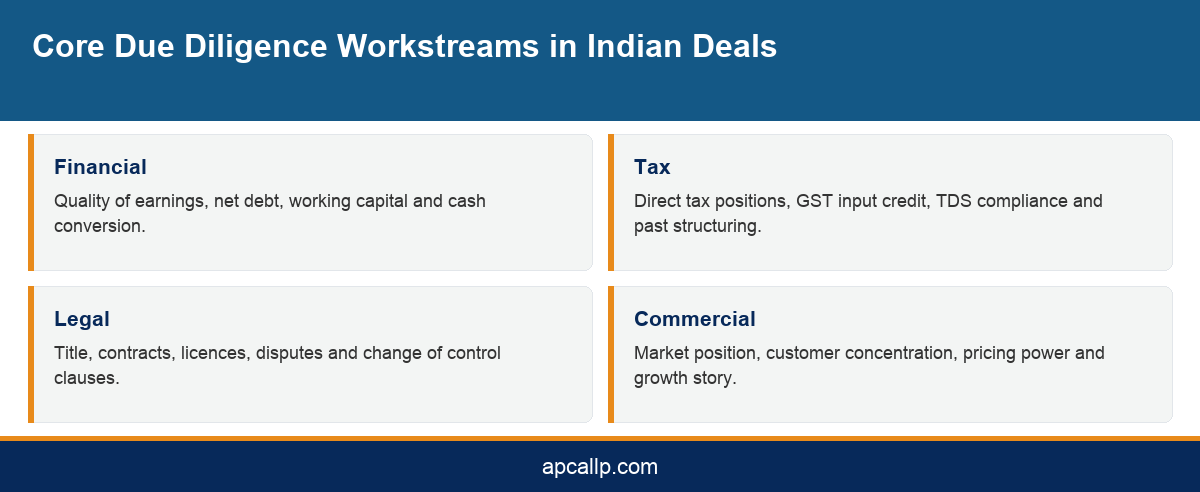
Due diligence is the buyer's structured examination of the business before it commits. For most mid market deals the core workstreams are financial, tax, legal and commercial, with technology and HR added for software companies. The general concept is well described in the Wikipedia overview of due diligence, but Indian deals add specific exposures.
Financial diligence tests the quality of earnings, the true level of debt and the normal level of working capital. Tax diligence tests direct tax positions, GST input credits, TDS compliance and exposure from past structuring. Legal diligence tests title, contracts, licences and disputes. Commercial diligence tests whether the market story holds.
Findings rarely end a deal. They move value. A tax exposure becomes an indemnity, an unclear receivable becomes a price reduction, and a pending licence becomes a condition before completion. The list of financial red flags buyers look for is a useful self test before a buyer runs it on you.
Sellers can also commission their own vendor diligence before going to market, which gives every bidder the same reliable starting point and usually shortens the buyer's own review.
The Documents Buyers Ask For First
Expect requests for three years of audited accounts, monthly management accounts, the tax and GST filings, customer and supplier contracts, the cap table, board minutes and employee agreements. Our list of documents investors expect to see is a practical starting point for building the data room before anyone asks.
How Long Diligence Takes
For a prepared mid market company, financial and tax diligence typically runs four to eight weeks. Unprepared sellers take longer, and every extra week gives the buyer time to find another issue. A clean, indexed data room is the single biggest lever on that timeline.
Tax and Regulatory Issues That Surface in Indian Deals
Tax is the workstream most likely to turn into an indemnity. Buyers look at past income tax assessments, transfer pricing on group transactions, TDS defaults on payments to vendors and non residents, and GST input credits claimed without matching supplier filings. Each is fixable before a sale and expensive after one.
Exchange control is the second area. Many Bengaluru companies have raised money from foreign investors. If past allotments were reported late or priced without a proper certificate, the buyer will want the position regularised before completion. Our guide to RBI and FEMA compliance for startups lists the filings that are checked most often.
Tax Positions That Become Indemnities
Open assessments, aggressive deductions and unpaid statutory dues are the usual candidates. A buyer that cannot measure an exposure will ask for a specific indemnity or an escrow sized to the worst case. Measuring and, where possible, settling exposures before a sale keeps more of the price in the seller's hands.
Founder and ESOP Matters
Founders often hold shares through personal names, family members or holding companies, and ESOP pools are frequently documented informally. Buyers need a clean cap table, valid grants and a clear view of how options are treated on a sale. These items take weeks to fix and should be on the readiness list from the start.
Valuation and the Price You Actually Receive
Valuation sets the range, but the headline number is not what the seller banks. Buyers usually price on an enterprise value basis and then adjust for cash, debt, debt like items and working capital. The gap between the headline and the cash received can be large.
Common methods include discounted cash flow, comparable company multiples and precedent transactions. The discounted cash flow method dominates for businesses with predictable cash generation, while early stage technology companies are often priced on revenue multiples supported by growth and retention data.
In Indian deals valuation is also a regulatory matter. Issues and transfers involving non residents follow pricing rules under exchange control law, and some transactions need a registered valuer's report under company law. The method has to satisfy the regulator as well as the buyer.
Sellers should also expect the buyer to test the forecast behind the valuation. A forecast that assumes a sharp jump in growth just after completion invites scepticism. A forecast built from the current pipeline, retention data and realistic hiring plans is far easier to defend, and it keeps the conversation on multiples rather than on credibility.
Quality of Earnings Comes First
Before anyone applies a multiple, the earnings have to be normalised. One off income, founder salaries below market, related party rent and capitalised costs are all adjusted. A small change to normalised EBITDA moves the price by the full multiple, which is why this analysis attracts so much negotiation.
Net Debt and Working Capital
Debt like items such as unpaid statutory dues, deferred revenue and customer advances are deducted from the price. A working capital target is agreed, and the price moves if the actual level at completion is above or below it. Both mechanisms are technical, and both are routinely underestimated by first time sellers.
Deal Structure Often Matters More Than Headline Price
Two offers with the same headline can be worth very different amounts. Structure decides how much is paid at completion, how much is deferred or contingent, how the seller is taxed and what protections the buyer keeps.
Share sales and business transfers have different tax and stamp duty consequences. Earn outs tie part of the price to future performance, and the general earn out mechanism works only when the measurement rules are written precisely. Escrows and holdbacks secure warranty claims.
Where a non resident buys from a resident, exchange control rules limit how much of the price can be deferred and for how long. Where the deal crosses the merger control thresholds, approval from the Competition Commission of India may be required before completion. Both need planning early.
Our note on preparing a business before a merger or acquisition covers the structural clean up that makes these choices easier, including related party arrangements and group simplification.
Share Sale or Business Transfer
In a share sale the buyer acquires the company with its history, so diligence and warranties carry more weight. In a business transfer the buyer picks the assets and liabilities it wants, which can be cleaner but brings transfer taxes, contract novations and employee transfers. The tax result for the seller often decides the choice, so model both early.
Escrows, Holdbacks and Warranty Protection
Buyers protect themselves by holding back part of the price in escrow for a fixed period, or by agreeing specific indemnities for known issues. Sellers should cap their liability, set time limits for claims and make full disclosure against the warranties. A well drafted disclosure letter is one of the cheapest forms of protection a seller has.
A Typical Mid Market Engagement, Week by Week
Every deal differs, but a prepared mid market transaction supported by transaction advisory services in Bangalore tends to follow a recognisable rhythm. Knowing it helps founders plan their own time, which is always the scarcest resource during a deal.
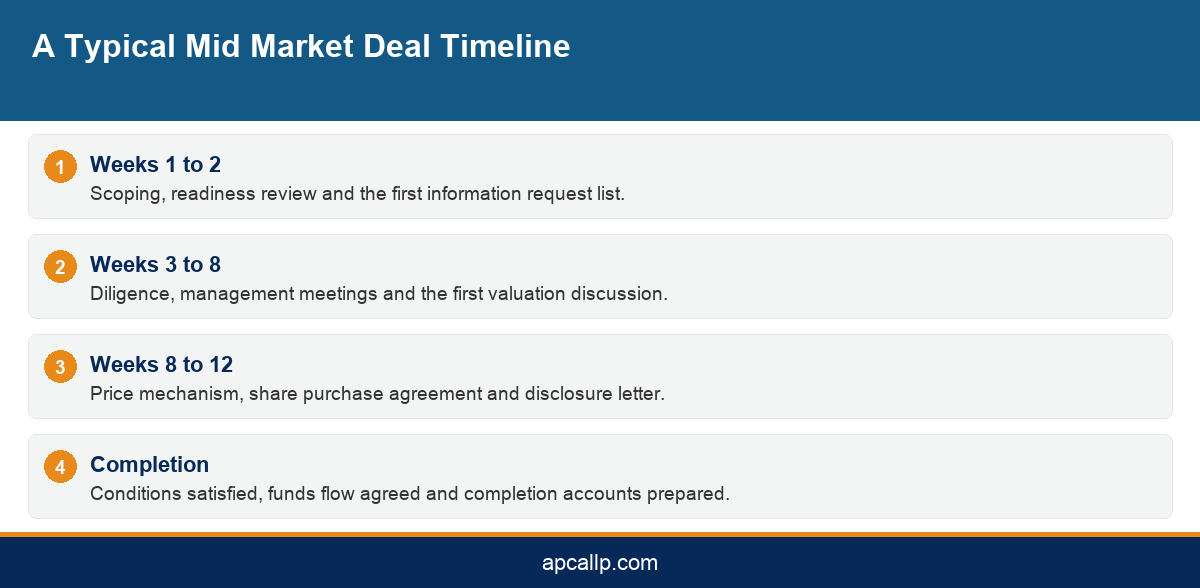
The first two weeks cover scoping, the readiness review and the request list. Weeks three to eight cover diligence, management meetings and the first valuation discussion. Weeks eight to twelve cover the price mechanism, the share purchase agreement and the disclosure letter. Completion follows once conditions are satisfied.
Founders should expect to spend a significant share of their week on the deal at its peak. Delegating the information work to a finance lead or an adviser protects the business, because buyers watch trading performance closely while the deal is live. A dip in monthly numbers during diligence is one of the commonest causes of a late price cut.
Secondary markets matter too. Many Bengaluru targets have buyers or investors in Mumbai, and the same discipline applies whichever city the counterparty sits in. The process, the documents and the risks are the same.
After completion, the work continues. Completion accounts are prepared and agreed, working capital adjustments are settled, and any escrow release dates are tracked. Sellers who keep their advisers involved through this stage recover more of the amounts that are held back.
Preparing Your Company Before You Approach Buyers
Preparation is where an adviser earns most of its fee. The aim is simple: a buyer should be able to understand the business quickly, verify what it is told, and find no surprises. Every surprise becomes a negotiation, and negotiations late in a deal usually favour the buyer.
Start with the numbers. Close the books monthly, reconcile bank accounts, receivables and payables, and make sure management accounts agree with the audited figures. Then move to contracts, statutory registers and the cap table. Our list of balance sheet improvements before a deal is a useful companion to this stage.
A Practical Readiness Checklist
Audited accounts for three years, monthly management accounts, reconciled GST and TDS filings, signed customer and supplier contracts, a current cap table with all allotment filings, documented ESOP grants, board and shareholder minutes, and a list of known disputes. If any item is missing, fix it before the information memorandum goes out.
Normalising the Numbers in Advance
Prepare your own quality of earnings view before the buyer does. Identify one off items, related party transactions and owner costs, and explain each with evidence. When the buyer's adjustments match yours, there is little left to argue about.
How to Choose a Transaction Adviser in Bengaluru
When comparing transaction advisory services in Bangalore, start with fit. Ask how many deals of your size and sector the team has worked on in the last three years, and on which side. Ask who will actually do the work, because the partner who pitches is not always the person in the data room at midnight.
Then test independence and scope. An adviser who also wants to sell you another product may not give a clean view on the deal. A clear engagement letter should list the deliverables, the team, the timetable and how fees are charged.
Finally, look for continuity. The best outcomes come from advisers who understand the finance function behind the numbers. Our due diligence practice and deal case studies show how that continuity works in Bengaluru transactions. Professional standards for chartered accountants are set by the ICAI, the profession's regulator, which is a useful reference when checking credentials.
Questions to Ask in the First Meeting
Which recent deals are most like ours, and what went wrong on them? Who will lead the work day to day? How will you run diligence, and what will you need from our team each week? How do you charge, and what is excluded? Clear, specific answers are a better guide than a polished proposal.
Warning Signs in an Adviser Proposal
Be cautious of guaranteed valuations, vague deliverables, fees tied only to headline value, and teams that change after the pitch. An adviser who will not discuss what could go wrong is unlikely to manage it well when it does.
Conclusion
Transaction advisory services in Bangalore are most valuable before the term sheet, not after it. Preparation, diligence, valuation and structure decide the cash you receive, and buyers in this market are well advised. Treat the deal as a project with its own timetable, put the information work in experienced hands, and keep the business trading well while the deal is live. If you are planning a sale, an acquisition or a strategic round in the next year, talk to the APCALLP team in HSR Layout about a readiness review.
Frequently Asked Questions
What do transaction advisory services in Bangalore include?

When should a business engage a transaction adviser?
How long does due diligence take for a mid market deal?
Why is the cash received lower than the headline price?
Do foreign buyers face extra rules when acquiring an Indian company?
What is the difference between buy side and sell side advice?
Can a small Bengaluru startup use transaction advisory?
What makes a data room ready for buyers?
Does APCALLP advise on deals outside Bengaluru?