Virtual CFO Services for Growing Businesses in India
 General
Growing businesses across Kochi, Kozhikode, and Bengaluru share a familiar problem. Revenue is rising, but financial visibility is not keeping pace with it. This is where virtual cfo services step in. A virtual CFO gives founders and business owners access to senior financial leadership without the cost of a full time hire. This guide explains what virtual CFO services actually include, why startups and SMEs across India are adopting this model, and how APCALLP structures its virtual CFO services for clients at different stages of growth.
Key Takeaways
Virtual CFO services give growing businesses senior financial leadership on a flexible, fractional basis, typically at a fraction of a full time CFO salary. The right virtual CFO model changes with stage: a pre revenue startup needs different support than an established SME preparing for a fundraise. APCALLP delivers virtual CFO services from offices in Kochi, Kozhikode, and Bengaluru, combining local compliance knowledge with financial strategy.
What Are Virtual CFO Services?
Virtual CFO services deliver the financial leadership of a Chief Financial Officer through a flexible, outsourced arrangement rather than a full time hire. Instead of recruiting a CFO onto payroll, a business engages an experienced financial professional or a firm like APCALLP on a retainer basis, for a set number of hours or a defined scope of work each month. The virtual CFO works directly with existing accountants and bookkeepers and reports to founders or the board on financial performance, risk, and strategy.
Core Responsibilities of a Virtual CFO
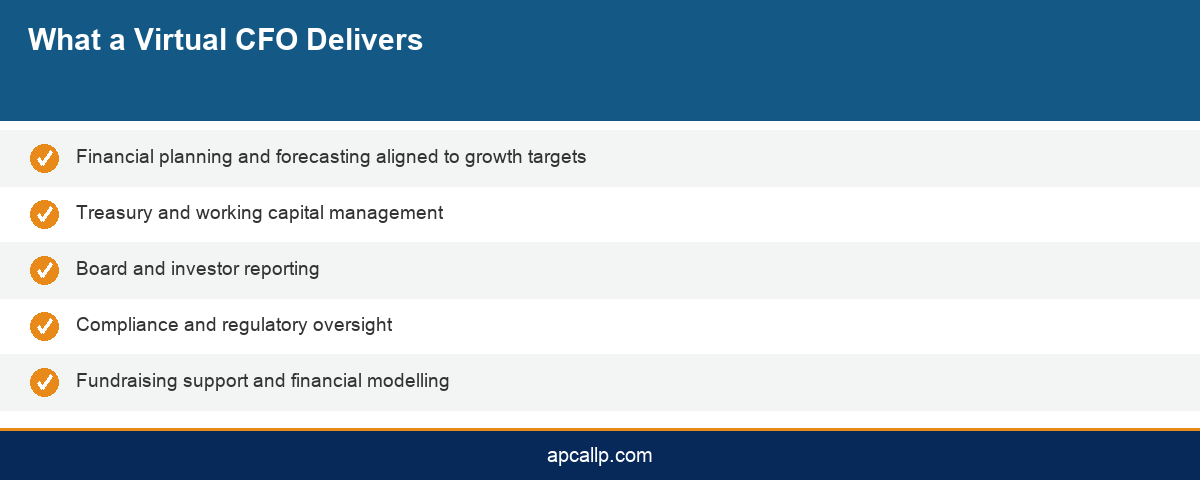
A virtual CFO typically owns financial planning and forecasting, cash flow and working capital management, budgeting, and board or investor reporting. Many engagements also include fundraising support, pricing and unit economics analysis, and process improvements across finance operations. The exact mix depends on the engagement, which is one advantage of the model. A pre revenue startup might lean heavily on fundraising and financial modelling, while an established SME might prioritise treasury management and statutory compliance instead.
A bookkeeper or accountant records transactions and prepares statutory filings accurately. A virtual CFO does that and more: they interpret the numbers, flag risk before it becomes a problem, and advise on decisions such as pricing, hiring, or raising capital. Chartered accountants registered with the Institute of Chartered Accountants of India bring the technical rigor behind the numbers; the virtual CFO layer adds forward looking strategy on top of that foundation, which is the real difference between the two functions.
How Virtual CFO Services Differ From Traditional Accounting
Traditional accounting is backward looking by design: it records what already happened and confirms it is correct. Virtual CFO services are forward looking by design: they use that same data to answer questions about what should happen next, whether that is a pricing change, a hiring decision, or the right time to raise a funding round.
Typical Engagement Models
Virtual CFO engagements are usually structured in one of three ways. An hours based retainer bills for a fixed number of hours each month and suits businesses with a clear, bounded set of tasks. A project based engagement covers a specific need, such as preparing a data room for a single fundraise, and ends once that project closes. A fractional CFO model sits closest to a part time senior hire, with a defined weekly or monthly commitment and ongoing involvement across the finance function. Most APCALLP clients start with an hours based retainer and move toward a fractional model as the relationship and the business both mature.
Why Growing Businesses in India Need Virtual CFO Services India's startup and SME ecosystem has grown quickly over the past decade, and financial complexity has grown with it. GST compliance, multiple funding rounds, cross border transactions, and investor due diligence all demand a level of financial sophistication that many growing companies have not yet built in house. The Startup India initiative has accelerated new company formation nationally, which means more founders are hitting this complexity earlier than founders did a decade ago. Virtual CFO services close that gap without the six or seven figure cost of a full time senior hire. For a full breakdown of how this plays out for Indian businesses specifically, read our guide to virtual cfo services in india.
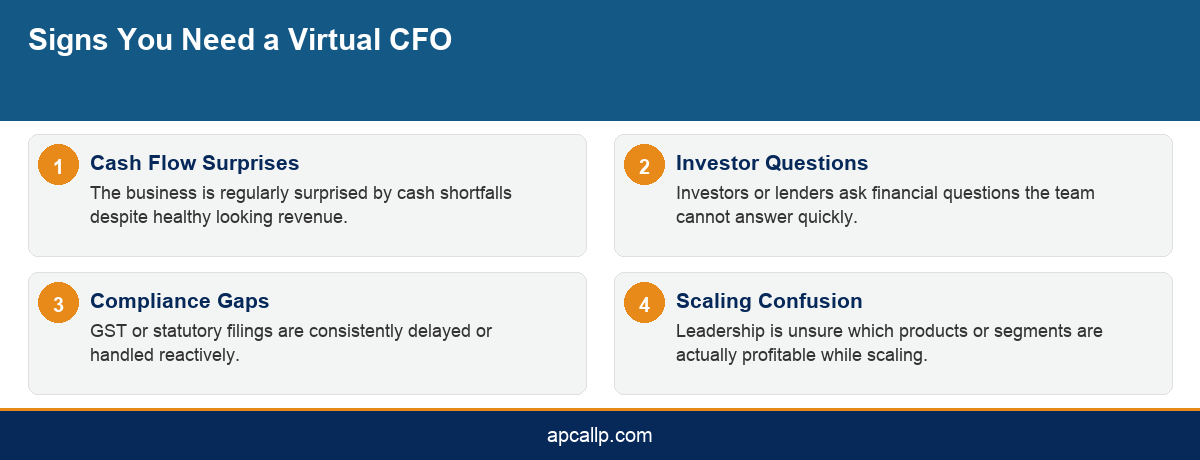
The GST regime alone illustrates the scale of the shift. Filing cadence, input credit reconciliation, and e-invoicing rules have all evolved since GST's rollout, and a business operating across more than one state now needs financial oversight that keeps pace with these changes in real time rather than catching up during an annual audit. Virtual CFO services absorb this monitoring so founders can stay focused on the business rather than the filing calendar.
Data tracked by IBEF shows India's SME and startup base continuing to expand across sectors well beyond the traditional metro hubs, which means demand for structured financial leadership is rising in tier two cities alongside Kochi, Kozhikode, and Bengaluru rather than staying concentrated in one or two markets. Businesses that build strong financial habits early tend to raise capital faster and on better terms than those that assemble this discipline only once an investor asks for it.
Startups and Early Stage Companies
Early stage founders are usually experts in their product or market, not necessarily in financial modelling or investor reporting. A virtual CFO service builds the financial infrastructure investors expect: clean books, a defensible model, and monthly reporting discipline. This matters directly at fundraising time, since due diligence moves faster when financials are already investor ready rather than assembled under deadline pressure. SMEs and Established Businesses
For SMEs with several years of revenue, the priority often shifts to margin discipline, working capital, and governance as the business scales past founder led decision making. A virtual CFO introduces the reporting cadence and controls that banks, larger customers, and eventually acquirers expect to see, without disrupting daily operations or forcing an abrupt change in team structure.
Virtual CFO Services in Kochi
APCALLP's Kochi office, based at JJ Square in Jawahar Nagar, Ernakulam, serves as the firm's home base for virtual CFO engagements across Kerala. Kochi has a dense cluster of IT, healthtech, and export oriented businesses, and each of these sectors carries its own compliance and reporting nuances. An IT services company managing SEZ benefits has different needs from an export business managing foreign exchange exposure, and a virtual CFO engagement should reflect that from the first month rather than applying a generic template.
Working with a virtual CFO based in Kochi means faster turnaround on local matters such as GST filings within the Kerala jurisdiction, coordination with local banks, and in person working sessions when a founder needs more than a call. Businesses that have historically relied on a single external accountant often find the transition to a virtual CFO model straightforward, since APCALLP absorbs existing compliance relationships rather than replacing them outright.
Typical Kochi engagements span a healthtech provider managing multi-state billing, an export business tracking foreign exchange realisation timelines, and an IT services company balancing SEZ compliance with a domestic client base. Each of these profiles needs a slightly different reporting structure, and part of the initial scoping conversation is identifying which one a business most closely resembles before the engagement design begins. For the full picture of how this local engagement model works in practice, see our dedicated guide to virtual cfo services in kochi.
Virtual CFO Services in Bengaluru
Bengaluru is home to one of India's largest concentrations of technology startups and scale ups, and APCALLP's Hustlehub Tech Park office in HSR Layout is built around that client base. Startups here typically move through funding rounds faster than in other cities, which means financial reporting has to be investor grade from an earlier stage than many founders expect walking in.
A virtual CFO engagement in Bengaluru usually centers on burn rate management, funding round structuring support, ESOP pool planning, and monthly board reporting formatted the way venture investors expect to see it. This is one reason many Bengaluru startups engage a virtual CFO well before their first institutional round rather than after it closes, since the reporting habits built early tend to persist through later, larger rounds.
Because so many Bengaluru clients operate in software, SaaS, and other IP heavy sectors, this work also frequently intersects with APCALLP's fundraising support services. Our detailed comparison of what Bengaluru companies need from a virtual CFO, virtual cfo services in bengaluru, covers this in more depth.
Client stage progression in Bengaluru tends to move faster than in other cities. A company might engage a virtual CFO around a seed round, need materially more rigorous reporting eighteen months later at a larger institutional round, and require dedicated support again around due diligence for a strategic acquisition offer a few years after that. Structuring the initial engagement so it can flex through each of these stages, rather than needing to be renegotiated from scratch each time, is a large part of what separates a good virtual CFO relationship from a transactional one.
How Virtual CFO Services Support Startups Specifically Startups sit in a different position from either SMEs or large corporates, since financial credibility often matters before revenue does. A virtual CFO typically joins a startup's team well before there is enough activity to justify a full time finance hire, and the engagement scales as the company grows rather than starting at full intensity from day one.
In practice this means building the first real financial model, setting up recurring investor updates, and preparing data rooms ahead of due diligence. Many APCALLP startup clients begin with lightweight support around a seed round and expand the engagement as they approach a larger institutional round, at which point board reporting, ESOP administration, and more rigorous forecasting typically become necessary rather than optional.
The support a startup needs also shifts by round. Pre-seed and seed stage companies mostly need a credible financial model and enough structure to answer basic investor questions. Series A stage companies need monthly board reporting, a cap table that is actually maintained rather than reconstructed before each round, and early cash flow forecasting discipline. Growth stage companies preparing for a later round or a strategic exit need audited financials, formal internal controls, and a finance function that can withstand real due diligence rather than a founder's spreadsheet.
This staged approach means founders are never paying for CFO capacity they are not yet using, which matters when every rupee of runway counts. For a closer look at how outsourced CFOs fuel early stage growth specifically, read our guide to cfo services for startups.
Outsourced CFO vs In House CFO: Making the Right Choice
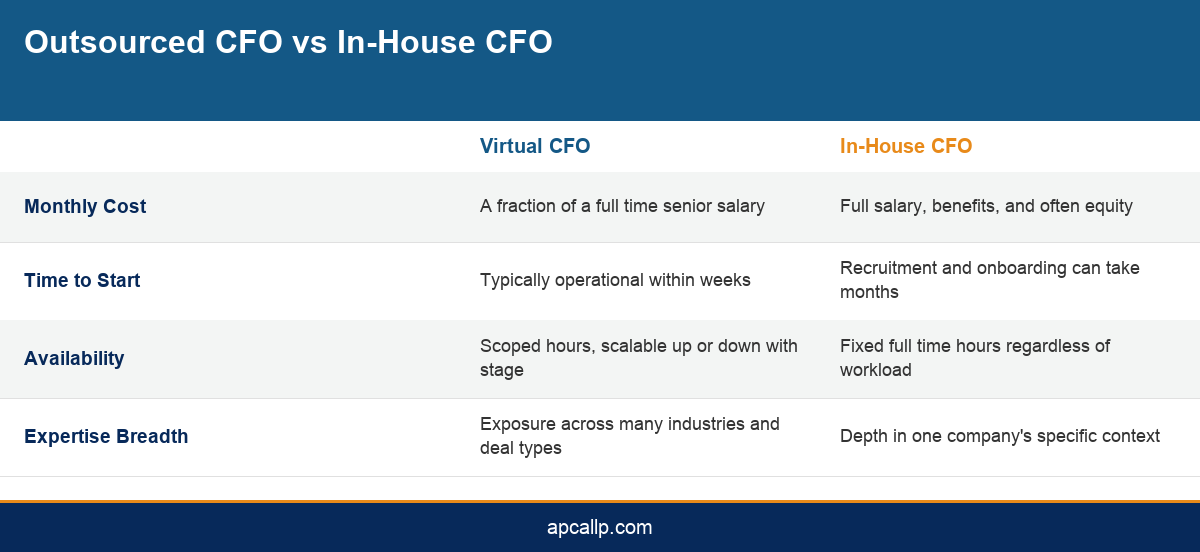
The decision between an outsourced virtual CFO and a full time in house CFO usually comes down to stage, budget, and how much dedicated attention the business needs day to day. A full time CFO makes sense once a company has enough financial complexity and headcount to justify a senior salary, plus benefits and often equity, on top of the time it takes to recruit and onboard someone into that seat.
An outsourced or virtual CFO delivers a large share of the same strategic value, scaled to the hours actually needed, which is typically a fraction of that cost. Many companies use a virtual CFO for two to four years before transitioning to an in house hire, often bringing the virtual CFO provider back in periodically for specific projects such as due diligence or fundraising even after that transition. Businesses expecting to raise a large funding round within twelve months should weigh how quickly a full time hire could realistically be recruited against the immediate availability of an outsourced team. Our full comparison, outsourced cfo vs in house cfo, lays out the cost and value tradeoffs in more detail.
When In-House Still Makes Sense
An in-house CFO tends to make more sense once a business has multiple entities, a large finance team that needs daily hands on management, or a board that expects a full time executive presence in leadership meetings. Businesses preparing for an IPO also typically move to an in-house CFO well before listing, since regulatory and investor relations expectations at that stage generally call for a dedicated, permanent seat rather than a fractional one.
Virtual CFO vs Financial Controller: Clarifying the Roles
Founders sometimes use the terms CFO and financial controller interchangeably, but the two roles sit at different altitudes within a finance function. A financial controller typically owns the accuracy of the books: monthly close, reconciliations, and ensuring statutory filings go out on time and correctly. A CFO, virtual or in house, sits a level above that and is responsible for financial strategy, forecasting, and communicating financial performance to the board or investors.
Many growing businesses need both functions but do not yet need two additional full time senior hires. A virtual CFO engagement can be structured to include financial controller oversight, or to work alongside an existing controller or accounting team, depending on what a business already has in place. Getting this distinction right matters when a company writes its first senior finance job description, since advertising for a financial controller when the business actually needs CFO level strategic input, or the reverse, tends to produce a mismatched hire. Our full explainer, cfo vs financial controller, breaks down where a financial controller's remit ends and a CFO's begins.
In practice, a common APCALLP setup pairs an internal or outsourced financial controller handling day to day bookkeeping and statutory compliance with a virtual CFO layered on top for strategy and investor communication. Neither role disappears when the other is added; they simply divide the finance function along the line that matches each person's actual strength.
How to Choose the Right Virtual CFO Partner
Choosing a virtual CFO partner comes down to three practical questions: does the provider understand the sector, can they operate across the specific compliance environment the business sits in, such as GST, ROC filings, or SEZ rules, and can the engagement scale as the business grows without a jarring transition. Regulatory bodies such as the Reserve Bank of India continue to update disclosure and reporting norms that affect how larger businesses manage treasury, which is another reason sector and stage fluency matters more than a generic playbook.
APCALLP structures its virtual CFO services around these three questions directly. The firm operates from Kochi, Kozhikode, and Bengaluru, which means clients get both a national perspective and local execution. Engagements typically start with a scoping conversation covering current financial operations, immediate priorities such as an upcoming fundraise or audit, and the reporting cadence a founder or board actually wants to see. Beyond virtual CFO services, APCALLP's fifteen service lines, spanning compliance support, tax consulting, transaction advisory, and startup advisory, mean a virtual CFO engagement can expand naturally as needs change, without bringing in an unfamiliar firm for each new requirement.
Businesses evaluating providers should ask for a sample board report or financial model before committing, since the quality of that single deliverable usually says more about fit than any pitch conversation. A short list of questions tends to separate a good fit from a poor one during that evaluation: Has the provider worked with businesses in this specific sector and at this specific stage before? Who exactly will handle the engagement day to day, and how experienced is that specific person? How does the provider handle a sudden spike in workload, such as an unplanned due diligence request? What does the transition look like if the business eventually hires an in house CFO?
It is also worth asking how a provider handles confidentiality and data access, since a virtual CFO typically needs visibility into bank accounts, payroll, and cap table detail that few outside parties ever see. A firm with formal engagement letters, defined data handling practices, and a track record across multiple client sectors tends to be a safer long term partner than an individual consultant working alone, particularly once the relationship extends past a single project into ongoing strategic support.
Conclusion
Virtual CFO services give growing businesses in Kochi, Kozhikode, Bengaluru, and across India access to senior financial leadership without the cost or delay of a full time hire. Whether the immediate need is investor ready reporting, tighter cash flow management, or simply clarity on where the business stands financially, the right virtual CFO engagement scales with the company rather than constraining it. Explore the guides linked throughout this page for a deeper look at each part of the model, or talk to APCALLP's team directly to scope a virtual CFO engagement for your business.
Frequently Asked Questions
- What do virtual CFO services include?
Virtual CFO services typically include financial planning, cash flow management, board and investor reporting, budgeting, and compliance oversight. Many engagements also add fundraising support and financial modelling, scoped to what the business needs at its current stage. 2. How much do virtual CFO services cost in India?
Cost depends on scope and hours, but virtual CFO services generally cost a fraction of a full time senior hire's salary and benefits. Most providers offer tiered retainers so a business only pays for the level of support it currently needs.
- Can a virtual CFO replace a full time accountant?
No. A virtual CFO works above the accounting function, using data an accountant or bookkeeper already prepares. Most businesses keep their existing accounting team and add a virtual CFO for strategy, forecasting, and reporting.
- How is a virtual CFO different from a financial controller?
A financial controller focuses on accurate books and timely statutory filings. A virtual CFO focuses on strategy, forecasting, and investor communication built on top of those books. Many engagements include both functions.
Do startups need a virtual CFO before their first funding round? Many do. Investors expect clean financials and a defensible model during due diligence, and building that after a term sheet arrives is often too late. A virtual CFO engaged earlier can prepare this in advance.
What is the average tenure of a virtual CFO engagement?
Many businesses retain a virtual CFO for two to four years before transitioning to an in house hire, then often continue using the provider for specific projects such as fundraising or due diligence services afterward.
- Does APCALLP provide virtual CFO services outside Kochi and Bengaluru?
Yes. APCALLP also operates from Kozhikode and supports clients across India remotely, combining local compliance knowledge in Kerala and Karnataka with financial strategy work delivered virtually wherever a client is based.
- How does GST compliance fit into virtual CFO services?
Virtual CFO services often include oversight of GST and other statutory compliance, either directly or in coordination with APCALLP's compliance support services, so filings stay accurate and on schedule alongside broader financial strategy.
- Can a virtual CFO help during an M&A or due diligence process?
Yes. Virtual CFOs frequently prepare data rooms, clean up financial records, and represent the finance function during buyer or investor due diligence, which is one of the highest value moments for this kind of engagement.
- When should a business move from a virtual CFO to an in house CFO?
The shift usually makes sense once financial complexity, transaction volume, or reporting frequency justify a dedicated full time seat, often after a large funding round or significant revenue growth increases day to day finance workload.