Virtual CFO Services in India for Startups and SMEs
 General
India's startup and SME landscape has grown faster than most founders' internal finance capabilities, and virtual CFO services have become one of the more practical ways to close that gap. This guide looks specifically at how virtual CFO services work for Indian startups and SMEs, the compliance considerations unique to operating here, and what to look for in a provider before signing on.
Key Takeaways
Virtual CFO services in India need to account for GST, ROC, and state level compliance on top of standard financial strategy work. Startups and SMEs use the model differently: startups lean on fundraising support, while SMEs often prioritise working capital and governance. A provider's familiarity with Indian regulatory timelines is often more valuable than generic financial expertise alone.
The State of Virtual CFO Services in India
India now has one of the largest startup ecosystems in the world, supported directly by the Startup India initiative, and a large base of established SMEs across manufacturing, services, and technology. Both groups face a similar problem as they grow: financial complexity increases faster than most founders expect, particularly once a business crosses state lines or takes on its first institutional investor. Virtual CFO services have grown alongside this shift because they let a business add senior financial capability without committing to a full time senior salary before the business is ready for one.
Data tracked by IBEF shows this growth extending well beyond the traditional metro hubs, with smaller cities increasingly producing venture backed startups and export oriented SMEs. Virtual CFO services scale naturally with this pattern, since the model does not depend on a provider having a physical office in every city a client operates from. For a broader look at what the role covers regardless of location, see our guide to what a virtual CFO is.
What is different in India compared to many other markets is the pace at which regulatory requirements themselves change. GST rules, tax slab structures, and compliance deadlines have all been revised multiple times since GST's introduction, and a virtual CFO service operating here needs to track these changes as part of routine work rather than treating them as occasional updates. This regulatory pace is one of the strongest arguments for working with a provider that operates primarily within India, rather than a generic international finance consultant unfamiliar with these specifics.
How Virtual CFO Services Work for Indian Startups
For startups, virtual CFO services in India typically center on fundraising readiness. This means building a financial model that can withstand investor scrutiny, setting up monthly reporting before an investor asks for it, and preparing a data room in advance of a term sheet rather than scrambling once one arrives. Our detailed guide to cfo services for startups covers this staged approach across funding rounds in more depth.
Indian startups also face a specific set of early compliance steps, including choosing the right entity structure, registering under relevant startup schemes where eligible, and setting up payroll and statutory compliance correctly from month one. Getting these basics wrong early is one of the more common and avoidable causes of delay during a later due diligence process, since investors will ask a startup to clean up any structural issues before closing a round.
ESOP structuring is another area where Indian startups frequently need early guidance. Pool sizing, vesting schedules, and the tax treatment of options at exercise all have specific Indian rules that differ from other markets, and getting this wrong tends to surface only once employees or investors start asking pointed questions about dilution or their own tax exposure, at which point unwinding a poorly structured pool is far more disruptive than setting it up correctly from the start.
How Virtual CFO Services Work for Indian SMEs
SMEs in India often approach virtual CFO services from a different angle. Rather than preparing for a first institutional round, the priority is usually improving margin visibility, tightening working capital, and building the kind of governance a bank or a larger customer expects before extending credit or signing a larger contract. A virtual CFO can introduce this discipline gradually, without the disruption of restructuring an entire finance team at once.
Family run and founder led SMEs in particular benefit from the external perspective a virtual CFO brings, since financial decisions in these businesses can otherwise stay informal for years. Introducing structured reporting, even on a modest scale, tends to reveal margin or cash flow issues that had been masked by steady top line growth, giving leadership a chance to address them before they become serious.
Succession planning is a related and often overlooked use case. SMEs preparing to hand leadership from a founding generation to the next, or preparing the business for a possible sale, need financial records and reporting practices robust enough to survive scrutiny from a buyer, a bank, or a family member stepping into a leadership role without the informal institutional knowledge the founder built up over years.
Compliance Considerations Unique to India
Any virtual CFO service operating in India needs working fluency in GST filing cycles, input credit reconciliation, and the GST portal's reporting requirements, since these obligations recur monthly regardless of a company's size or stage. A provider unfamiliar with these specifics will need time to get up to speed, which is time a growing business often cannot afford to lose.
Businesses operating across more than one state face an additional layer of complexity, since registration, filing, and even certain tax treatments can vary by jurisdiction. APCALLP's compliance support services and tax consulting work alongside virtual CFO engagements specifically to cover this ground, so a client is not left coordinating between multiple unconnected providers for what is ultimately one integrated financial picture.
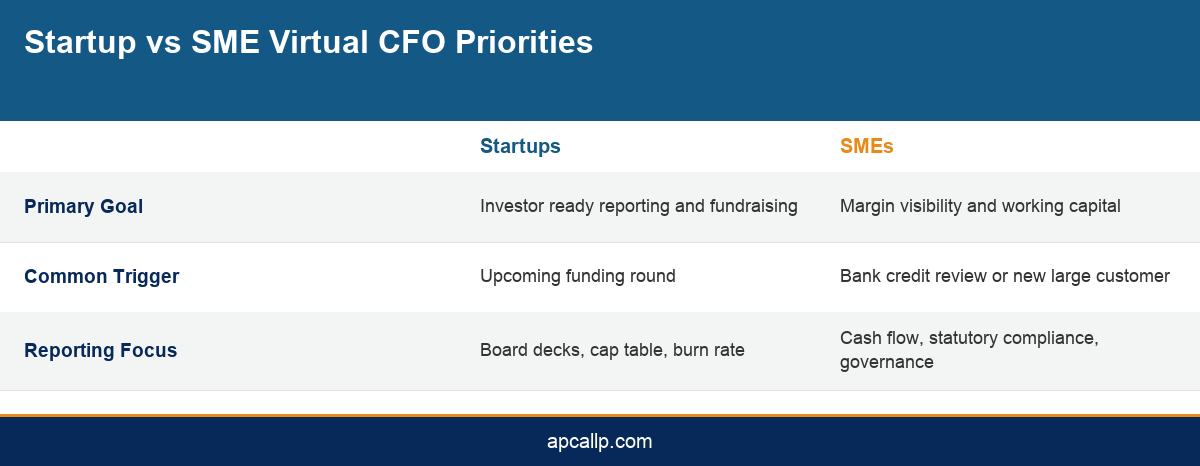 virtual CFO priorities for Indian startups versus SMEs
Choosing a Virtual CFO Provider in India
The most useful filter when evaluating a provider is direct experience with businesses at a similar stage and in a similar sector, rather than general financial credentials alone. A provider that has taken multiple startups through a funding round, or multiple SMEs through a bank credit review, brings pattern recognition that is difficult to substitute for. It is also worth asking how the provider structures its own team, since a single individual working across dozens of clients will inevitably have less bandwidth for a specific business than a firm with a dedicated team assigned to the engagement.
City presence matters too, even for a remote first model. Local presence in Kochi or Bengaluru, for example, can matter when a business needs an in person working session or has to coordinate with a local bank or registrar.
Finally, ask how the engagement would flex if priorities changed midway, such as an unplanned acquisition offer or a sudden need for a statutory audit. A provider that can only deliver the exact scope agreed at signing, with no ability to absorb a genuine change in circumstances, is a weaker long term partner than one built to handle a business's full financial lifecycle as it evolves.
Conclusion
Virtual CFO services in India need to combine financial strategy with real fluency in GST, ROC, and state level compliance, which is different from what the same model looks like in many other markets. Startups and SMEs use the model differently, but both benefit from a provider who understands the specific regulatory environment they operate in. Talk to APCALLP's team to discuss what a virtual CFO engagement could look like for your business.
Frequently Asked Questions
What are virtual CFO services in India? Virtual CFO services in India provide outsourced, senior financial leadership covering planning, compliance, and reporting, adapted to Indian requirements such as GST filing and ROC compliance, without the cost of a full time hire.
Do virtual CFO services in India handle GST compliance? Many providers include GST oversight directly, or coordinate closely with a dedicated compliance team, so filings stay accurate and on schedule alongside broader financial strategy work.
Are virtual CFO services suitable for early stage Indian startups? Yes, particularly for startups preparing for a first fundraise. A virtual CFO can build investor ready financials well before the business could justify a full time finance hire.
How do virtual CFO services differ for SMEs versus startups in India? Startups typically focus on fundraising readiness and financial modelling, while SMEs often prioritise working capital, margin visibility, and the governance needed for bank or customer credit reviews.
Can a virtual CFO in India work with businesses across multiple states? Yes. Most virtual CFO engagements are delivered remotely using cloud accounting tools, which makes multi state coverage straightforward as long as the provider understands each relevant state's compliance requirements.
What should an Indian startup look for in a virtual CFO provider? Look for direct experience with similar stage companies, familiarity with Indian compliance requirements, and a clear sense of how the engagement scales as the business grows, rather than a fixed, one size offering.
Is a virtual CFO the same as a chartered accountant in India? Not exactly. A chartered accountant is a regulated professional designation focused on audit, tax, and statutory work. A virtual CFO role is broader and often filled by a chartered accountant with additional strategic finance experience.
How quickly can a virtual CFO service start in India? Most engagements can begin within a few weeks of a scoping conversation, since the model does not require a lengthy recruitment process the way a full time senior hire typically does.