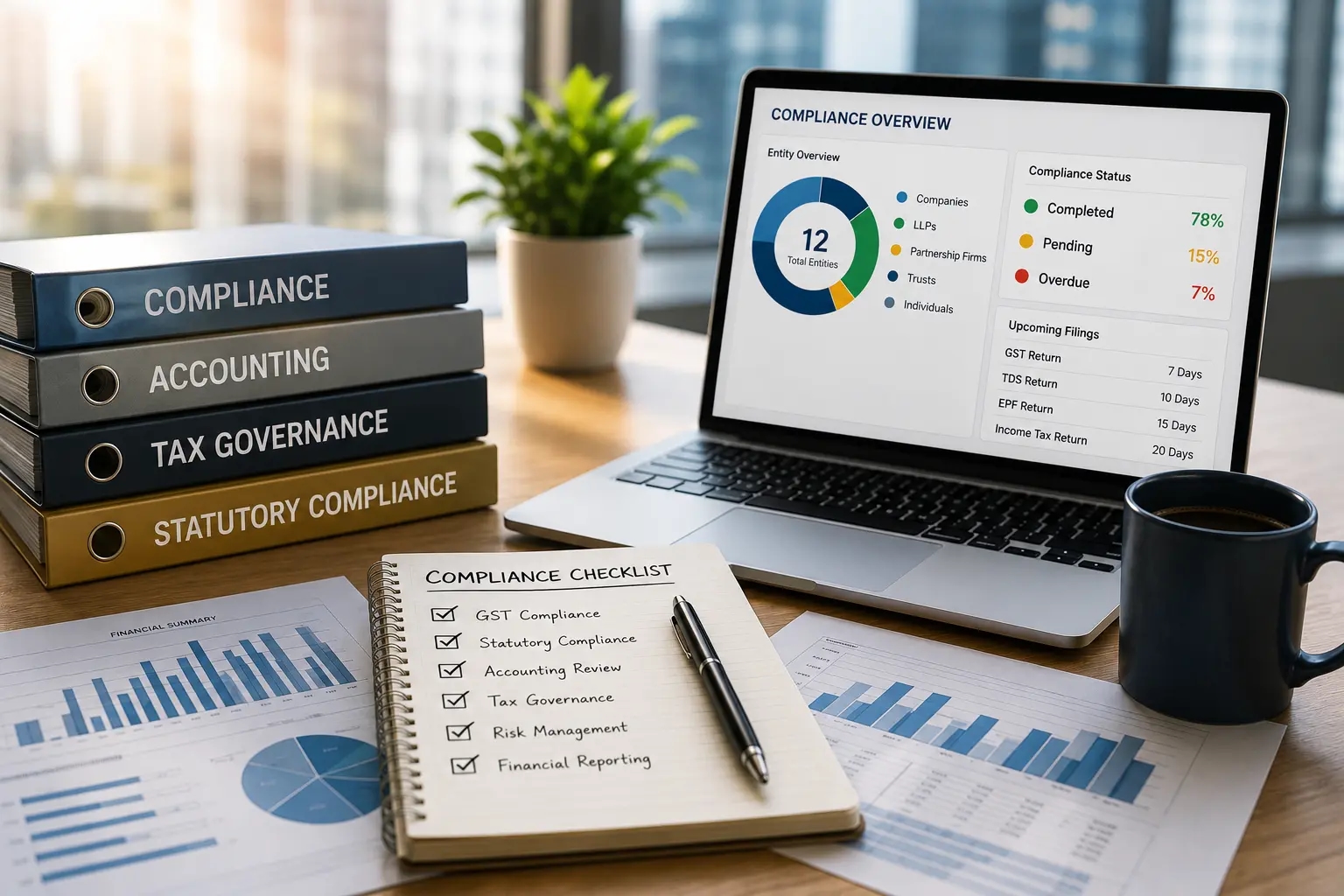
Managing compliance across multiple business entities has evolved far beyond tracking statutory filing deadlines. Today, diversified business groups must maintain consistent accounting records, monitor entity-level regulatory obligations, strengthen financial governance, and ensure timely compliance across complex legal structures.
As businesses expand through companies, LLPs, partnership firms, trusts, and individual entities, fragmented compliance processes can create significant operational and regulatory risks.
This case study demonstrates how APCALLP delivered Compliance Advisory Services to a diversified business group by centralizing statutory compliance monitoring, reviewing historical accounting records, and establishing a structured framework for stronger governance and financial control.
Executive Summary
Client
Multi-Entity Business Group
Industry
Diversified Business Group
Business Structure
Companies, LLPs, Partnership Firms, Trusts, and Individuals
Engagement
Multi-Entity Compliance Management, Accounting Review & Governance Assessment
Service Delivered
Centralized Compliance Monitoring, GST Statutory Compliance Oversight, Accounting Review, Financial Governance & Compliance Advisory
Business Outcome
Improved compliance visibility, standardized accounting processes, strengthened governance, improved financial oversight, and reduced compliance risk
The Challenge
The client managed multiple legal and business entities, each with different statutory, tax, and regulatory obligations. Compliance activities were being monitored through decentralized processes, while accounting records across entities required review and standardization.
This limited management visibility, increased administrative effort, and created a higher risk of missed statutory deadlines and inconsistent financial reporting.
The Solution
APCALLP implemented a centralized compliance management framework supported by a comprehensive accounting review.
The approach consolidated statutory compliance monitoring across entities, improved tracking of upcoming and overdue obligations, reviewed historical accounting records, and introduced standardized processes to strengthen financial governance.
The Outcome
The engagement helped the client establish a structured compliance monitoring system, improve accounting accuracy, strengthen Corporate Tax Governance, enhance management visibility, and reduce the operational risks associated with fragmented compliance management.
Introduction
India's growing business ecosystem has led many promoters and business families to operate through multiple legal entities, including private limited companies, LLPs, partnership firms, trusts, and individual structures.
While this approach can support business expansion and operational flexibility, it also increases the complexity of managing statutory and regulatory obligations.
Each entity may have different requirements relating to GST Statutory Compliance, TDS, EPF, ESI, Professional Tax, Income Tax Returns, DPT-3, LLP Form 11, and other applicable filings. Businesses can refer to the officialCBIC GST resources andIncome Tax Department resources for applicable tax and statutory requirements.
When these obligations are managed through fragmented systems, businesses can face limited visibility, inconsistent accounting processes, delayed filings, and increased compliance risk.
An effective Compliance Advisor can help businesses move from reactive compliance management to a more structured and proactive governance framework.
For multi-entity businesses, professional Compliance Advisory Services are not limited to statutory filing support. They can also help strengthen compliance monitoring, accounting controls, financial reporting, and long-term governance.
This case study highlights how APCALLP helped a diversified business group establish a centralized framework for compliance and accounting management.
Case Overview
| Engagement | Multi-Entity Compliance & Accounting Review |
|---|---|
| Client Type | Diversified Multi-Entity Business Group |
| Industry | Diversified Business Group |
| Service | Compliance Advisory Services |
| Business Structure | Companies, LLPs, Partnership Firms, Trusts & Individuals |
| Duration | Multi-Stage Compliance and Accounting Review |
| Focus Areas | GST Compliance, Statutory Compliance, Accounting Records, Financial Governance, Corporate Tax Governance |
| Result | Improved Compliance Monitoring, Accounting Accuracy, Governance & Operational Visibility |
Client Overview
The client is a diversified business group operating through multiple legal and business structures in India.
The group included:
- Companies
- Limited Liability Partnerships (LLPs)
- Partnership Firms
- Trusts
- Individual entities
As the number of entities and associated compliance requirements increased, management recognised that the existing decentralized approach was becoming difficult to manage efficiently.
The group needed a more structured framework to ensure that statutory obligations were monitored consistently while accounting records across different entities remained accurate, organized, and accessible.
Management sought professional Compliance Advisory Services to evaluate the existing processes and establish a centralized approach to compliance and financial record management.
The objective was not simply to avoid missed deadlines but to create a scalable governance framework capable of supporting the group's continued growth.
The Challenge
Managing compliance across multiple entities requires balancing different statutory requirements, filing deadlines, accounting practices, and regulatory responsibilities.
As the client's business structure expanded, several challenges emerged.
Strengthening Statutory Compliance Management
The group was required to manage multiple statutory obligations across different entities.
These included:
- GST Statutory Compliance
- GST Compliance
- TDS
- EPF
- ESI
- Professional Tax
- Income Tax Returns
- DPT-3
- LLP Form 11
- Other applicable statutory filings
Because these obligations were being monitored through decentralized methods, management had limited visibility into the overall compliance status of the group.
Improving Compliance Visibility
The absence of a centralized compliance monitoring system made it difficult to obtain a consolidated view of:
- Upcoming compliance deadlines
- Completed filings
- Pending obligations
- Overdue requirements
- Entity-level compliance status
This increased the risk of delayed filings and made compliance follow-up more time-consuming.
Reviewing Historical Accounting Records
Accounting records maintained across different entities required comprehensive review.
Differences in accounting practices and record management created challenges in maintaining consistency and continuity across the group's financial information.
The client required an accounting review to identify areas for standardization and improve the reliability of financial records.
For businesses facing similar multi-entity accounting challenges, APCALLP'smulti-entity LLP accounts rectification and compliance case study demonstrates how reconciliation, accounting correction, and statutory alignment can help restore financial clarity.
Strengthening Financial Governance
As the group continued to grow, management required better oversight of financial information across its entities.
The absence of standardized accounting processes and centralized compliance information limited management's ability to obtain a consolidated view of financial and regulatory responsibilities.
The client therefore needed an approach that combined compliance oversight with financial governance and accounting discipline.
Supporting Future Business Growth
The objective was not limited to resolving existing compliance challenges.
The client wanted to establish a scalable framework capable of supporting future expansion while maintaining consistent compliance monitoring and financial control.
As businesses expand, new compliance gaps can emerge across GST, ROC filings, taxation, and other regulatory areas. APCALLP's guide oncommon compliance gaps during business expansion provides additional context on why structured compliance processes become increasingly important during growth.
Why Compliance Advisory Services Matter for Multi-Entity Businesses
For businesses operating through multiple legal entities, compliance risk can arise from fragmented processes, inconsistent documentation, and limited visibility across statutory obligations.
The regulatory framework applicable to businesses can involve multiple areas, including GST, income tax, corporate law, labour-related requirements, and entity-specific filings. Official resources from theCBIC andIncome Tax Department provide information on applicable tax and statutory requirements.
For a business group managing multiple entities, the challenge is therefore not only completing individual filings but also maintaining a consistent system for monitoring responsibilities across the entire group.
A structured Compliance Advisory Services framework can help businesses:
- Improve visibility across multiple entities
- Monitor statutory deadlines
- Strengthen GST Compliance
- Improve accounting consistency
- Identify potential compliance gaps
- Establish clearer accountability
- Strengthen financial governance
- Improve management reporting
- Support Corporate Tax Governance
- Build scalable compliance processes
APCALLP's guide onCompliance Advisory Services vs GST Compliance Services explains how broader compliance advisory extends beyond GST return filing into governance, financial controls, risk management, and wider regulatory oversight.
For diversified business groups, the role of a Regulatory Compliance Advisor therefore extends beyond tracking deadlines. It involves helping management establish structured processes that support ongoing compliance, governance, and operational control.
APCALLP's Approach
Rather than treating the engagement as a simple checklist exercise, APCALLP adopted a structured approach that combined compliance monitoring, accounting review, and financial governance.
The engagement focused on six critical areas:
- Comprehensive assessment of existing compliance processes
- Centralized monitoring of statutory obligations across entities
- Review of GST and other applicable statutory compliance requirements
- Comprehensive review of historical accounting records
- Standardization of accounting and financial data management practices
- Establishment of a structured governance and compliance framework
This approach enabled APCALLP to provide management with practical recommendations designed to improve compliance visibility and strengthen financial control.
The engagement also reflected the broader role of a professional Compliance Advisor, where compliance management is integrated with accounting and governance rather than treated as an isolated statutory function.
Key Strategies Implemented
Centralizing Compliance Monitoring
Establishing a Unified Compliance Framework
The engagement began with an assessment of the client's existing compliance monitoring processes across all entities.
APCALLP implemented a centralized statutory compliance tracker that brought multiple entity-level obligations into a structured monitoring framework.
This allowed management to gain better visibility into compliance requirements across companies, LLPs, partnership firms, trusts, and individual entities.
The centralized framework helped create a more consistent approach to monitoring statutory responsibilities.
Strengthening GST and Statutory Compliance
Improving Visibility Over Compliance Obligations
The compliance framework incorporated monitoring of key statutory obligations, including GST Compliance, TDS, EPF, ESI, Professional Tax, Income Tax Returns, DPT-3, LLP Form 11, and other applicable filings.
The objective was to create a structured system that could identify upcoming and overdue requirements and enable timely follow-up.
This improved the client's ability to monitor GST Statutory Compliance and other regulatory obligations across multiple entities.
For additional context on GST-related compliance risks faced by growing businesses, see APCALLP's guide onGST Compliance Services and avoiding tax risks.
Implementing Deadline Monitoring
Reducing the Risk of Missed Statutory Deadlines
APCALLP established structured monitoring for upcoming and overdue compliance requirements.
The system provided management with better visibility into compliance timelines and helped identify pending obligations requiring attention.
This reduced reliance on fragmented tracking methods and supported a more proactive approach to compliance management.
Reviewing and Standardizing Accounting Records
Improving Financial Information Quality
Historical accounting records across the entities were comprehensively reviewed.
The objective was to identify inconsistencies, improve record organization, and establish standardized accounting practices.
This helped improve the consistency and accuracy of financial information while creating a stronger foundation for future financial reporting.
Strengthening Financial Controller-Level Oversight
Improving Financial Control Across Entities
The engagement improved the organization and availability of financial information across the group.
By standardizing accounting processes and improving financial data management, the framework supported stronger financial oversight similar to the role performed by a Financial Controller.
Management gained better access to organized financial information, enabling more informed review and decision-making.
Businesses seeking broader financial leadership can also explore APCALLP'sCFO Consulting Services, which cover financial management and advisory support for growing businesses.
Strengthening Corporate Tax Governance
Creating Better Tax Compliance Oversight
The centralized framework also supported stronger Corporate Tax Governance.
By improving the organization of tax-related information and statutory compliance responsibilities, the engagement created a more structured environment for ongoing tax oversight.
The approach also complemented broader Tax Consulting and Advisory Services by connecting tax compliance requirements with accounting and financial governance processes.
Establishing a Governance and Compliance Framework
Creating a Scalable Structure for Future Growth
APCALLP established structured processes to support ongoing compliance monitoring and financial record management.
Rather than focusing only on immediate compliance requirements, the framework was designed to create a scalable foundation capable of supporting the group's continued expansion.
Outcomes Delivered
Improved Compliance Visibility
The client gained centralized visibility into statutory obligations across multiple entities.
Management could better monitor upcoming, completed, and pending compliance requirements.
Reduced Compliance Risk
The structured monitoring framework reduced the operational risks associated with fragmented compliance processes and limited visibility.
It helped management identify compliance requirements in a more timely and organized manner.
Improved GST and Statutory Compliance Monitoring
The centralized framework strengthened oversight of GST Compliance and other applicable statutory obligations across the group's diverse entity structure.
Standardized Accounting Processes
The review of historical accounting records helped improve consistency across entities and established a stronger foundation for accurate financial reporting.
Stronger Financial Governance
Improved financial data management and standardized accounting practices enhanced management's ability to review financial information and support better decision-making.
Enhanced Corporate Tax Governance
The structured approach improved the organization and monitoring of tax-related information and supported stronger Corporate Tax Governance.
Improved Operational Efficiency
Centralizing compliance information reduced the effort required to monitor statutory obligations across multiple entities.
The structured framework enabled management to move away from fragmented compliance tracking toward a more organized process.
Scalable Compliance Framework
The engagement established a scalable framework capable of supporting the group's future growth and increasing compliance complexity.
Why This Matters for Multi-Entity Businesses
The Expanding Role of Compliance Advisory Services
As businesses expand across multiple entities, compliance management becomes increasingly complex.
Modern Compliance Advisory Services are expected to contribute beyond basic statutory filing support.
Businesses increasingly require advisory support that combines:
- Regulatory compliance
- GST compliance
- Accounting oversight
- Financial reporting
- Tax governance
- Internal controls
- Risk management
- Financial governance
For businesses operating through multiple entities, the value of a Compliance Advisor lies in creating systems that improve visibility and accountability while reducing operational risks.
A structured approach can also help businesses integrate compliance management with the responsibilities typically handled by a Financial Controller, creating stronger coordination between statutory compliance and financial reporting.
For growing business groups, investing in structured compliance and governance processes early can provide a stronger foundation for sustainable expansion.
Conclusion
Governance and Compliance Are Investments in Sustainable Growth
Managing compliance across companies, LLPs, partnership firms, trusts, and individual entities requires more than maintaining separate filing calendars.
It requires a structured framework that connects statutory compliance, accounting processes, tax governance, financial oversight, and management reporting.
Through its Compliance Advisory Services, APCALLP helped the client move from fragmented compliance monitoring toward a centralized and structured framework.
The engagement improved visibility into statutory obligations, strengthened GST Statutory Compliance monitoring, standardized accounting records, enhanced financial governance, and supported stronger Corporate Tax Governance.
The case demonstrates how a proactive approach to compliance can help diversified business groups reduce operational risk, improve financial control, and establish scalable governance processes.
As businesses continue to expand across multiple legal entities, organizations that invest early in structured compliance management and financial governance will be better positioned to manage regulatory complexity and support long-term growth.
Frequently Asked Questions
What are Compliance Advisory Services?
Compliance Advisory Services help businesses identify, monitor, and manage their statutory, tax, and regulatory obligations. For multi-entity businesses, these services can include compliance tracking, deadline monitoring, GST compliance oversight, governance reviews, and regulatory risk management.
Why are Compliance Advisory Services important for multi-entity businesses?
Multi-entity businesses often have different compliance requirements across companies, LLPs, partnership firms, trusts, and individual entities. A centralized compliance framework improves visibility, strengthens accountability, and reduces the risk of missed deadlines and regulatory non-compliance.
What does a Regulatory Compliance Advisor do?
A Regulatory Compliance Advisor helps businesses assess applicable regulatory requirements, identify compliance gaps, monitor statutory obligations, and establish structured processes for managing regulatory risks.
How can businesses improve GST Compliance across multiple entities?
Businesses can improve GST Compliance by centralizing compliance tracking, monitoring filing deadlines, maintaining accurate records, assigning clear responsibilities, and regularly reviewing compliance status across each entity.
What is the role of a Financial Controller in a multi-entity business?
A Financial Controller supports financial oversight by improving accounting processes, maintaining financial controls, reviewing financial reporting, and ensuring consistency and accuracy of financial information across business entities.
How do Compliance Advisory Services support Corporate Tax Governance?
Compliance Advisory Services can support Corporate Tax Governance by improving the organization of tax-related information, monitoring tax obligations, identifying compliance gaps, and establishing structured processes for tax oversight across multiple entities.
When should a business consider Tax Consulting and Advisory Services?
Businesses may consider Tax Consulting and Advisory Services when they operate through multiple legal entities, face complex tax obligations, expand into new business structures, or require professional support for tax compliance and governance.
How can a Compliance Advisor help a growing business?
A Compliance Advisor can help a growing business establish structured compliance processes, improve statutory deadline monitoring, identify potential risks, strengthen governance, and create scalable systems that support future expansion.
What is GST Statutory Compliance?
GST Statutory Compliance refers to meeting applicable GST-related legal and regulatory requirements, including timely filing of returns, maintaining appropriate records, and fulfilling other applicable GST obligations.
Why is centralized compliance management important?
Centralized compliance management provides businesses with a consolidated view of statutory obligations across multiple entities. It can improve monitoring, reduce administrative effort, strengthen accountability, and help management identify potential compliance risks more effectively.