2027 Tax Planning: Why October, Not March, Is When Smart Investors Start
 Accounting Services
A tax saving investment plan 2027 that starts in October gives you six months of choices, while one that starts in March gives you a few rushed days. The Union Budget 2025-26 made income up to Rs 12 lakh tax free under the new regime, so the first question is no longer where to invest but which regime suits you. The Income-tax Act, 2025 also came into force on 1 April 2026, so the tax year ending 31 March 2027 is the first one planned fully under the new law. Before you commit money, you can talk to the APCALLP team in Kochi, Kozhikode or Bengaluru for a quick review of your numbers. This guide explains why October is the smarter starting line and how to use the months ahead.
Key Takeaways
- Starting a tax saving investment plan 2027 in October lets you spread investments through SIPs, compare both tax regimes calmly and avoid last minute products you do not need.
- AMFI data for 2026 shows record SIP contributions but steady ELSS outflows, so choosing the best tax saving mutual funds Kochi 2027 investors can rely on needs a regime check first.
- A financial advisor near me for tax planning Kerala searchers can trust should connect regime choice, investments and advance tax into one calendar.
Why March Tax Planning Costs Investors More Than They Think
March planning feels efficient because the deadline forces action. In practice, it compresses a year of decisions into a few weeks and pushes investors toward whatever product is easiest to buy. The cost shows up later as weaker returns, locked money and missed deductions.
When the financial year closes, many salaried investors are asked for investment proofs by their employers. Anyone who has not planned ends up writing one large cheque. That lump sum goes into the market at a single price, often into an insurance policy or a fixed deposit chosen for the deduction rather than for fit. Rushed buyers also skip the question of liquidity, and discover later that a policy or deposit cannot be broken without penalties. Business owners face a similar squeeze, since the final advance tax instalment falls on 15 March. A plan started in October replaces that pressure with a clear and calm schedule. You get time to read scheme documents, compare lock in periods and check whether a deduction even applies to you. Our guide to legal ways businesses reduce tax liability shows how early planning works at company level too.
What the 2026 Data Says About Tax Saving Investors
Recent industry figures show investors saving more regularly than ever, while pulling money out of dedicated tax saving funds. That split is exactly why regime choice must come before product choice.
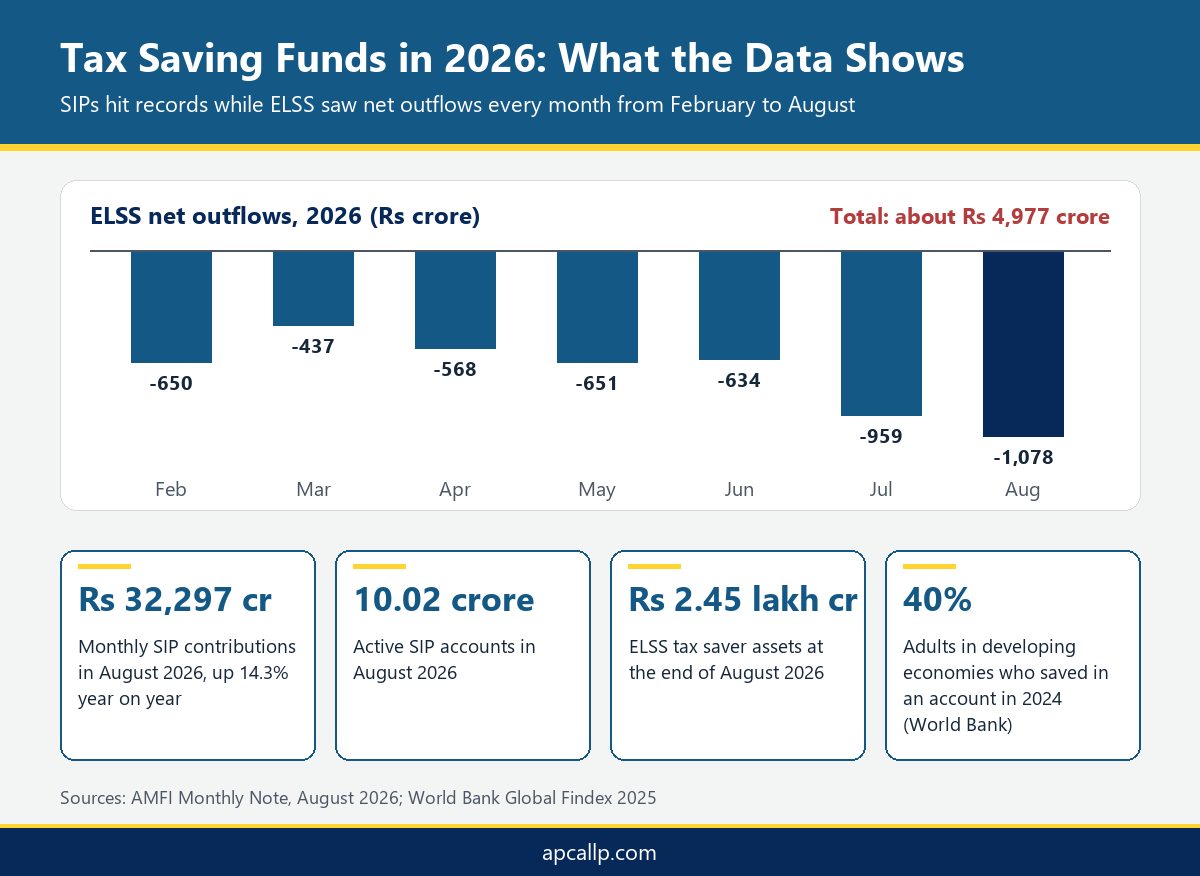
The AMFI monthly note for August 2026 reports SIP contributions of Rs 32,297 crore in a single month, up 14.3% on a yearly basis, with active SIP accounts crossing 10.02 crore. Yet ELSS tax saver funds recorded net outflows in every month from February to August 2026, totalling about Rs 4,977 crore, including Rs 1,078 crore in August alone. ELSS assets still stood at about Rs 2.45 lakh crore at the end of August. The pattern is global too. The World Bank Global Findex 2025 found that 40% of adults in developing economies saved in a financial account in 2024, up 16 percentage points since 2021. Regular saving is growing. Tax driven saving is being questioned.
Part of this shift likely reflects more taxpayers moving to the new regime, where ELSS brings no deduction. Some investors may also be redeeming units once the lock in ends. For your own planning this tax year, the lesson is simple: keep the SIP habit, but choose ELSS only if the old regime genuinely works for you.
Old Regime or New Regime: Decide Before You Invest
Your regime decides whether a tax saving investment earns you any deduction at all. Make this call in October, using your actual salary structure, loans and expected income, not last year's habits.
Under the new regime, the slabs run from nil up to Rs 4 lakh to 30% above Rs 24 lakh, and a rebate removes tax on income up to Rs 12 lakh. Most deductions are not available there. The old regime still allows the familiar Rs 1.5 lakh deduction, which now sits in Section 123 of the Income-tax Act, 2025 instead of Section 80C. Investors with a home loan, high rent and full use of these deductions may still find the old regime cheaper. Others may pay less by choosing the new regime and investing purely for goals. Running both calculations early, with help from our tax consulting specialists, stops you from buying products that save no tax in your chosen regime. An investment plan built on the wrong regime can easily lock money away for years without cutting a single rupee of tax.
An October to March Roadmap for Your Tax Saving Investment Plan 2027
A simple month by month calendar turns tax planning into a routine. Each step below takes little time when done early and becomes stressful when left to March.
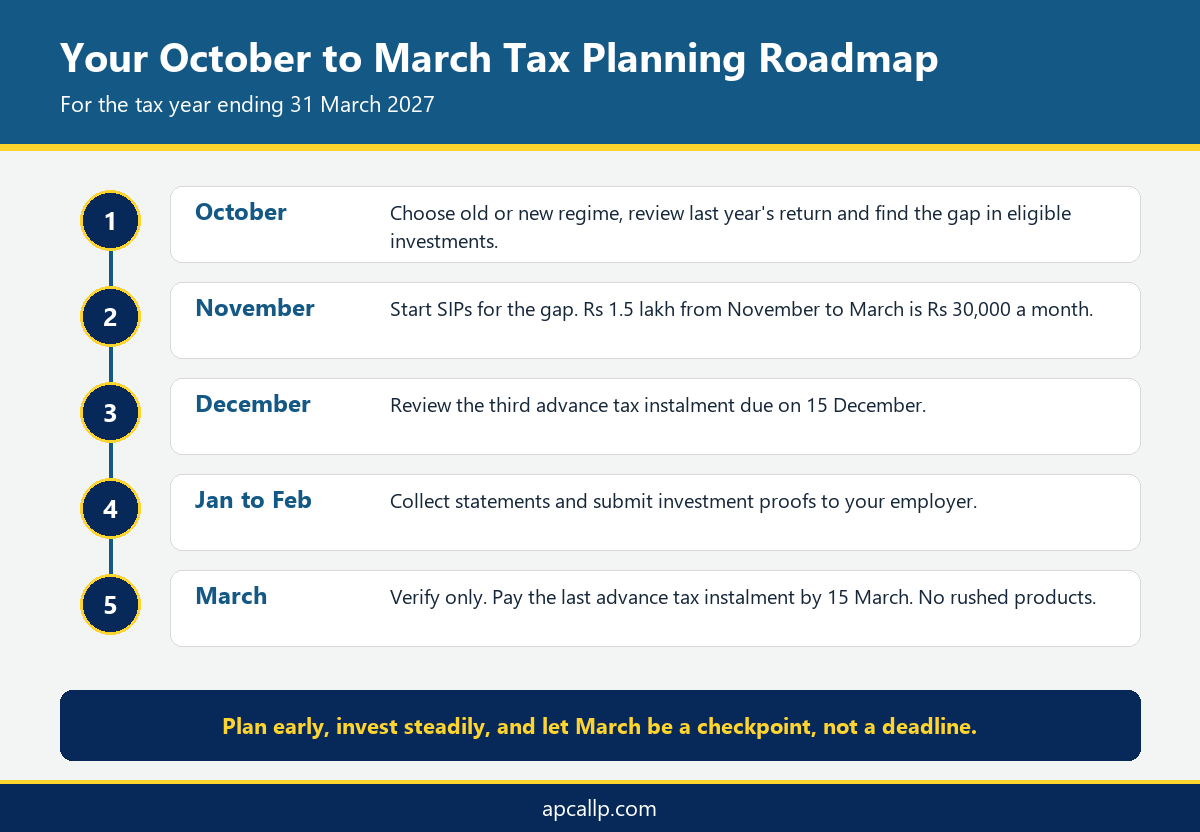
In October, pick your regime, review last year's return and calculate any gap in eligible investments. In November, start SIPs for that gap. Spreading Rs 1.5 lakh from November to March means Rs 30,000 a month instead of one large payment. In December, review your third advance tax instalment due on 15 December. In January and February, collect statements and submit proofs to your employer. In March, only verify, never rush into new commitments. When shortlisting the best tax saving mutual funds Kochi 2027 investors can hold for years, look at consistency across market cycles, expense ratios and portfolio quality rather than last year's returns. ELSS carries a three year lock in, the shortest among Section 123 options. Our investment advisory services can help match funds to your risk profile.
Keep a single folder, digital or physical, for every statement and receipt. Set reminders for each date above and review progress on the first weekend of each month. If your employer allows it, declare planned investments early so that monthly TDS reflects them and your take home pay stays predictable. Small habits like these make the final quarter a formality instead of a scramble.
When to Bring in a Financial Advisor for Tax Planning in Kerala
Some situations are too layered for a do it yourself spreadsheet. If your income comes from more than one source, professional advice usually pays for itself through fewer errors and better timing.
Consider expert help if you earn salary plus rental or business income, expect capital gains this year, hold investments abroad or return to India as an NRI. Founders and partners also need to align personal tax planning with company decisions such as salary versus dividend, which is where virtual CFO support becomes useful. Anyone searching for a financial advisor near me for tax planning Kerala should check registrations, ask how fees are charged and confirm that tax and investment advice come from people who talk to each other. APCALLP combines chartered accountants with SEBI registered investment advisors under one roof, so your regime choice, fund selection and filing stay consistent. A good advisor will also explain what not to buy, which is often as valuable as any recommendation. Ask for a written summary of the plan so you can track it through the year.
Conclusion
October planning gives you what March never can: time. You can compare regimes calmly, spread investments through SIPs and check each fund before committing. The 2026 data shows investors are saving steadily but questioning tax driven products, which makes a personalised tax saving investment plan 2027 more valuable than a generic checklist. Start with your regime decision, build a six month calendar and review it each quarter. If you want a clear plan before the year closes, book a consultation with our advisors and start the tax year ending March 2027 with confidence.
Frequently Asked Questions
Why should I start tax planning in October instead of March?

What is a good tax saving investment plan 2027 for salaried employees?
Is ELSS still useful if I choose the new tax regime?
What replaced Section 80C from 1 April 2026?
How much tax do I pay on Rs 12 lakh income under the new regime?
How do I choose the best tax saving mutual funds Kochi 2027 investors can rely on?
How much should I invest each month to use the full Rs 1.5 lakh limit?
When should I consult a financial advisor near me for tax planning Kerala?
Which advance tax dates matter between October and March?