Tax Planning Strategies for Indian Businesses: Reducing Liability Legally
 General
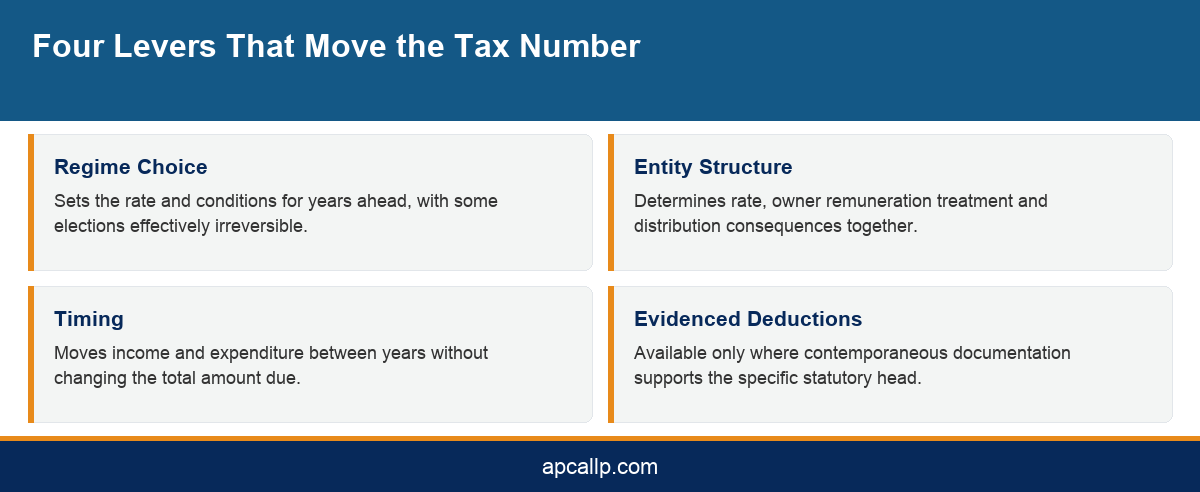
Legal tax planning is about sequence and structure, not about finding loopholes. Sound tax planning in India means choosing the right regime, holding the right entity form, timing income and expenditure deliberately, and keeping evidence for every position taken. Businesses that do this pay exactly what they owe and no more. Businesses that improvise pay penalties on top of it. This guide sets out the four decisions that move the number most, and the documentation discipline that keeps each one defensible.
Key Takeaways
- Regime choice, entity structure, timing and deduction evidence account for most of the difference between two businesses reporting identical profit.
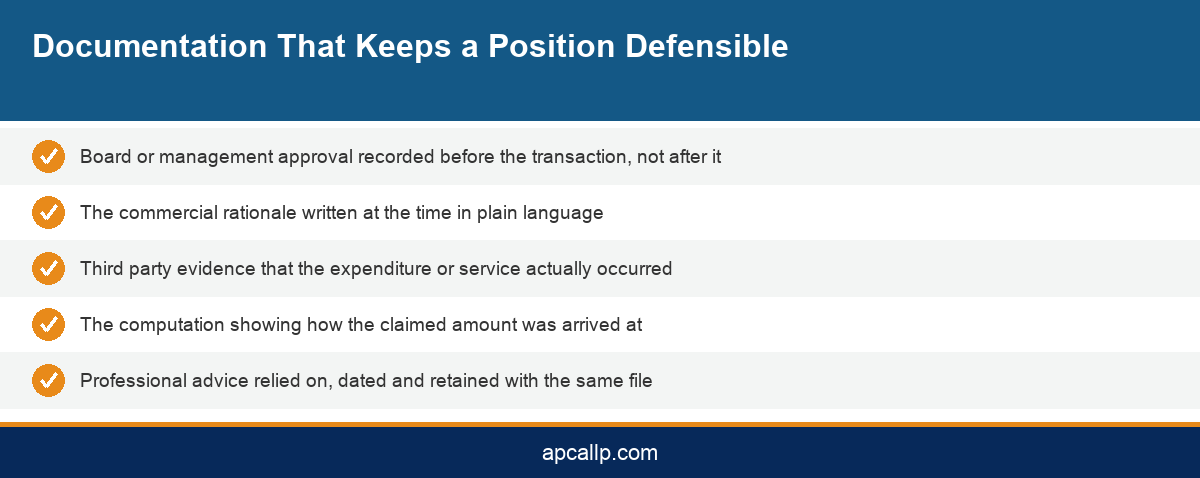
- Every planning position needs contemporaneous documentation, because a defensible position without evidence behaves exactly like an indefensible one.
- Planning decisions taken before a transaction are legal and available; the same decisions applied afterwards are usually not available at all.
Start With Regime and Entity Structure
The two structural decisions dominate everything that follows. Which tax regime the entity elects, and what legal form the entity takes. Regime elections often come with conditions attached, and some are effectively irreversible once exercised, so the decision needs a projection across several years rather than a comparison of a single year.
Entity form matters just as much. A proprietorship, a limited liability partnership and a private limited company face different rates, different treatment of owner remuneration and different consequences when profit is distributed. For owner managed businesses the effective total burden depends on how profit actually reaches the owner, not on the headline entity rate.
Our company incorporation team models this before a structure is chosen, because changing it later triggers a tax cost of its own and sometimes a lock in period. The modelling is not complicated. It simply has to be done before the entity is registered rather than after the first profitable year.
Holding structures deserve the same attention where a promoter runs more than one venture. Where the businesses will eventually be sold separately, separate entities usually work better. Where they share customers, staff and working capital, a single entity with divisional reporting is simpler and cheaper to operate. The choice is hard to reverse once assets, contracts and employees have accumulated inside the wrong shell.
Time Income and Expenditure Deliberately
Timing is the most legitimate and least used lever available to Indian businesses. Capital expenditure placed in service before the year end changes when depreciation begins. Provisions recognised correctly change the year in which a deduction is available. Revenue recognised on delivery rather than on invoice changes the year of taxation entirely.
None of this is aggressive and none of it changes the total amount eventually paid. It simply requires the decision to be made before the year closes rather than discovered when the accounts are being finalised months afterwards.
The discipline that makes this work is a forecast prepared in the third quarter estimating the full year position, followed by decisions taken with two months still available to act. Businesses using virtual CFO support usually have that forecast already as a by product of monthly reporting, which is why they capture timing benefits that similar businesses miss entirely.
Timing decisions must still be commercially genuine. Buying equipment purely to create a deduction is a poor use of cash, and an assessment officer is entitled to ask what business purpose the purchase served. The correct use of timing is to bring forward or defer something the business was going to do anyway, and to be able to show the commercial reason it happened when it did.
Claim Every Deduction You Can Actually Evidence
The list of allowable deductions is long and most businesses use only part of it. Research and development expenditure, employee welfare costs, statutory contributions, specified investments and depreciation on qualifying assets all reduce taxable profit. Sector and location based incentives add further options for manufacturing and export oriented businesses.
The constraint is almost never the law. It is evidence. A deduction claimed without contemporaneous documentation is a deduction that reverses on assessment, with interest running from the original due date. The reversal is usually more expensive than the deduction was worth.
Build the evidence file when the expenditure happens, keyed to the specific statutory head being claimed. Our note on research and development tax credits covers one of the most commonly under claimed categories in India, and the same evidence principle applies to every other head without exception.
Review the deduction list annually rather than assuming it is static. Incentives are introduced, extended and withdrawn each year, and a business claiming the same set of deductions it claimed three years ago is almost certainly leaving something on the table. Equally, a deduction that was available when a scheme opened may have lapsed since, and continuing to claim it creates exposure that grows quietly with every filing.
Plan Before the Transaction, Not After It
This is the rule that separates planning from wishful thinking. A business restructuring, an asset sale, a share transfer or a promoter distribution can often be arranged in more than one entirely legitimate way, and each way produces a different tax outcome. Once the transaction has been executed, the choice has already been made on your behalf.
The income tax department portal publishes the return and form requirements clearly, but no portal can restore an option you have already closed. Advisers are frequently asked to improve the tax outcome of a transaction that completed last quarter, and the honest answer is usually that the moment has passed.
The practical rule is simple and cheap to follow. Any transaction above a threshold you set for yourself gets a tax review before signature. That review takes days and costs very little. Undoing a poorly structured transaction takes years, costs a great deal, and rarely succeeds completely.
Set the threshold low enough that it actually catches things. Most owner managed businesses set it too high, with the result that the transactions reviewed are the ones already obvious to everybody. A modest threshold catches the share transfer to a family member, the property held personally but used by the business, and the loan from the promoter that was never documented. Those are the transactions that cause problems years later.
Planning Mistakes That Reverse on Assessment
The first mistake is treating a family arrangement as a tax structure. Salaries paid to relatives who do not work in the business, rent paid for premises that are not used, and interest on loans that were never actually advanced all reverse on examination. The test applied is whether the payment reflects something real, and that test is easier to fail than most owners expect.
The second is copying a structure that worked for somebody else. Another business in the same sector may operate under different facts, a different regime election or a different shareholding pattern. Structures do not transfer between businesses the way processes do, and a structure adopted without modelling the specific facts frequently produces a worse outcome than doing nothing.
The third is leaving the reasoning undocumented because the position feels obviously correct at the time. Three years later the officer asking the question has none of that context, the people involved have moved on, and an obviously correct position without a file looks identical to an aggressive one.
The fourth is planning at entity level while ignoring the promoter. A structure that minimises company tax but traps profit where the owner cannot access it without a second layer of tax has not reduced anything. Model the full path from revenue to the owner's hands before deciding that a structure works.
Conclusion
Effective tax planning in India comes down to four decisions taken in the right order. Choose the regime and entity structure with a multi year projection rather than a single year comparison. Use timing deliberately before the year closes. Claim every deduction you can actually evidence. And review any significant transaction before you sign it rather than afterwards. None of this requires aggressive positions, and all of it requires documentation created at the time. If your last year end produced surprises, plan the next one differently. Talk To Us.