CFO Services for Startups: Fueling Early Stage Growth
 General
Startups face financial complexity long before they can justify a full time finance executive, which is exactly the gap cfo services for startups are built to fill. This guide looks at how outsourced CFO support fuels early stage growth, what a CFO company typically delivers at each funding stage, and how to choose the right cfo consultant for a startup's specific needs.
Key Takeaways
- Startups typically need financial credibility before they have meaningful revenue, which makes outsourced CFO services valuable earlier than many founders expect.
- A CFO company's deliverables shift with funding stage, from a first financial model at seed to audited reporting ahead of a growth round.
- Choosing the right cfo consultant depends more on stage and sector experience than on general financial credentials alone.
Why Startups Need Dedicated CFO Services Early
Founders are usually experts in their product or market, not in financial modelling or investor reporting, and that gap becomes visible the moment a serious investor conversation begins. Backed by ecosystem support such as Startup India, more founders are starting companies earlier in their careers than a decade ago, which means many are encountering investor grade financial expectations for the first time with no prior exposure to what a clean financial model or a proper data room actually looks like.
CFO services for startups exist specifically to close this gap without requiring a founder to make an expensive, premature full time hire. An outsourced cfo consultant brings the reporting discipline and modelling skill a startup needs at exactly the volume the business can use, rather than forcing a founder to either do it themselves badly or overpay for capacity that sits underused.
This matters because investor trust is built cumulatively. A founder who consistently sends accurate, on time monthly updates earns a different level of confidence from existing investors than one who only produces numbers when directly asked, and that accumulated trust tends to translate into faster decisions and better terms at the next round.
There is also a defensive reason to start early. Startups that wait until a funding conversation is already underway to fix messy books often find that the cleanup itself becomes a source of delay and lost negotiating leverage, since a diligence team that spots inconsistent numbers early in a process tends to price that uncertainty into the terms they eventually offer, if they offer terms at all.
What a CFO Company Delivers at Each Funding Stage
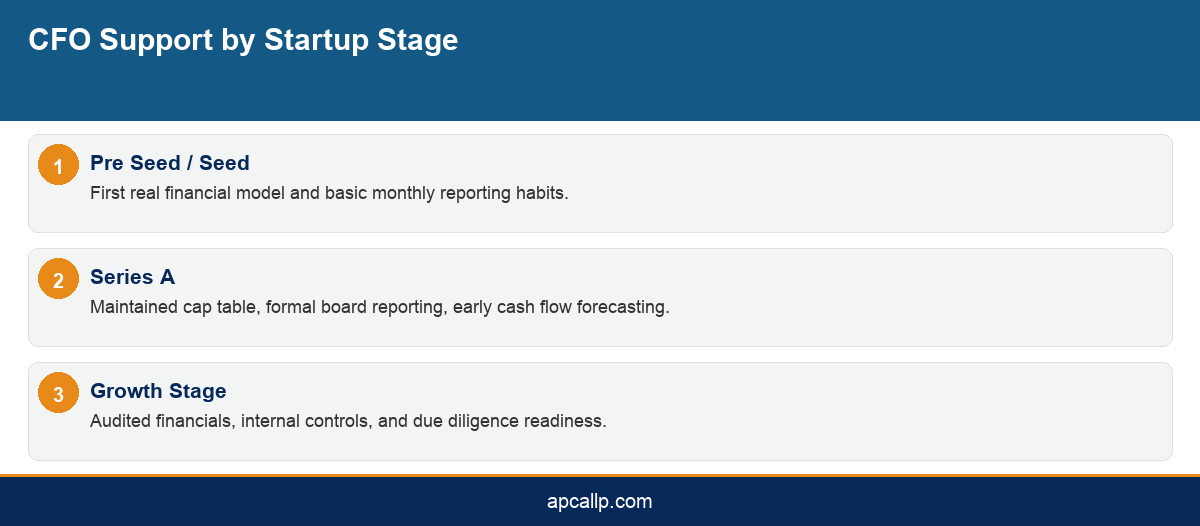
At the pre seed and seed stage, a cfo company typically focuses on building the startup's first real financial model, one that can withstand basic investor scrutiny rather than a rough spreadsheet assembled the night before a pitch. This stage also usually includes setting up clean bookkeeping practices and a simple monthly reporting habit that did not previously exist.
At Series A, expectations rise substantially. Investors expect a maintained cap table, monthly board reporting formatted to a recognisable standard, and early cash flow forecasting that flags problems before they become urgent. Our guide to virtual CFO services in Bengaluru looks at how this plays out specifically in India's most active startup funding market.
By the growth stage, a startup preparing for a later round or a strategic exit typically needs audited financials, documented internal controls, and a finance function that can survive genuine due diligence rather than a founder's personal spreadsheet. CFO consultants who have taken companies through this progression before can anticipate what a diligence team will ask well before the request actually arrives.
The support a startup needs does not always move in a straight line either. A company that raises a large round and then faces a slower growth period may need to shift its CFO engagement from fundraising support toward cost discipline and runway extension, then shift back again once growth resumes. A good cfo consultant adjusts to this rhythm rather than applying the same playbook regardless of where the business actually stands.
Building Investor Confidence Through Financial Discipline
Investor confidence is built less by any single impressive number and more by consistency over time. A startup that reports the same metrics, calculated the same way, every single month builds a track record an investor can trust, while a company that changes its reporting format or its definition of key metrics between updates raises questions regardless of how strong the underlying business actually is.
Data tracked by IBEF shows Indian startup funding activity remaining resilient across market cycles, which means the startups that maintain financial discipline through a slower funding environment are often best positioned to raise when conditions improve, since they have not had to rebuild investor trust from scratch after a period of weak or inconsistent reporting.
This is one of the less obvious value adds of dedicated CFO services for startups: the discipline itself compounds. A founder who has been through two or three properly run reporting cycles internalises habits that continue paying off even during periods when active fundraising is not the immediate priority.
Choosing the Right CFO Consultant for a Startup
The single most useful filter is direct experience with startups at a similar stage and in a similar sector. A cfo consultant who has taken multiple SaaS companies through a seed round brings pattern recognition that a generalist accountant, however capable, has not had the opportunity to build on this specific type of company.
It is also worth understanding exactly who will handle the engagement day to day. Some cfo consulting firms assign a senior partner only at the pitch stage and hand day to day work to a junior team member afterward, which can create a mismatch between the experience a founder expected and the experience they actually receive month to month.
Our full explanation of what a virtual CFO is covers the core responsibilities any competent provider should deliver, which is a useful baseline to compare a specific consultant's proposal against before signing an engagement letter.
When to Transition From Outsourced to In House
Most startups outgrow the outsourced model eventually, typically once financial complexity, transaction volume, or reporting frequency justify a dedicated full time seat. This usually happens after a significant funding round or a sustained period of headcount growth that increases day to day finance workload beyond what a part time engagement can reasonably absorb.
The transition does not have to be abrupt. Many startups bring on a first internal finance hire while keeping their outsourced cfo consultant involved in an advisory capacity, particularly for specialised work like a future fundraise or a due diligence process. Our detailed comparison of outsourced versus in house CFO services walks through how to plan this transition without losing continuity in reporting.
A well planned transition also preserves institutional knowledge. A CFO consultant who has worked through two or three of a startup's funding rounds understands context, such as why a particular metric is defined a certain way or why an earlier investor asked for a specific reporting format, that a brand new internal hire would otherwise need months to rebuild from scratch.
Conclusion
CFO services for startups exist to bridge the gap between what a founder can realistically manage alone and what investors expect to see, without the cost of a premature full time hire. The right cfo consultant scales support to match each funding stage, building the discipline that compounds into faster, better funded growth. Talk to APCALLP's team about startup advisory services and CFO support built around your funding timeline.
Frequently Asked Questions
What do CFO services for startups typically include?

How much do CFO services for startups cost in India?
When should a startup hire its first CFO consultant?
What is the difference between a CFO company and an individual consultant?
Can outsourced CFO services help during a Series A round?
Do startups need CFO services if they already have a bookkeeper?
How long does a typical CFO services engagement last for a startup?
What industries most commonly use CFO services for startups?