Outsourced CFO vs In House CFO: Cost and Value
 General
Deciding between outsourced cfo services and a full time in house CFO usually comes down to cost, control, and how much dedicated attention a business genuinely needs right now. This guide compares both models directly across the factors that matter most, so a growing business can make this call with a clear picture of the tradeoffs rather than a general sense that one option is simply better than the other.
Key Takeaways
- Outsourced CFO services typically cost a fraction of a full time in house CFO's salary, benefits, and equity package.
- An in house CFO offers more day to day availability and presence, which matters more once a business reaches a certain size and complexity.
- Many businesses use outsourced CFO services for two to four years before transitioning to an in house hire, often retaining the outsourced provider for specific projects afterward.
Comparing Cost: Outsourced vs In House CFO
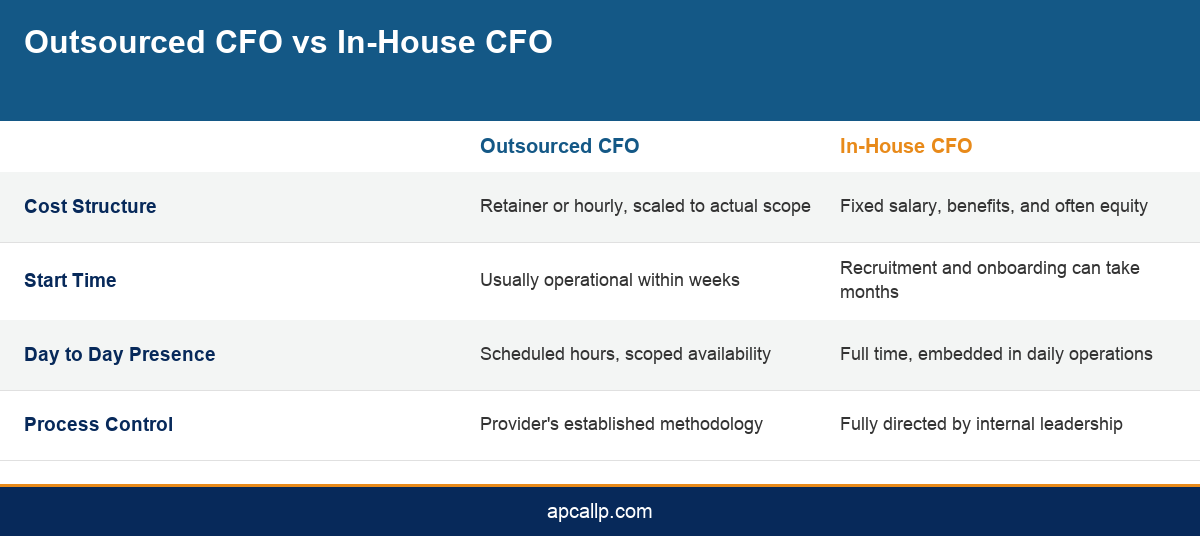
Cost is usually the first and most obvious difference. A full time in house CFO commands a senior salary, benefits, and in many cases an equity grant, all of which accrue regardless of how much strategic work is actually needed in a given month. Outsourced cfo companies typically price on a retainer or hourly basis scoped to actual need, which means a business pays for the work it uses rather than a fixed headcount cost.
This does not mean outsourced is automatically cheaper in every case. A business with enough complexity to keep a senior finance executive fully occupied every week may find that a well structured in house role delivers better value per rupee than a heavily used outsourced retainer billed at a premium hourly rate. The comparison only favors outsourcing clearly once the workload genuinely fits inside a part time or fractional scope.
Recruitment cost is a related factor many founders underweight. A senior CFO search can take several months and often involves recruiter fees on top of the eventual salary, while an outsourced engagement can typically start within weeks of a scoping conversation, which has its own financial value when time to strategic input matters.
Severance and turnover risk deserve mention too. If an in house hire does not work out, a business faces the cost of severance, a fresh search, and a gap in financial leadership during the transition. An outsourced provider can usually be exited or adjusted with far less disruption if the engagement is not delivering the expected value.
Comparing Availability and Control
An in house CFO is present every working day, available for impromptu conversations, and fully embedded in company culture and internal politics in a way that even the best outsourced cfo consulting relationship cannot fully replicate. For businesses where financial decisions need daily, hands on involvement, this presence has real value.
Outsourced CFO services trade some of this immediacy for flexibility. Engagements are typically scoped to a defined number of hours or a specific set of deliverables, which means availability outside that scope may require advance notice or additional cost. Businesses that anticipate frequent, unplanned financial questions should factor this into the comparison honestly rather than assuming an outsourced provider will always be reachable on the same timeline as an employee.
Control over process is another dimension. An in house CFO can be directed to adopt internal systems and processes exactly as leadership prefers, while an outsourced provider often brings its own established methodology, which can be a benefit when that methodology is more mature than what the business would build internally, or friction when a founder has a strong preference for a different approach.
Comparing Expertise and Objectivity
Outsourced cfo consulting firms typically work across many clients and sectors simultaneously, which builds a breadth of pattern recognition that a single in house hire, however talented, cannot match purely through one company's internal history. This breadth shows up clearly during unusual events, such as a first fundraise, an acquisition offer, or a sudden compliance change, where an outsourced provider has likely seen a similar situation before.
An in house CFO instead builds deep, specific knowledge of one company's operations, relationships, and internal dynamics over time, which has its own value once a business has grown complex enough that this depth outweighs external breadth. Professionals registered with the Institute of Chartered Accountants of India bring technical rigor in either arrangement, but the depth versus breadth tradeoff remains regardless of individual qualification.
Objectivity tends to favor the outsourced model. An outside provider has no personal stake in internal politics or a founder's attachment to a specific initiative, which makes it easier to deliver an honest, sometimes uncomfortable read on what the numbers actually show, compared to an employee whose own position may be tied to a project's perceived success.
When Outsourced CFO Services Make the Most Sense
Outsourced CFO services fit best for startups and SMEs that need senior financial judgment but do not yet have enough sustained workload to justify a full time salary. This is also the right model for a business anticipating a specific, time bound need, such as fundraising support or due diligence preparation, where a dedicated but temporary engagement is more efficient than a permanent hire.
Our guide to cfo services for startups looks specifically at how this model supports early stage companies through successive funding rounds, while our broader explanation of what a virtual CFO is covers the core responsibilities that make the outsourced model work well across most stages and sectors.
Seasonal or cyclical businesses are another good fit. A company with predictable busy and slow periods can scale an outsourced engagement up around year end reporting or an annual compliance push and scale it back down the rest of the year, an option a fixed full time salary simply does not offer regardless of how the workload actually fluctuates.
When an In House CFO Makes More Sense
An in house CFO tends to make more sense once a business has multiple entities, a large finance team requiring daily management, or a board that expects a full time executive presence in leadership discussions. Companies preparing for an IPO also typically move to an in house CFO well before listing, since regulatory and investor relations expectations at that stage usually call for a dedicated, permanent seat.
Even after making this transition, many businesses continue using an outsourced provider for specific specialised work, such as due diligence during an acquisition or a periodic second opinion on financial strategy. Our comparison of cfo vs financial controller is also useful reading at this stage, since businesses transitioning to an in house CFO often need to clarify how that role divides responsibility from an existing financial controller.
Board and investor expectations also shift the calculation. Once a company has a formal board with independent directors, there is often an expectation that a senior executive, not an external contractor, holds ultimate accountability for financial reporting, even if outsourced specialists continue supporting specific technical work behind that person.
Conclusion
Neither outsourced CFO services nor an in house CFO is universally better; the right choice depends on a business's current stage, workload, and how much dedicated presence it genuinely needs. Many companies use outsourced support for years before transitioning, and some never fully leave the model behind even after making that shift. Talk to APCALLP's team to work through which model fits your business today.
Frequently Asked Questions
Is outsourced CFO services cheaper than an in house CFO?

How quickly can outsourced CFO companies start working with a business?
Can outsourced CFO services scale as a business grows?
Do outsourced CFO services offer the same expertise as an in house CFO?
When should a business switch from outsourced to in house CFO?
Can a business use both outsourced and in house CFO support?
What is the biggest risk of choosing outsourced CFO services?
What is the biggest risk of hiring an in house CFO too early?