Chartered Accountants in Calicut (Kozhikode): Local CA Firms and Services
 General
Kozhikode carries a long commercial history and a business base that looks different from Kochi or Bengaluru. Chartered accountants in Calicut deal with trading houses, manufacturing units and family owned groups far more often than with funded startups. That changes what a good firm here needs to be able to do. This guide covers the services Malabar businesses actually need, how to compare local CA firms, and the specific issues that recur in this market.
Key Takeaways
- Malabar's business base skews towards trading, manufacturing and family owned groups, so succession and structure questions arise more often than funding ones.
- Local CA firms should be assessed on assessment and representation experience, not only on filing capability.
- One firm covering Kozhikode alongside Kochi and Bengaluru avoids the reconciliation problem that appears when a business expands out of the region.
The Malabar Business Base and What It Needs
Kozhikode's economy runs heavily on trading, distribution, timber and food processing, with a substantial base of businesses that have been in the same family for two or three generations.
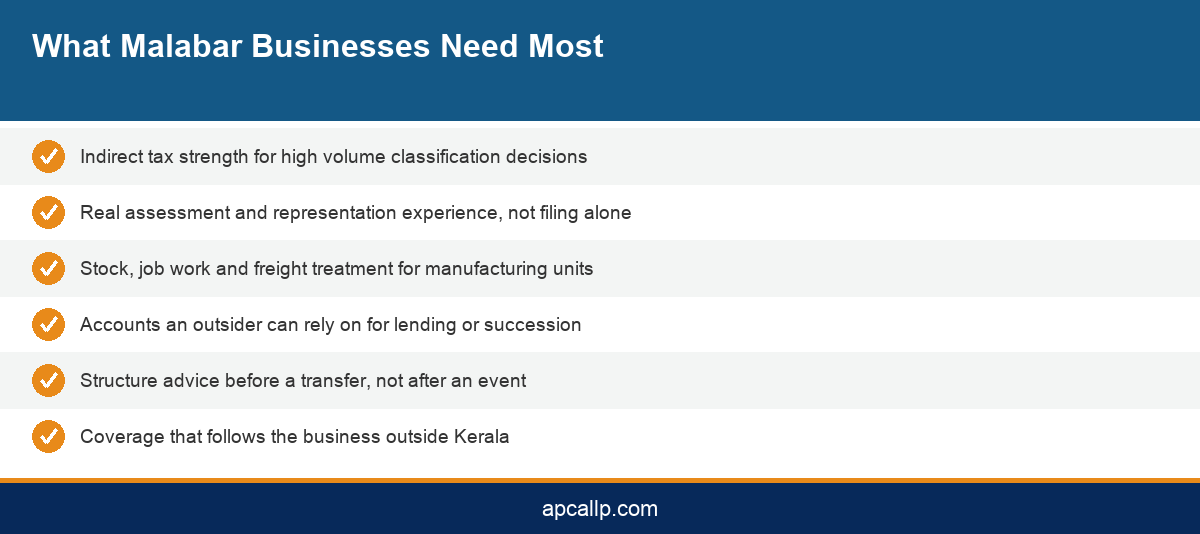
Those businesses are frequently profitable and almost as frequently under documented. The accounts exist for tax purposes and were never designed to be read by a bank, a partner or a buyer.
That produces a specific advisory need. Not tax minimisation, but the construction of a reliable set of numbers and a structure that can survive the founder stepping back.
Manufacturing units add their own requirements: cost records, stock valuation, job work flows and the indirect tax treatment of each. These are unglamorous and they are where most assessments start.
A firm serving this market well needs strength in indirect tax, real assessment experience, and enough commercial judgement to advise on succession without turning it into a purely legal exercise.
Export oriented businesses add a further layer. Refund claims, shipping documentation and the treatment of zero rated supply all carry their own timing and evidence requirements. Refund delays are a working capital problem rather than a compliance one, and they are usually caused by document mismatches rather than by the department. A firm that handles exports regularly builds that documentation discipline in from the first shipment.
Comparing CA Firms in Calicut
The professional community in Kozhikode is small enough that reputation travels quickly, which is useful when you are choosing.
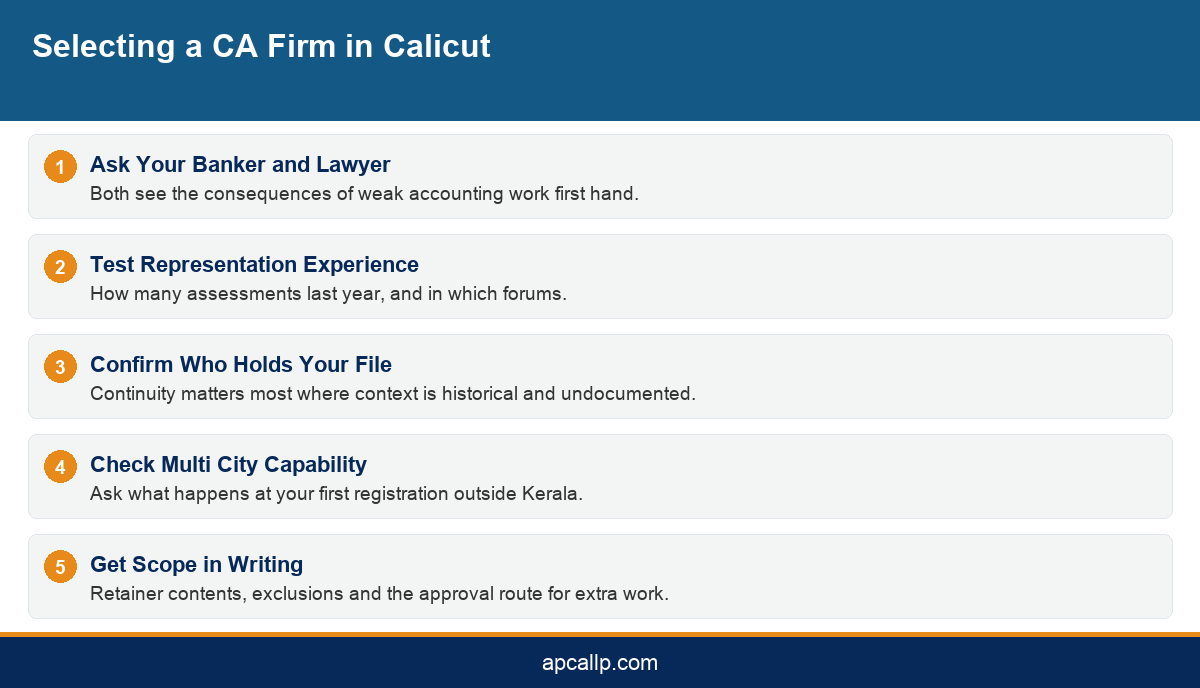
Start by asking your banker and your lawyer. Both see the downstream consequences of weak accounting work and their recommendations tend to be conservative and well informed.
Then test capability directly. Ask how many assessments the firm handled in the last year and in which forums. Filing competence is common. Representation competence is not, and it is what you will need eventually.
Ask who will handle your file and how long they have been with the firm. Continuity matters more in a market where much of the useful context is historical and undocumented.
Finally, ask what happens when the business expands outside Kerala. A firm that can only serve you locally is fine until the first Bengaluru or Chennai registration, at which point you are managing two relationships.
Test responsiveness before you appoint rather than afterwards. Send a genuine question and see how long a considered answer takes to arrive. Two working days for something substantive is a reasonable benchmark in this market. Firms that are slow during the sales process are rarely faster once the engagement letter has been signed.
Succession and Structure in Family Businesses
Succession is the most common significant advisory question in this market and the one most often deferred.
The technical work is manageable: reviewing the holding structure, separating personal and business assets, documenting what the business actually owns, and planning the transfer in a tax efficient and legally sound way.
The difficult part is sequencing. Many decisions are only available before a transfer happens, and families frequently begin the conversation after an event rather than before one.
A related issue is the personal use of business assets, particularly property. Where a building is owned personally and used by the business without documentation, both the tax position and any future sale become complicated.
Our startup and business advisory work applies the same structural thinking to established family businesses, because the underlying question is identical: is this business in a form somebody else could buy, fund or inherit.
Documentation is usually the binding constraint rather than tax. Many family businesses cannot readily prove who owns what, because assets were acquired informally over decades and never recorded properly. Fixing that is patient, unglamorous work that has to happen before any structural decision. It is also the single highest value thing most of these businesses can do.
Indirect Tax and Assessment Exposure
Trading and manufacturing businesses carry more indirect tax risk than service businesses, simply because they make more classification decisions.
Stock movement, job work, branch transfers and freight all have their own treatment, and each one repeats constantly.
The most common exposure we see is input credit claimed but never matched against what suppliers actually reported. The gap is invisible monthly and substantial annually.
The GST returns help section documents the mechanics, but the control that catches the gap has to be built into the monthly routine.
Ask any prospective firm how they handle monthly reconciliation and what they send you when something does not match. A firm that produces an exception report is doing the work. A firm that only confirms filings is not.
Stock and job work records deserve particular attention in manufacturing units. Goods sent for processing, returned late or short, and scrap generated in the process all have specific treatment, and the records are frequently maintained by production staff rather than by finance. Bringing those records into the monthly close is often the fastest way to reduce assessment exposure.
Freight and transport charges deserve the same care. Reverse charge obligations on goods transport are among the most frequently missed items in trading businesses, and because the amounts are small each month they attract no attention until several years have accumulated. A standing check in the monthly close removes the entire category of risk.
Working With a Firm That Covers More Than Kozhikode
Businesses in Malabar expand in predictable directions: a Kochi office, a Bengaluru sales presence, or exports.
Each of those adds registrations, and each registration is an opportunity for two sets of records to diverge.
Handling it with one firm means the same technical treatment applies everywhere and one team holds the consolidated position.
It also means the conversation about a new state happens before the first invoice rather than after it, which is where the real saving sits.
Our Kozhikode office on Jawahar Nagar Avenue Road works alongside Kochi and Bengaluru on exactly this basis, and our Kozhikode tax and compliance work describes what that looks like in practice.
Keep your own archive regardless of which firm you appoint. Filed returns, financial statements, registration certificates and key correspondence should sit with the business, not only with the adviser. Businesses that hold their own records can change firms within a week if they need to. Businesses that cannot are effectively locked in, and that weakens every fee conversation they will ever have.
Finally, agree what the first year is meant to deliver. Filings on time, no unexplained reconciling items, one partner review each quarter and a clean audit is a reasonable baseline for any Kozhikode business. Reviewing against that at renewal turns a vague relationship into a manageable one.
Conclusion
Chartered accountants in Calicut serve a market built on trading, manufacturing and family owned businesses, which makes indirect tax strength, assessment experience and succession judgement the capabilities that matter. Check representation experience rather than filing competence alone, ask who holds your file, and think ahead about what happens when the business expands beyond Kerala. If you want a straight comparison against your current arrangement, Talk To Us.
Frequently Asked Questions
What do CA firms in Calicut typically handle?

How do I choose between CA firms in Kozhikode?
Why does succession planning come up so often here?
What indirect tax risks affect trading businesses most?
Should I use a local firm or a multi city firm?
What should a monthly compliance report include?
How is a family business made investor ready?
Do CA fees differ between Kozhikode and Kochi?
Can one firm handle exports and domestic sales together?
What records should I have ready before appointing?