GST Audit Compliance: What Businesses Must Prepare For
 General
Most businesses meet GST audit compliance once a year and treat it as a filing exercise. It is closer to an examination of twelve months of decisions. The annual return and the reconciliation statement compare what you declared each month against what your audited accounts say, and every difference between them has to be explained. This guide covers who is in scope, what the reconciliation actually tests, which records must be produced, and how departmental audit differs from the annual filing.
Key Takeaways
- The GST annual return and reconciliation statement test twelve months of monthly filings against your audited financial statements.
- Departmental audit is a separate process in which officers examine records directly, and it can look back across several financial years.
- Businesses that reconcile monthly complete GST audit compliance in weeks; businesses that reconcile at year end usually surface demands they can no longer reverse.
Who Is Covered by GST Audit Requirements
Every registered taxpayer other than a few excluded categories files an annual return consolidating the year's outward supplies, input credit claimed and tax paid. Above a prescribed turnover threshold, a reconciliation statement must also be filed, reconciling that annual return with the audited financial statements of the entity.
Turnover for this purpose is computed on a PAN basis across all registrations, which regularly catches multi state businesses that assess each state separately and conclude they are below the threshold. The CBIC GST resources set out current thresholds and formats.
Separately, the department can select any registration for audit regardless of turnover. Being below the reconciliation threshold reduces your filing burden but it does not remove audit exposure, and smaller businesses are often less prepared when a notice arrives.
There is one further category worth noting. Businesses that surrendered or cancelled a registration during the year still have to complete the annual filing for the period the registration was live. Cancellation stops future obligations, it does not erase past ones, and a final return left unfiled keeps the matter open indefinitely.
What the Reconciliation Statement Actually Tests
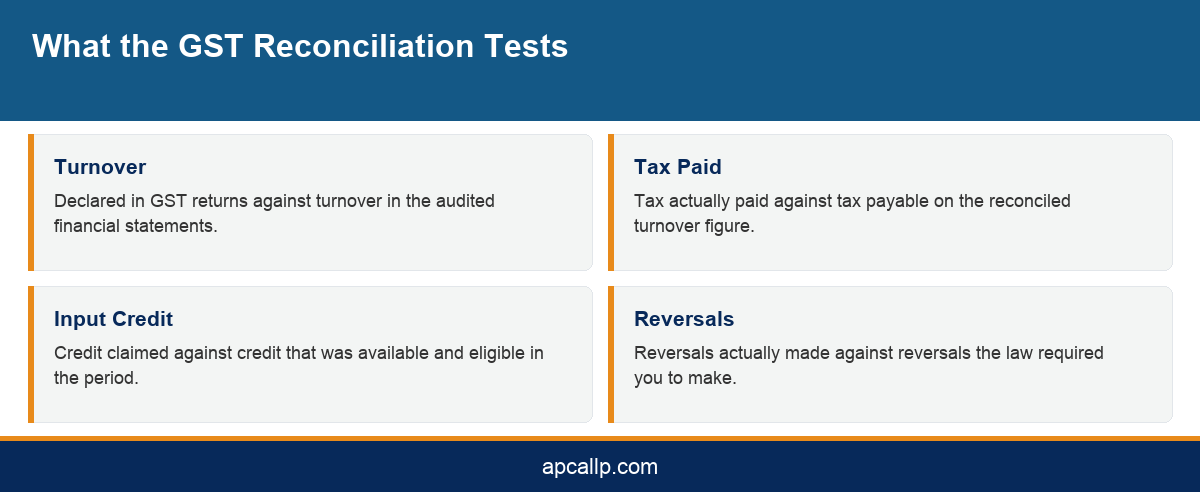
The reconciliation compares four things. Turnover declared in GST returns against turnover recognised in the financial statements. Tax paid against tax payable on that reconciled turnover. Input credit claimed against credit that was available and eligible. And credit reversals actually made against reversals the law required.
Differences are normal and expected. Unexplained differences are the problem. Common legitimate causes include revenue recognised in accounts but not yet supplied, credit notes issued after the year end, advances received against future supply, and transactions that sit entirely outside the scope of GST.
Each of those needs a documented explanation rather than a balancing entry that makes the numbers agree. An auditor can accept a difference that is explained. An auditor cannot accept a difference that has simply been absorbed. This is exactly where the monthly discipline described in our GST reconciliation practice pays for itself, because the explanation is written when the transaction happens rather than a year later.
Build the reconciliation as a standing schedule rather than an annual project. A simple monthly sheet that records declared turnover, book turnover and the reason for any gap will be ninety percent complete by the time the year ends. The remaining ten percent is genuine year end adjustment, which is a manageable amount of work. Starting from a blank sheet in the final month is what turns this into a two month exercise.
Records the Audit Will Ask For
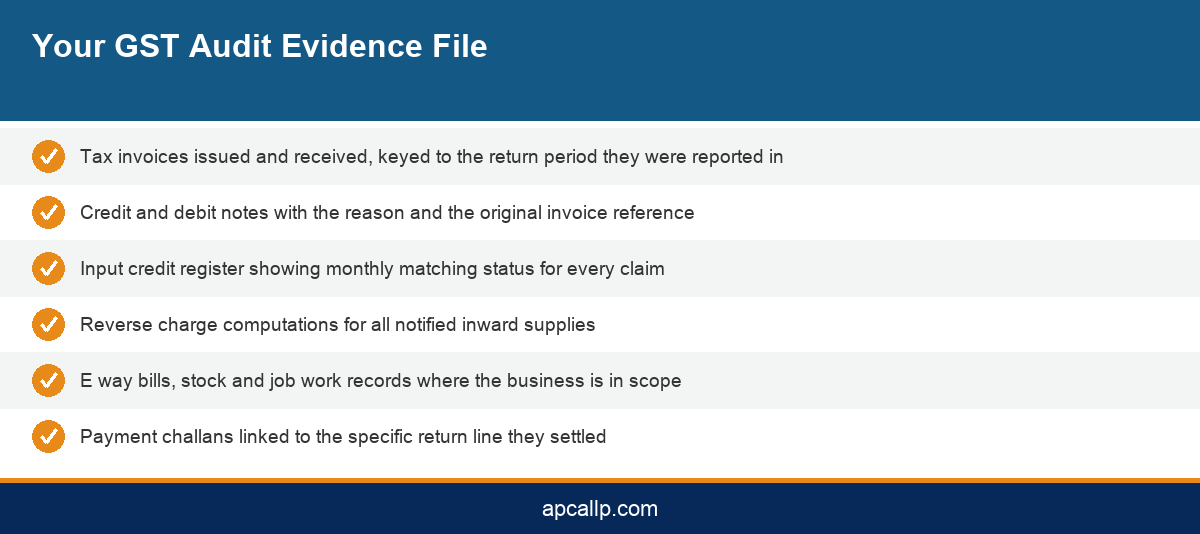
Prepare the evidence file before the reconciliation, not after it. At minimum you need tax invoices issued and received, credit and debit notes, the input credit register with monthly matching status, reverse charge computations, e way bill records where applicable, stock and job work records, and payment challans tied to specific periods.
For businesses holding multiple registrations, the same file must exist separately for each one, keyed to the same accounting period. Consolidated files are useful for management but they do not answer a registration specific query.
The most common failure is not missing documents. It is documents that cannot be tied back to a specific return line. A folder containing every invoice is not evidence if nobody can show which return each invoice was reported in. Build that link at the time of filing. Reconstructing it a year later takes ten times as long and rarely convinces an assessing officer.
Retention format matters as much as retention itself. Scanned copies stored in a structured folder, named consistently and indexed against the return period, satisfy a request in minutes. The same documents sitting in a physical file in another office satisfy nobody within the time allowed. Agree the naming convention once and apply it from the next filing onwards rather than trying to reorganise history.
Departmental Audit Is a Different Exercise
The annual return is self assessment. Departmental audit is examination. Officers issue a notice, request records, and conduct the audit either at your premises or from their office. They can question classification, valuation, place of supply, credit eligibility and reversal, and they can look back across multiple years within the limitation period.
The practical response is procedural rather than technical. Nominate one person to receive and respond to all communication, so that nothing is answered twice or inconsistently. Provide exactly what is asked for and nothing more, because volunteered documents open new questions. Record every submission with a date and keep a copy of what was sent.
Where a position is genuinely debatable, the strength of your case depends on whether the reasoning was documented at the time it was taken. A position defended retrospectively looks like an afterthought regardless of how sound it is. Businesses that have already tightened their compliance advisory framework handle these audits with far less disruption, because the file already exists and simply needs to be produced.
Escalation is also worth planning before it is needed. Know in advance who signs a reply, who approves a concession, and at what point professional representation is engaged. Businesses that decide these things during the audit tend to respond inconsistently across successive letters, and inconsistency is itself treated as a finding.
The Ninety Day Plan Before You File
Work backwards from the filing date in three blocks of thirty days. In the first block, close the reconciliation for every month of the year and list every unresolved difference with an owner against it. This is a data exercise rather than a judgement one, and it can be delegated to whoever maintains the ledgers.
In the second block, resolve what can be resolved. Chase suppliers on unmatched credit, obtain missing invoices, and write the explanation for every difference that will remain. Anything still open at the end of this block is a position rather than an error, and it needs a decision rather than more chasing.
In the third block, review the positions with your adviser, quantify the exposure attached to each, and agree how each will be presented in the reconciliation. Leave the final week clear for the mechanical filing itself, because portal issues near a deadline are common and entirely predictable.
Assign the whole plan to a single owner with a weekly checkpoint. Ninety day programmes fail when they are owned by a committee, because the first thirty day block feels unhurried and the work slips into the second block without anyone noticing. A short weekly review that reports only two numbers, months reconciled and differences still open, keeps the schedule honest without adding reporting overhead.
Businesses that follow this rhythm find the annual return unremarkable. The income tax department portal runs a similar annual rhythm for direct tax, and running both calendars against the same ninety day structure means the finance team prepares once rather than twice.
Conclusion
GST audit compliance rewards businesses that treat reconciliation as a monthly control rather than an annual event. Know whether the reconciliation statement applies to you on a PAN basis across all registrations. Explain every difference between returns and accounts with evidence rather than adjustments. Build the link between each document and each return line while the transaction is still fresh. If your annual return is approaching and your monthly credit matching is incomplete, start there. Talk To Us.