GST Compliance and Corporate Tax Advisory for Indian Businesses
 General
Every growing Indian business eventually discovers that tax is two jobs, not one. Strong GST compliance services keep monthly filings clean and input credit intact. Corporate tax advisory decides how much you legally pay across the year. Treated as separate exercises, they leave gaps that surface during an audit, a funding round or a sale. This guide explains what GST compliance actually covers, which deadlines carry real penalties, how corporate tax sits beside GST rather than inside it, and how a chartered accountancy firm builds a compliance calendar that runs quietly in the background.
Key Takeaways
- GST compliance is a monthly discipline built on registration accuracy, return filing and input tax credit reconciliation, not a year end clean up exercise.
- Corporate tax planning runs on a separate calendar of advance tax instalments, TDS returns and audit obligations that GST filings never touch.
- Businesses in Kochi, Kozhikode and Bengaluru can move both cycles onto one calendar with APCALLP compliance support and keep an audit ready record without hiring a full finance team.
What GST Compliance Covers for Indian Businesses
GST compliance is the full set of obligations that follow from being a registered taxable person. It starts at registration and continues through every invoice, every return and every reconciliation for as long as the registration stays active. Most businesses underestimate the volume of work involved. A single state registration on a monthly filing cycle generates more than twenty statutory actions a year once returns, annual filings and reconciliations are counted. Multi state operations multiply that by the number of registrations held.
The obligations also change as the business changes. Adding a warehouse in another state, launching a second service line, or beginning to export each alter what has to be reported and how. Businesses that treat compliance as a fixed monthly routine tend to keep filing the same way long after the underlying facts have moved on, which is how classification errors quietly accumulate over several years.
Registration and Rate Classification
Registration is not a one time formality. Turnover thresholds, a new place of business, additional verticals and any interstate supply all change what you must register for. Classification matters just as much. Applying the wrong HSN code or rate to a product creates an exposure that compounds every month until somebody catches it. The official GST law reference is the starting point, but real classification decisions usually need professional judgement, particularly for bundled offerings, works contracts and services that sit close to an exemption boundary.
The Monthly and Annual Return Cycle
Most registered businesses file an outward supply return for sales invoices and a summary return through which tax is actually paid, every month. Composition dealers and small taxpayers follow quarterly cycles instead. Above those sits the annual return, and above a turnover threshold, a reconciliation statement comparing the annual return with audited accounts. The GST return filing forms list on the government portal sets out which form applies to which taxpayer category, and the sequence in which they must be filed each period.
Input Tax Credit Discipline
Input tax credit is where most money leaks quietly. Credit is available only when your supplier has actually reported the invoice and paid the tax. If your books claim credit that the portal does not show, the difference becomes a demand later, usually with interest attached. Monthly reconciliation between purchase records and the auto populated statement is the only reliable defence, which is why our team treats GST reconciliation as a monthly control rather than an annual clean up task.
Filing Deadlines and the Real Cost of Missing Them
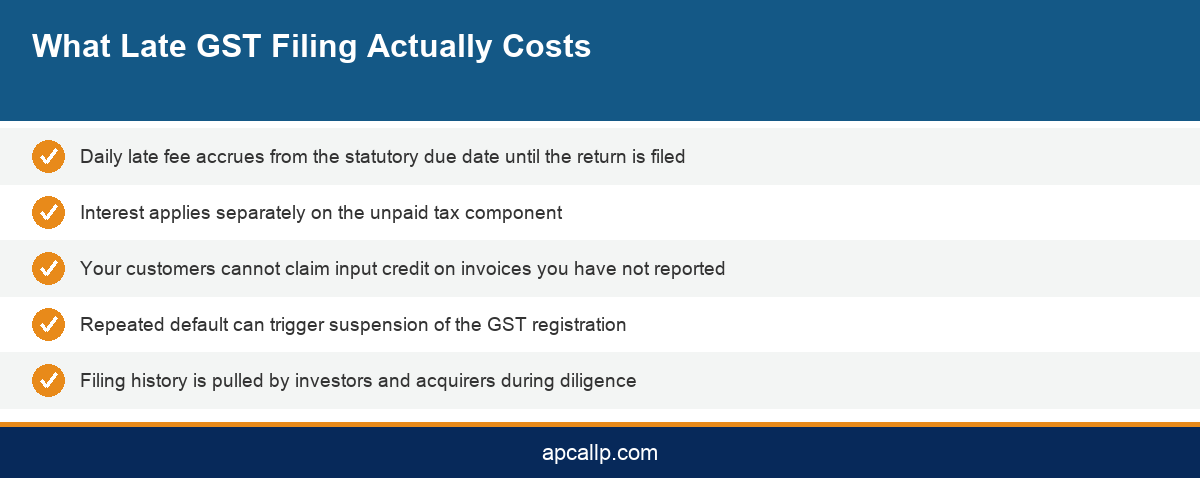
Late filing under GST carries a daily late fee plus interest on the tax outstanding. That is the visible cost, and for most businesses it is the smaller one. The structural cost is larger. A late outward supply return blocks your customer from claiming credit, which turns an internal compliance slip into a commercial problem with the people who pay your invoices. Procurement teams at larger buyers monitor supplier filing status, and repeat offenders lose preferred vendor status.
Repeated defaults can also lead to registration suspension, and a suspended registration stops you from issuing compliant invoices at all. At that point the business is not facing a penalty, it is facing a halt in trading.
There is a third dimension that founders discover late. Investors and acquirers pull the GST filing history during diligence. A pattern of late returns reads as weak financial control even when the tax was eventually paid in full. We have seen this specific issue slow deals and increase indemnity demands, which is why our due diligence red flag work treats filing history as a primary indicator of overall discipline. The practical fix is not heroic effort in the last three days before a deadline. It is a fixed internal cut off, usually five working days ahead of the statutory date, by which sales and purchase data must be closed. That buffer absorbs the errors that always appear, and it converts a monthly scramble into a routine.
The Internal Cut Off That Prevents Late Filing
Set an internal deadline five working days ahead of the statutory date and treat it as immovable. Sales data closes, purchase data closes, and reconciliation begins on that date whether or not every invoice has arrived. Late arrivals move into the following period rather than delaying the return. Businesses that adopt this rule stop missing deadlines almost immediately, because the buffer absorbs the one supplier or the one disputed invoice that would otherwise have held everything up.
How Buyers Monitor Supplier Filing Status
Larger buyers increasingly check supplier filing status before releasing payment, because unreported invoices sit on their books as blocked credit. Procurement teams run this check monthly and escalate repeat offenders. A supplier who files late is not just risking a fee, they are risking the working capital relationship with their biggest customers. This is why filing discipline belongs in the sales conversation as much as in the finance one.
Corporate Tax Compliance Sits Beside GST, Not Inside It
GST is an indirect tax on supply. Corporate tax is a direct tax on profit. They share a data source in your accounting records but almost nothing else. Businesses that assume their GST filings keep them broadly tax compliant are usually surprised by their first assessment notice. The two systems use different periods, different thresholds, different forms and different authorities.
The practical consequence is that a business can be fully current on GST and materially exposed on corporate tax at the same time. Monthly GST filings say nothing about whether advance tax instalments were estimated correctly, whether TDS was deducted at the right rate, or whether the year's provisions will survive an audit. Each of those runs on its own timetable, and each carries its own interest cost when missed.
Advance Tax and TDS
Companies pay tax in instalments through the year rather than in a single payment at the end of it. Missing an advance tax instalment triggers interest even when the final liability is settled on time, and the interest is not recoverable. Separately, every business deducting tax at source carries its own quarterly return calendar, its own certificates and its own correction cycle. Our guide to TDS compliance sets out the deduction categories that generate the most notices, particularly contractor payments and professional fees.
Tax Audit and Assessment
Above prescribed turnover limits a tax audit becomes mandatory and must be certified by a chartered accountant. The audit tests documentation quality as much as arithmetic, and it asks questions the monthly bookkeeping cycle never raises. Businesses that keep clean ledgers through the year finish the audit in weeks. Businesses that reconstruct records afterwards spend months and still carry exposure into the assessment, a pattern covered in our note on tax audit readiness.
Where the Two Systems Actually Meet
There is one important overlap. Turnover declared under GST is compared against revenue in the audited financial statements, and unexplained differences attract questions under both laws. Credit notes, advances, exempt supplies and schedule entries all create legitimate differences. What matters is that each difference has a written explanation prepared when it arose. Businesses that maintain that bridge monthly answer both sets of questions from a single file.
How APCALLP Compliance Support Works
Our compliance support runs on a single calendar that holds both the indirect and the direct tax cycle for each client entity. Each month begins with a structured data request, moves through reconciliation, and ends with a filed return and a short exception report. The exception report matters more than the filing confirmation. It tells the founder what did not reconcile, what it is likely to cost, and what needs a commercial decision rather than an accounting one.
Clients across Kochi, Kozhikode and Bengaluru use the same process, and the same team handles the entity across all of its registrations. That continuity matters for businesses expanding into a second state, because the first interstate registration usually exposes classification decisions that were never properly tested when the business was local. Where a business also needs board and filing support, the same calendar absorbs secretarial compliance obligations so nothing sits in a separate spreadsheet owned by somebody else.
Firms that already have a full finance team often use us as a review layer instead of a preparation layer. In that model the internal team prepares, we review positions and reconciliations before submission, and the quarterly meeting focuses on open exposure rather than on data entry. Both models produce the same artefact: a defensible file that somebody outside the business can follow.
Choosing Between an In House Team and Outsourced Compliance
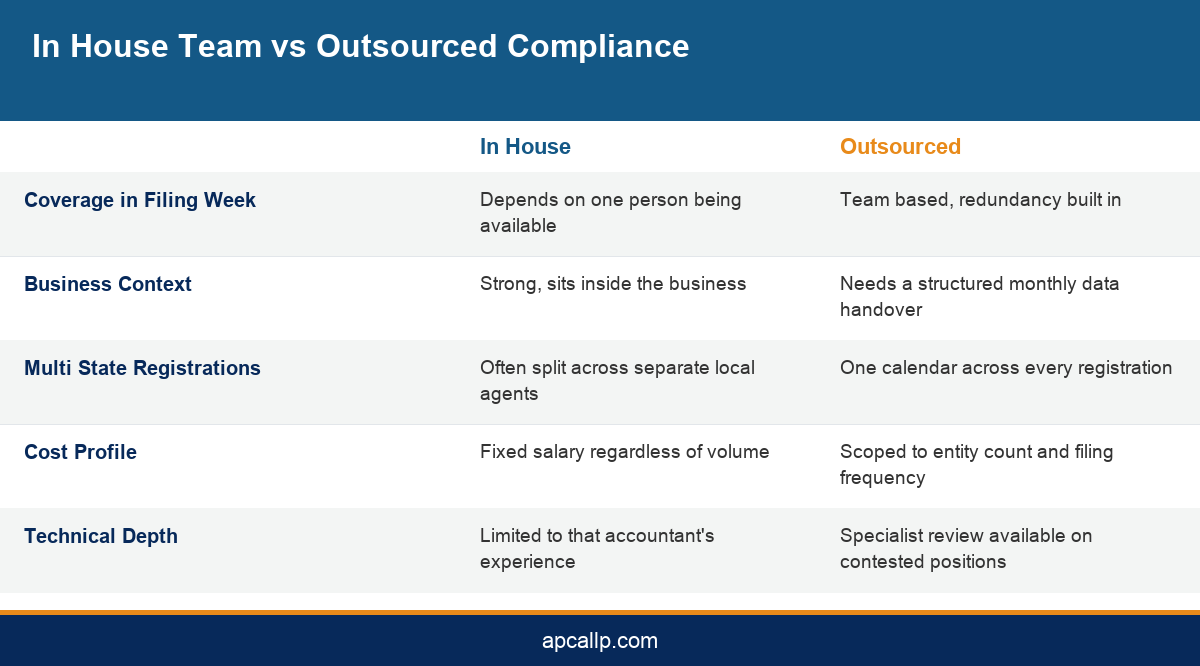
The honest comparison is not cost against cost. It is coverage against cost. A single accountant handling compliance in house is a concentration risk. When that person is unavailable during filing week, the deadline does not move and neither does the penalty. An outsourced team carries redundancy by design, and it carries exposure to how other businesses in the same sector handle the same questions.
In house teams win decisively on context. They know why a particular customer was invoiced late, which purchase was disputed, and what the promoter intends to do next quarter. That knowledge is genuinely hard to transfer in a monthly data handover.
The strongest arrangement in growing companies is usually hybrid. An internal accountant owns day to day records and supplier relationships. An external firm owns the statutory calendar, the reconciliation and the review of any position that carries exposure. That split is close to how our outsourced CFO services engagements are structured for companies that have outgrown a single bookkeeper but cannot yet justify a full finance department with a controller above it.
What the Hybrid Model Looks Like in Practice
The internal accountant maintains the ledgers, raises invoices and manages supplier queries day to day. The external firm receives a defined data pack each month, reconciles it, prepares the return and issues the exception report. Anything with a quantified exposure above an agreed threshold goes to a joint call before filing. The split works because each side does what it is genuinely better placed to do, and the handover point is written down rather than assumed.
The Cost Question, Answered Honestly
A competent compliance accountant costs a full salary regardless of whether the month is busy. An outsourced engagement is scoped to entity count and filing frequency, so it scales with the business rather than ahead of it. For most companies below a certain size the outsourced route costs less and covers more. Above that size the internal team becomes clearly worthwhile, and the external firm shifts from preparation to review.
Compliance Risk Changes with Business Stage
Early stage companies fail on registration and classification. They register later than they should, choose the wrong scheme for their customer base, or misclassify their principal supply because nobody senior reviewed it. The amounts involved are small at the time, but the errors are structural and get repeated every month for years before anyone tests them.
Growth stage companies fail on reconciliation. Transaction volume rises faster than process, input credit mismatches accumulate in the background, and nobody notices until the annual return forces a comparison against audited accounts. This is the stage where most demand notices originate, and it is also the stage where the business is least able to spare the time to fix them.
Established companies rarely miss filings. They fail on positions instead. An aggressive credit claim, a related party transaction priced without documentation, or an incentive claimed without the underlying evidence. These are advisory problems rather than clerical ones, and they surface years after the decision was taken. They are the reason corporate tax planning mistakes tend to be expensive: by the time they are challenged, the same treatment has been repeated across several assessment years.
Recognising which stage you are actually in matters, because the remedy differs completely. An early stage classification error is fixed by a single review and a voluntary correction. A growth stage reconciliation backlog is fixed by process and headcount. An established company's contested position is fixed only by documentation and, sometimes, by litigation.
The mistake we see most often is applying an early stage remedy to a growth stage problem. Businesses hire one more accountant when what they actually needed was a monthly control and an exception report. More hands processing the same unreconciled data produce more filings, not better ones.
Building a Compliance Calendar That Runs Itself
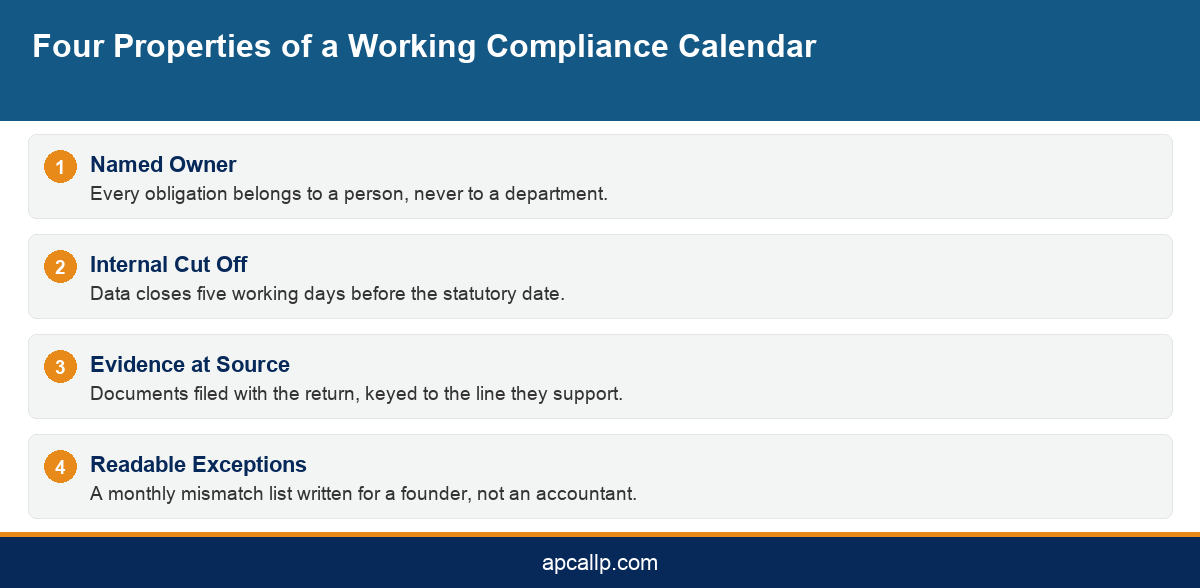
A working compliance calendar has four properties. It names an owner for every obligation, a person rather than a department. It sets an internal date earlier than the statutory date, with enough room to absorb a bad month. It records evidence at the time of filing rather than at audit, keyed to the specific return line it supports. And it produces an exception list that somebody who is not an accountant can read and act on.
Most businesses already have a version of the first two. What they lack is the exception discipline. A filed return with an unexplained mismatch is not compliance, it is a deferred problem with interest running on it. The GST portal user guide documents the mechanics of each return, but the control layer around those mechanics has to be designed for the business and reviewed as the business changes.
Our clients receive that control layer as part of compliance support, along with a quarterly review that looks forward at upcoming obligations rather than backward at filed ones. The forward view is what catches the new warehouse, the new export customer or the new intercompany charge before it becomes a filing question.
The fourth property, readable exceptions, is the one most often missing. Finance teams produce reconciliation working papers that only another accountant can interpret, and the founder signs off without understanding what was actually unresolved. Rewriting that output in plain language takes ten minutes a month and changes who is genuinely accountable for the numbers.
None of this requires software. A shared spreadsheet with owners, internal dates, statutory dates and an exception column outperforms an expensive tool that nobody updates. Buy the tool later if volume justifies it, but design the control first and prove it works manually for a quarter.
When Compliance Becomes a Growth Constraint
There is a point where compliance stops being administrative and starts limiting what the business can do. A company cannot raise institutional capital with unreconciled GST positions on its balance sheet. It cannot complete an acquisition with an unquantified tax exposure sitting in a subsidiary. It cannot expand into a new state confidently without knowing how its supply will be classified there and what that does to pricing.
Recognising that point early is the actual value of good advisory work. Businesses that clean up before they need to raise or sell keep their optionality intact and negotiate from a position of strength. Businesses that clean up under deal pressure lose leverage and frequently accept an indemnity or an escrow they could have avoided entirely with eighteen months of ordinary discipline.
Our transaction advisory team sees both patterns regularly, and the difference between them is almost never technical sophistication. It is whether somebody owned the calendar, wrote down the reasoning, and read the exception report each month.
There is a useful test for founders who are unsure where they stand. Ask how long it would take to produce, for any single month in the last two years, the return filed, the reconciliation behind it, and the explanation for every difference. If the answer is measured in days rather than minutes, the business is carrying diligence risk it has not priced.
Fixing that is rarely dramatic. It usually means back filing the reconciliation for the last four quarters, documenting the three or four positions that carry real exposure, and putting the monthly control in place going forward. The work takes a quarter. The benefit lasts for every conversation with a lender, an investor or an acquirer afterwards.
Conclusion
GST compliance services and corporate tax advisory work best as one calendar with one owner. Returns filed on time protect your customers and your input credit. Advance tax and audit readiness protect your profit. Exception reporting protects you from surprises during diligence. Businesses in Kochi, Kozhikode and Bengaluru work with our team to hold both cycles in a single process, with a quarterly review that looks forward rather than backward. If your filings are current but your reconciliations are not, that is exactly the right time to act. Talk To Us.
Frequently Asked Questions
What do GST compliance services actually include?

How often must a business file GST returns in India?
What happens if a GST return is filed late?
Is corporate tax compliance covered by GST filings?
When does a tax audit become mandatory?
Can a startup outsource all of its tax compliance?
How do input tax credit mismatches arise?
Does compliance history affect fundraising?
Do businesses in Kochi and Bengaluru face different GST rules?
How do I know whether my current compliance is adequate?