GST Return Filing for Proprietorship Firms: Step by Step Guide
 Accounting Services
Proprietorship firms carry the same GST obligations as companies but almost never have the same finance support behind them. GST return filing for proprietorship firms usually falls to the owner, who is also running sales, purchasing and delivery. That is why proprietors miss filing cycles more often than any other entity type in India. This guide sets out exactly which returns apply, what each one asks for, the order to file them in, and the small number of recurring mistakes that cause most proprietorship notices.
Key Takeaways
- A proprietorship files the same core GST returns as a company, but the owner remains personally liable for the tax, the interest and the penalties.
- Choosing between the monthly and quarterly filing option early avoids a mismatch between your filing cycle and the credit expectations of business customers.
- Reconciling purchase records against the portal every month prevents the input credit gaps that produce the majority of proprietorship demand notices.
Which GST Returns a Proprietorship Firm Must File
A registered proprietorship files an outward supply return reporting every sales invoice raised in the period, and a summary return through which the tax is actually paid. Most proprietors also file an annual return consolidating the year. If you opted into the composition scheme the pattern changes to a simpler quarterly statement plus an annual return, and you lose the ability to pass input credit to your customers. The official GST returns help section lists the current form set and who each form applies to.
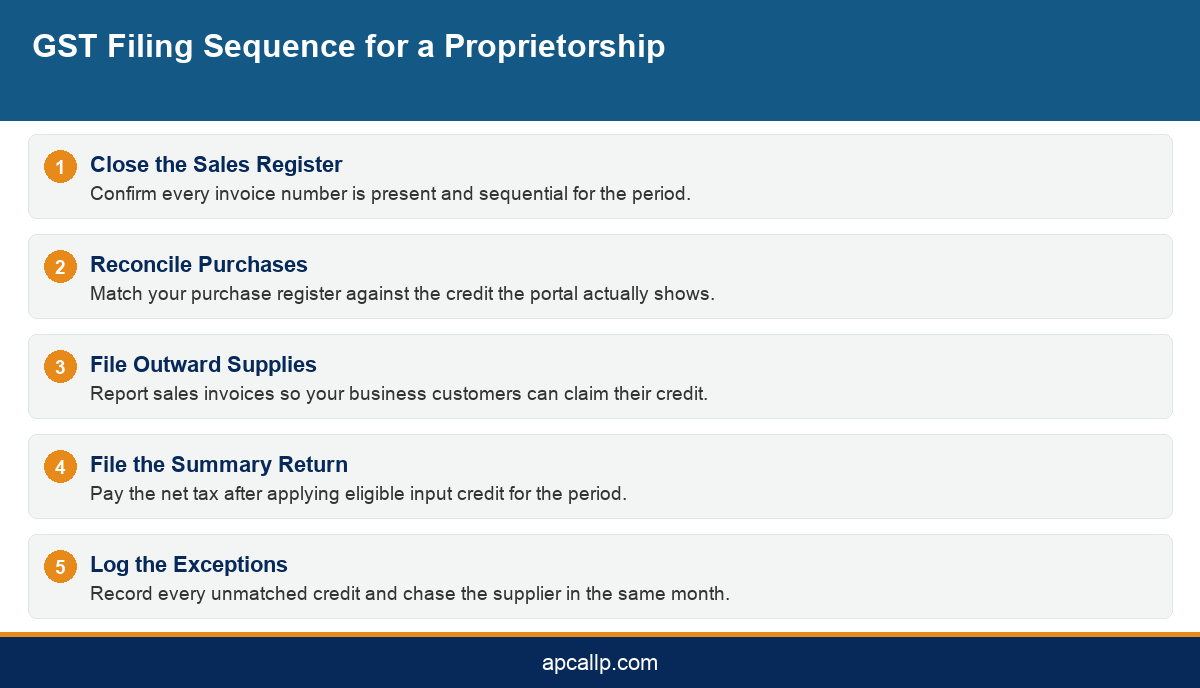
Whichever pattern applies, the sequence matters more than most owners realise. Outward supply data must be filed before the summary return, because the summary return draws on that data and on the credit the portal has made available to you. Filing them out of order, or filing the summary return with incomplete sales data, creates a mismatch that has to be corrected in a later period. Corrections are permitted, but every correction is visible and repeated corrections attract attention during scrutiny.
One more point catches proprietors out regularly. The obligation to file continues even in months with no sales at all. A dormant registration still requires a nil return for every period, and skipping those returns accumulates late fees exactly as a missed active return would. If the business genuinely stops trading, cancel the registration rather than leaving it open and unfiled.
Monthly or Quarterly: Choosing Your Filing Cycle
Small taxpayers can opt for quarterly return filing with monthly tax payment. It reduces the filing workload substantially, but it carries a commercial consequence that is easy to miss when the decision is made.
Your business customers see your invoices in their credit statement only after you have reported them. If you file quarterly and they claim monthly, they wait up to three months for credit on money they have already paid you. Some larger buyers will simply ask you to move to monthly filing, and a few will make it a condition of the purchase order.
The right choice depends on who you sell to. Proprietors selling mainly to consumers rarely face any pressure and benefit clearly from the quarterly option. Proprietors supplying other businesses usually find monthly filing easier commercially even though it is more work each month. Review the decision at the start of each financial year rather than treating it as a permanent setting, because customer mix changes faster than filing habits do.
There is also a cash flow angle worth weighing. Quarterly filers still pay tax monthly, so the option reduces paperwork rather than deferring payment. Proprietors who assume quarterly filing means quarterly payment usually discover the difference in the first month and are caught short. Plan the monthly outflow either way, and treat the filing frequency purely as an administrative choice rather than a funding one.
Preparing Your Data Before You File
Filing is the last ten minutes of the process. The real work sits in the data preparation before it. Close your sales register for the period and confirm that every invoice number is present and sequential. Gaps in numbering attract questions later and are difficult to explain a year afterwards. Then pull your purchase register and compare it line by line against the credit the portal actually shows against your registration.
Anything you have recorded that the portal does not show means your supplier has not reported it, or has reported it under a different registration. Chase it in the same month while the invoice is still recent and the relationship is still active. Credit that stays unmatched past the annual cut off is usually lost permanently, and for a small business that loss goes straight to the bottom line.
This single habit separates proprietors who never receive notices from those who receive them regularly. It is the same discipline our team applies in GST reconciliation work for much larger clients, scaled down to a spreadsheet and an hour a month.
Keep the reconciliation itself rather than only the result. A saved monthly file showing which invoices matched, which did not, and what you did about the gaps is the single most useful document a proprietor can produce if the registration is ever selected for scrutiny. It converts an argument about memory into a conversation about records, and that shift usually decides how quickly the query closes.
Common Mistakes That Cause Proprietorship Notices
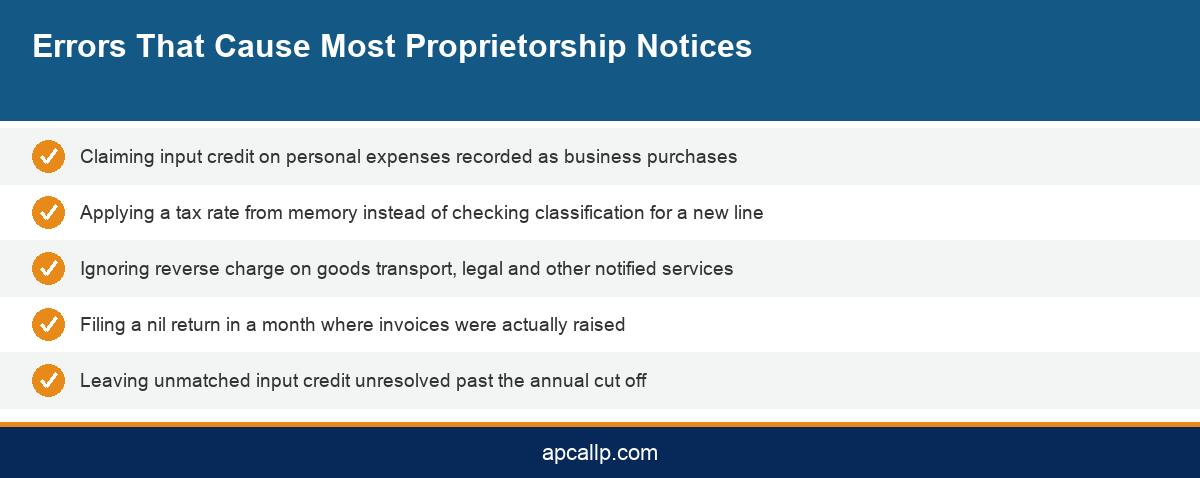
Four errors account for most of the trouble. Treating personal expenses as business purchases and claiming credit on them. Applying a tax rate from memory rather than checking classification when a new product or service line is added. Ignoring reverse charge obligations on notified services such as goods transport or legal fees. And filing a nil return during a quiet month when a small number of invoices were in fact raised.
None of these are technically complex. All of them become expensive once interest and penalty accumulate across several years before anyone reviews the position. The amounts are usually modest per month and substantial in aggregate.
Because a proprietorship has no separate legal identity, the liability lands on the owner personally rather than on a business entity. That is a meaningful difference from every corporate structure and it affects personal assets, not just business ones. Proprietors planning to convert to a company later should fix these positions before conversion rather than after, because the successor entity inherits questions about the predecessor's filings.
A fifth error deserves its own mention because it is entirely avoidable. Many proprietors use a single bank account for business and personal transactions. That makes it almost impossible to demonstrate that a claimed purchase was genuinely for the business. Opening a separate current account costs nothing and removes an entire category of argument during any later examination.
When a Proprietor Should Bring in Professional Support
Three triggers usually justify outside help. Crossing into interstate supply, because place of supply rules change what you charge and to whom. Adding a second product or service line that carries a different rate or a different classification. And approaching the turnover level at which audit obligations and closer scrutiny begin.
Support does not have to mean handing over everything. Many proprietors keep invoicing and record keeping in house and engage a chartered accountancy firm only for monthly reconciliation and a review of the return before submission. That arrangement costs very little and removes the two risks that actually matter: wrong classification and unmatched credit.
Our tax consulting team structures exactly this kind of light touch engagement for proprietors across Kochi, Kozhikode and Bengaluru, and scales it up only when the business genuinely needs more. The point of professional support at this size is not to take work away from the owner. It is to make sure the two decisions that compound over years are made correctly the first time.
A fourth trigger is worth adding for proprietors who sell online. Marketplace platforms deduct tax at source on your behalf and report it separately, which creates a reconciliation your ordinary sales register will not capture. Sellers who ignore that stream routinely under report turnover without intending to, and the mismatch surfaces automatically because the platform has already filed.
Conclusion
GST return filing for proprietorship firms is entirely manageable once the sequence is fixed and the monthly reconciliation habit is in place. File outward supplies first, pay through the summary return, and never let an unmatched credit cross into the next quarter. Choose your filing cycle based on who your customers are rather than on how much effort it saves you. If you are approaching interstate supply or adding a new product line, get the classification reviewed before you invoice, not after. Talk To Us for a proprietorship compliance review.
Frequently Asked Questions
Does a proprietorship need GST registration?

Which GST returns does a proprietorship file?
Can a proprietor file GST returns without an accountant?
What is the composition scheme?
What happens if I file a nil return by mistake?
Is the proprietor personally liable for GST dues?
How do I handle reverse charge as a proprietor?
Should a proprietorship convert to a private limited company?
What records must a proprietorship keep for GST?
How long does a monthly GST cycle take to complete?