Income Tax Filing Consultants: Services, Process and What to Expect
 Accounting Services
Most people engage a filing consultant a week before the deadline and judge them on price alone. Income tax filing consultants actually differ far more in what happens after the return is submitted than in what happens before it. This guide covers what the service includes, which documents are needed, how the process runs from start to finish, what it reasonably costs, and how to choose someone whose capability matches the complexity of your own return.
Key Takeaways
- The value of a filing consultant shows up after submission, when a mismatch or a notice needs somebody to respond on your behalf.
- Complexity rather than income level should determine what you pay, because equity, capital gains and foreign assets each add real work.
- Assembling documents before you engage a consultant shortens the process considerably and usually improves the quality of the return.
What the Service Actually Includes
At minimum, a filing consultant collects your information, determines which return form applies, prepares the computation and submits the return within the deadline. The income tax portal guidance on return applicability sets out which form fits which situation. Choosing the wrong form is a surprisingly common error and it invalidates the filing.
A better service also reconciles your income against what has already been reported to the department by employers, banks and other deductors. Mismatches between your return and those reported figures are the single largest source of automated queries. Catching them before filing is far easier than explaining them afterwards.
The best consultants also handle what comes next, including responding to intimations, correcting mismatches and filing revised returns where necessary. This is where the real difference between providers sits. Ask specifically whether post filing support is included or charged separately.
Some consultants add a short planning conversation before filing, covering deductions you may be entitled to and whether your regime choice still suits you. For most individuals this is a fifteen minute conversation that occasionally saves a meaningful amount. It is worth asking whether it is part of the service.
Business filings work differently, because the return depends on bookkeeping, deductions at source and audit work already completed. For companies this normally sits inside a wider compliance support engagement rather than being bought as a standalone service. Splitting it across providers creates exactly the inconsistency that automated matching is designed to catch.
Documents You Will Be Asked For
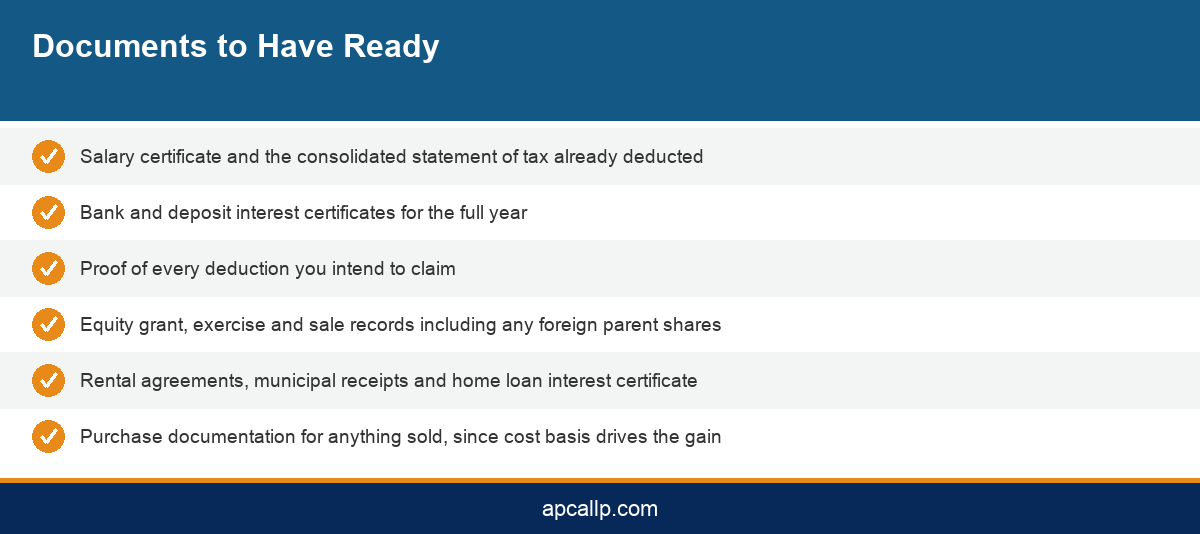
For a straightforward salaried return, expect to provide your salary certificate, the consolidated tax statement showing amounts already deducted, interest certificates from banks, and proof of any deductions you intend to claim. Having these ready before you engage anyone shortens the process considerably.
If you hold equity, add the grant and exercise records, the broker statement for any sales, and the details of any shares held in a foreign parent. Equity is the most common source of error in Indian individual returns, because tax arises at exercise and again on sale, on different bases.
If you own property, add the rental agreements, municipal tax receipts and home loan interest certificate. If you have sold property or securities, add the purchase documentation as well, because the cost basis determines the gain. Missing purchase records is the most frequent cause of last minute delay.
If you hold any foreign assets, including shares, bank accounts or property, say so at the outset. Disclosure obligations apply separately from the tax computation itself, and the consequences of omission are disproportionate to the amounts involved. Consultants who handle this routinely will ask; those who do not may never raise it.
Assemble everything in one folder before you engage anybody, organised by category rather than chronologically. Consultants price partly on how much chasing they expect to do, and a client who supplies a complete set at the outset usually gets both a better fee and a better return. It also removes the last minute scramble that causes most avoidable errors.
How the Process Runs
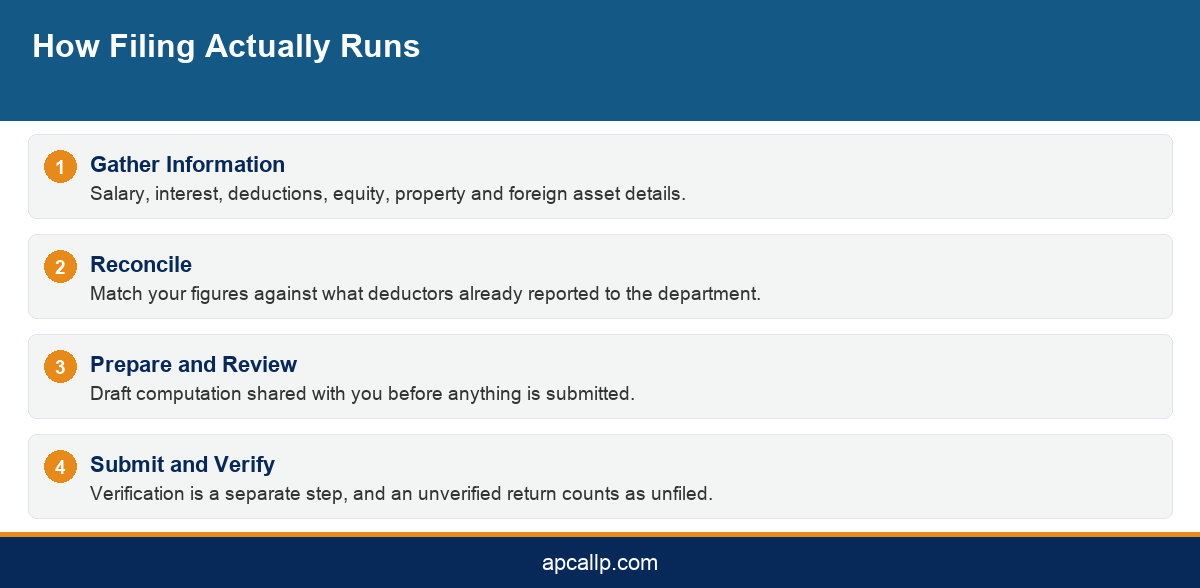
A well organised filing runs in four steps: information gathering, reconciliation against reported figures, preparation and review, then submission and verification. Verification is a separate step from submission and an unverified return is treated as not filed. This trips up a surprising number of people every year.
Expect the consultant to send you a draft computation before filing rather than simply filing on your behalf. Reviewing that draft is your opportunity to catch an omitted income source or a deduction you forgot to mention. Consultants who file without showing you the computation are removing a useful control.
Timelines depend almost entirely on how complete your information is. A simple salaried return can be completed in a day once documents are provided, while a return with equity, property and foreign assets takes a week or more. The delay is almost never the preparation itself.
After filing, keep the acknowledgement, the computation and the supporting documents together. You may need them years later for a loan application, a visa or a query. Consultants should provide all three as a matter of course.
Keep them for the full statutory retention period rather than only until the refund arrives. Queries can be raised several years later, and reconstructing a computation from memory is neither quick nor convincing. A simple folder per assessment year is enough.
What It Should Cost
Individual return preparation is normally a fixed fee scaled by complexity rather than by income. A simple salaried return sits at the bottom of the range and each additional element adds to it. Equity, capital gains, multiple properties and foreign assets are the usual drivers.
Ask whether post filing support is included, because this is where quoted fees most often diverge in practice. A low fee that excludes responding to an intimation is not obviously cheaper than a higher one that includes it. Most people only discover the difference when something goes wrong.
Business returns are usually part of a broader compliance retainer rather than a standalone fee, because the return depends on bookkeeping, TDS and audit work that has already been done. Buying the return in isolation from a different provider rarely works well.
Be cautious about unusually cheap filing services that ask few questions. A consultant who does not ask about equity, foreign assets or property is not going to catch the errors that matter. The fee saved is small relative to the cost of a mismatch pursued three years later.
Choosing a Consultant for Your Situation
Match the consultant to the complexity of your return rather than to convenience. A high volume filing service is entirely adequate for a simple salaried return and a poor choice for one involving equity and foreign assets. Being honest about your own complexity is the first step.
Ask directly how many returns like yours the consultant handled last year. Someone who files hundreds of straightforward returns and a handful of complex ones will process yours competently but is unlikely to spot the unusual point.
Ask what happens if an intimation or a notice arrives after filing. The answer should be specific about who responds, how quickly and at what cost. Vague answers here reliably predict an unwelcome conversation later.
Finally, ask whether they will share the computation before filing and provide the full document set afterwards. Both are basic professional practice and both are occasionally missing. If you want to discuss a return involving equity or foreign assets, our contact page lists all three offices.
Conclusion
Income tax filing consultants differ most in what they do after submission rather than before it. Assemble your documents early, disclose equity and foreign assets at the outset, and insist on seeing the computation before the return is filed. Match the consultant to the complexity of your situation rather than to price, and confirm whether post filing support is included. If your return involves equity, capital gains or assets held abroad, Talk To Us.
Frequently Asked Questions
What do income tax filing consultants actually do?

Which documents will I need to provide?
Why are equity holdings such a common source of error?
What happens if I have foreign assets?
Is submitting the return the final step?
Should I see the computation before filing?
How much should filing cost?
What is post filing support?
Can businesses buy filing in isolation?
How do I choose for a complex return?