Tax Consulting and Advisory Services in Bengaluru: A Guide for Growing Companies
 Accounting Services
Growing companies in Bengaluru consume tax advice unevenly, with long quiet periods interrupted by intense demand around funding, hiring and expansion. Tax consulting and advisory services in Bangalore therefore need to be scoped for that rhythm rather than for a steady monthly workload. This guide covers what growing companies here actually need from an adviser, where the recurring exposures sit, how diligence changes the requirement, and how to structure the relationship so the advice arrives before the decision rather than after it.
Key Takeaways
- Bengaluru's advisory demand is lumpy rather than steady, concentrated around funding rounds, hiring waves and any expansion outside India.
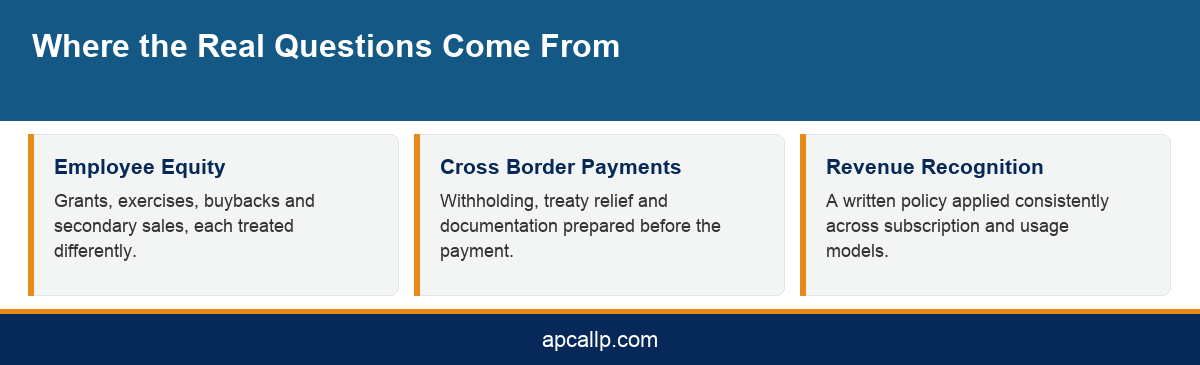
- Equity, cross border payments and revenue recognition account for most of the tax questions that actually matter to growing companies here.
- Advisory that arrives after a decision has been made is documentation, not advice, so build a pre decision review habit into the relationship.
What Growing Companies Here Actually Need
The recurring compliance calendar for a Bengaluru technology or services company is usually straightforward, covering advance tax, TDS returns, the annual return and a tax audit above thresholds. None of it requires much judgement once the process is established. The demanding work sits entirely in the decisions taken between those filings.
Employee equity generates the largest volume of questions, because option grants, exercises, buybacks and secondary sales each carry a different treatment. Errors made when the pool was first created become expensive at the next round, when investors examine the cap table properly. This is the single most common area where early informality creates later cost.
Cross border payments generate the second largest volume, covering software licences, professional services, parent company charges and remittances. Withholding obligations, treaty relief and documentation all apply, and the rules reward getting the paperwork right before the payment rather than afterwards. The RBI master directions set out the exchange control framework those payments sit within.
Revenue recognition is the third, particularly for subscription, multi year and usage based models. The company needs a written policy applied consistently, because investors and auditors will both test whether it has been. Changing the policy retrospectively is possible and always uncomfortable.
A fourth area appears once the company has staff in more than one state, which happens earlier in Bengaluru than most founders expect. Professional tax, labour registrations and payroll withholding all vary by state, and each obligation is small enough to be forgotten individually. Collected on one calendar they are trivial, and scattered across providers they become diligence findings.
Why Advisory Demand Is Lumpy in Bengaluru
A growing company can go two quarters needing nothing beyond routine compliance and then need three weeks of concentrated advisory attention in a single month. Funding rounds, acquisitions, ESOP refreshes and entry into a new market all arrive with short notice and hard deadlines. A retainer designed for a steady workload handles this badly.
The practical answer is to agree the arrangement for peak periods at appointment rather than during one. Some firms offer a fixed diligence support fee, others charge hourly, and either works provided it was settled before the term sheet arrived. Negotiating scope while investor counsel is waiting is the worst possible moment.
It also helps to give the adviser advance notice of what is coming, even informally. A firm that knows a round is likely in the next quarter can prepare the documentation that always gets requested. That preparation is inexpensive in advance and expensive under time pressure.
Finally, accept that some months you will pay for advice you did not use. The alternative, engaging an adviser only when something has already gone wrong, is reliably more expensive. Companies that treat advisory as insurance rather than as a transaction get better outcomes from the same spend.
There is a practical way to smooth the peaks without overpaying. Agree a base retainer covering the calendar and a pre agreed day rate for everything else, then review the balance annually against what was actually used. That structure keeps the adviser engaged without forcing you to buy capacity you do not need every month.
Diligence Changes What You Need
The moment a funding round or an acquisition begins, the requirement shifts from compliance to evidence. Investors and acquirers do not ask whether you filed, they ask you to prove what you filed and to explain every difference. Companies discover the state of their own records at exactly this point.
The documents requested are predictable, covering filed returns, reconciliations, the cap table with supporting resolutions, employment and contractor arrangements, related party transactions and any correspondence with authorities. Our note on the ten financial documents investors expect sets out the list in detail.
What slows diligence is rarely a bad position and usually a missing explanation. A difference between GST turnover and audited revenue is entirely normal, and an unexplained one becomes a question that consumes days. Preparing those explanations in advance shortens the process substantially.
The commercial consequence of poor preparation is not usually a failed round. It is a larger indemnity, a bigger escrow or a delayed close, all of which cost real money. Advisers who have supported several rounds know which items attract attention and prepare for them by default.
Our note on why investor confidence drops once diligence starts describes how quickly a well received company can lose momentum. The trigger is almost always a document that should have existed and did not, rather than a substantive problem with the business itself.
Structuring the Adviser Relationship
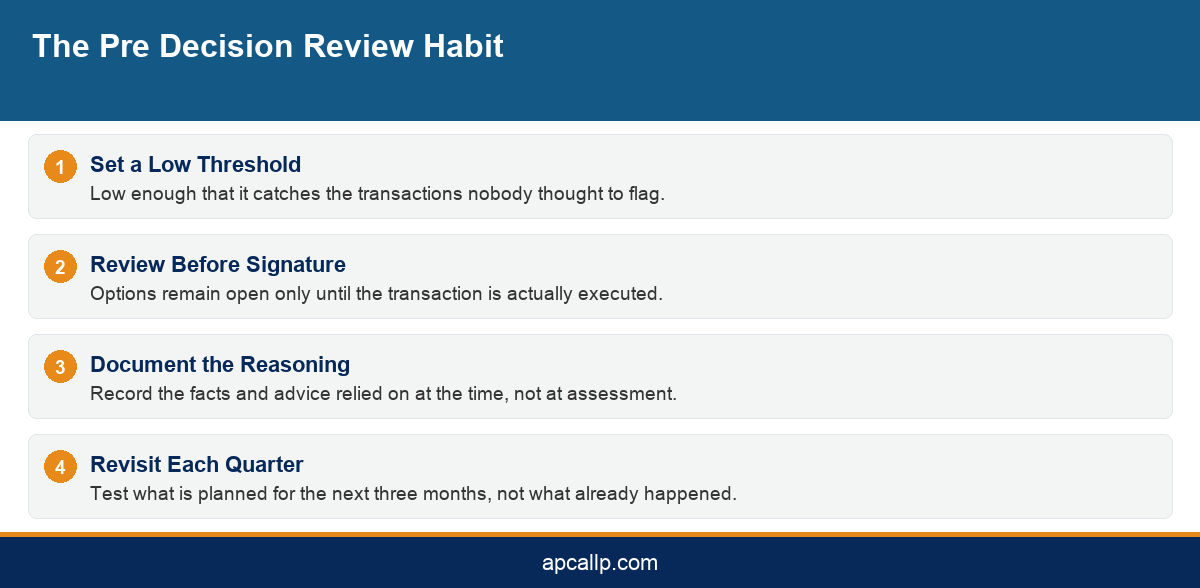
Agree a pre decision review habit at the start, defining a threshold above which any transaction gets a tax review before signature. Set it low enough that it actually catches things, because most companies set it so high that only obvious transactions qualify. The review usually takes days and the alternative takes years to unwind.
Name the people on both sides. One person in the company owns the relationship and one person at the firm owns the account, with a reviewing partner above them. Relationships without named owners default to whoever is available, which produces inconsistent advice.
Set a quarterly rhythm that looks forward rather than backward. The meeting should cover what is planned for the next three months and what it implies, not what happened in the last three. This is the single change that most improves the value companies get from their advisers.
Finally, insist on a written position file for anything contested. Positions defended retrospectively rarely convince an assessing officer regardless of their technical merit. Our tax consulting engagements build that file as part of the routine rather than as a separate exercise.
Choosing an Adviser in a Crowded Market
Bengaluru has more firms than any city in South India, and credentials are broadly comparable across most of them. The differences that matter are sector familiarity, diligence experience and who actually does the work. Ask about all three explicitly rather than reading the service list.
Ask how many funding rounds the firm supported in the last year and request a reference from one of those companies. Ask that reference how many surprises appeared late in the process. A well prepared adviser produces findings early, and late surprises usually indicate weak planning rather than complex facts.
Test responsiveness before signing rather than after. Send a genuine question and see how long a considered answer takes to arrive. Two working days for something substantive is a reasonable benchmark, and firms that are slow while selling rarely improve afterwards.
Finally, ask what the firm would want to fix in your first ninety days given what they have seen. A specific answer means they have read your records, and a general one means they have not. Our Bengaluru office details are on the contact page if you want to run that question past us.
Conclusion
Tax consulting and advisory services in Bengaluru work best when they are scoped for lumpy demand rather than steady workload. Get equity, cross border payments and revenue recognition right early, because all three become expensive to correct once investors are involved. Agree the diligence arrangement before a term sheet arrives, and build a pre decision review habit with a threshold low enough to matter. If you want a straight assessment of where your current arrangement leaves gaps, Talk To Us.
Frequently Asked Questions
What do growing companies in Bengaluru need most from a tax adviser?

Why is advisory demand described as lumpy?
How should diligence support be priced?
What slows a diligence process down most?
What does poor diligence preparation actually cost?
What is a pre decision review threshold?
Why do ESOP errors become expensive later?
How do cross border payments create risk?
How do I test an adviser before appointing?
What should the quarterly meeting cover?