Tax Consulting and Advisory Services in Kerala: What Kochi and Kozhikode Businesses Need
 Accounting Services
Kerala businesses face a tax environment shaped by trade, export and a large base of family owned companies rather than by venture capital. Tax consulting and advisory services in Kerala therefore look different from the same service elsewhere in India, with more weight on indirect tax, assessment support and structure. This guide covers what Kochi and Kozhikode businesses actually need, where the recurring exposures sit, and how to judge whether your current advisory arrangement is doing the work it should be.
Key Takeaways
- Kerala's business base is dominated by trading, export and family owned companies, which shifts advisory weight towards indirect tax and structure rather than funding readiness.
- The most common recurring exposure in the state is input credit claimed in the books but never matched against what suppliers actually reported.
- Advisory value in this market shows up as fewer assessments and cleaner records, not as aggressive positions or headline tax savings.
What Kerala Businesses Actually Need From Tax Advisory
The dominant need across Kochi and Kozhikode is indirect tax that is handled correctly the first time, because trading businesses make classification decisions on every invoice. A single wrong rate or place of supply decision repeats monthly and compounds for years before anybody tests it. Correcting it later costs far more than getting it reviewed once at the outset.
The second need is assessment support, which is different from filing and much less commonly available. When a notice arrives somebody has to draft the reply, assemble evidence from several years ago and appear if a hearing is called. Businesses discover the difference between a filing practice and an advisory practice at exactly that moment.
The third is structure, particularly for family owned companies where personal and business assets have merged over decades. Property held personally but used by the business, informal loans between family members and undocumented ownership all create tax and commercial problems. None of them are urgent until a sale, a loan application or a succession makes them urgent simultaneously.
The fourth is export and refund handling for the substantial number of Kerala businesses selling outside India. Refund delays are a working capital problem rather than a compliance one, and they are usually caused by document mismatches. Advisers who handle exports routinely build that documentation discipline in from the first shipment.
Where the Recurring Exposures Sit
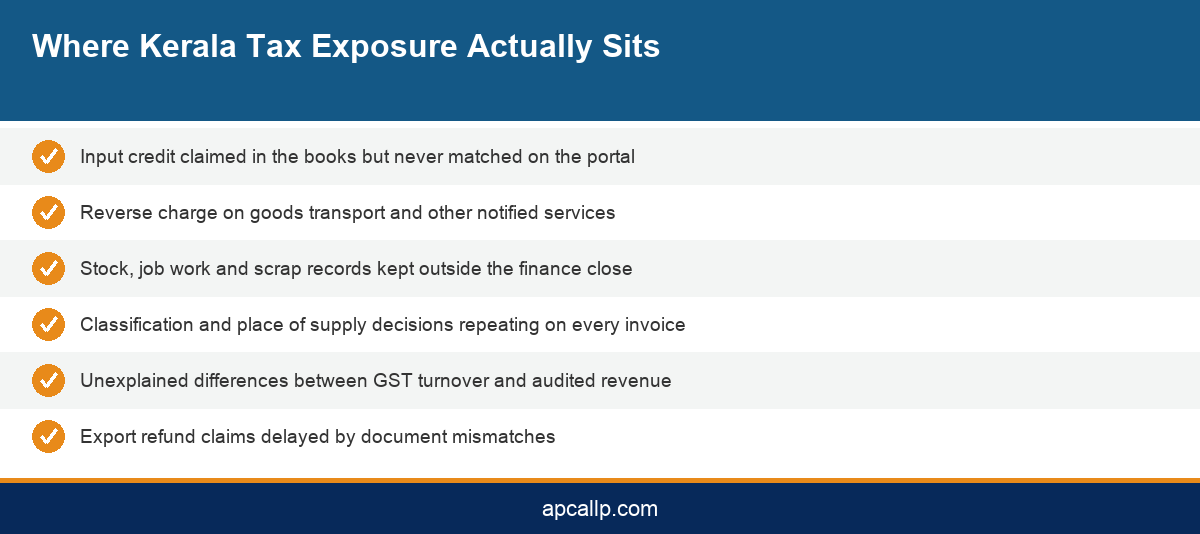
Input tax credit is the largest single exposure in this market, because credit is available only where the supplier has actually reported and paid. Books that claim credit the portal does not show create a difference that becomes a demand later with interest attached. The gap is invisible in any single month and substantial across a year.
Reverse charge on goods transport is the second, and it is missed constantly in trading and manufacturing businesses. The monthly amounts are small enough to attract no attention, which is exactly why several years accumulate before anybody checks. A standing item in the monthly close removes the entire category.
Stock and job work records are the third, particularly in manufacturing units where those records are maintained by production staff rather than finance. Goods sent for processing, returned short and scrap generated all have specific treatment. Bringing these into the monthly close is usually the fastest available reduction in assessment exposure.
The fourth is the bridge between GST turnover and audited revenue, which is compared under both laws. Legitimate differences exist and each one needs a written explanation prepared when it arises. The GST returns help section documents the filing mechanics, but the reconciliation discipline has to be designed for the business.
Family Owned Businesses and Structure
A large share of Kerala's established businesses are family owned across two or three generations, profitable, and considerably under documented. The accounts were built for tax purposes and were never designed to be read by a bank, a partner or a buyer. That is the single most common constraint on what these businesses can do next.
The technical work of fixing it is manageable rather than difficult, covering the holding structure, the separation of personal and business assets, and proper documentation of what the business actually owns and owes. The difficult part is sequencing, because many options are only available before a transfer rather than after it.
Personal use of business property deserves particular attention, since a building owned personally and used by the business without documentation complicates both the tax position and any future sale. Regularising it is straightforward while everybody agrees and awkward once they do not. It should be dealt with well before any transaction is contemplated.
Our startup and business advisory work applies the same structural thinking to established family businesses as to new ones. The underlying question is identical in both cases. Is this business in a form that somebody else could buy, fund or inherit without needing to rebuild it first.
What Good Advisory Looks Like in Practice
Good advisory in this market produces fewer assessments rather than lower headline tax, and that distinction is worth being explicit about. Advisers promising unusual savings are generally proposing positions that will be challenged. Advisers producing clean records and documented reasoning are reducing risk you can actually measure.
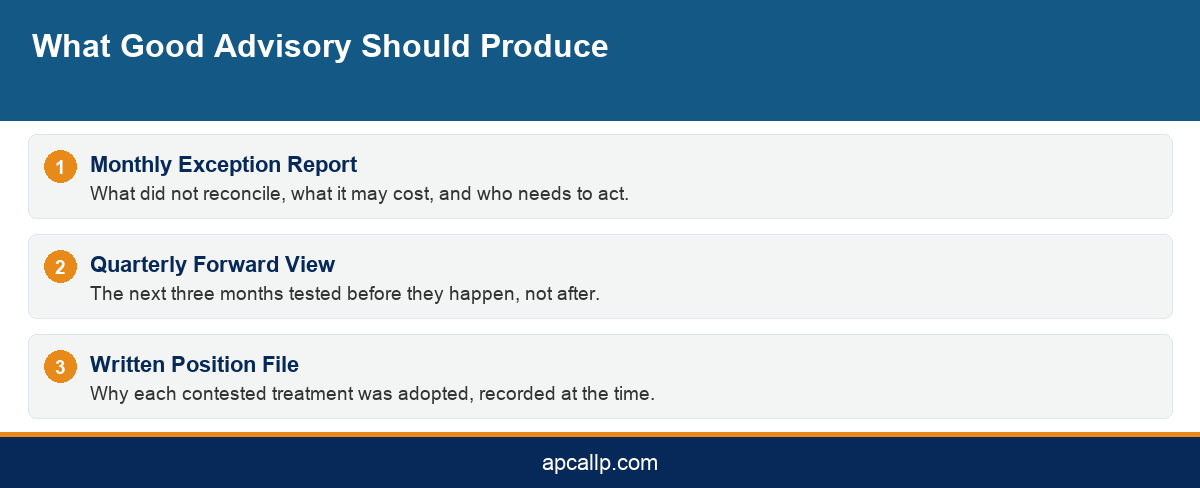
The practical output should be a monthly exception report rather than a filing confirmation. It should list what did not reconcile, what it is likely to cost, and who needs to act on it. A business that receives this every month knows its position, and a business that receives only confirmations does not.
The second output is a quarterly forward view covering the next three months rather than the last three. New locations, planned capital expenditure, a first export order or a change in group structure all get tested before they happen. That is where the real value sits, because the options are still open.
The third is a written position file recording why any contested treatment was adopted, with the facts and advice relied on. Positions defended retrospectively rarely convince an officer regardless of how sound they are. Positions documented at the time usually close a query in a single exchange.
None of these three outputs are expensive to produce once the routine exists. What they require is a firm that treats reconciliation as a monthly control rather than an annual project, and a client who reads what arrives.
Assessing Your Current Arrangement
There is a simple test for any Kerala business unsure whether its current advisory arrangement is adequate. Ask for last month's reconciliation rather than last month's filing confirmation. If nobody can produce a list of unmatched items with explanations, the process is filing on time without being in control.
A second test is to ask how long it would take to produce, for any single month in the last two years, the return filed, the reconciliation behind it and the explanation for every difference. An answer measured in days rather than minutes indicates diligence risk that has not been priced.
A third is to ask when your adviser last raised something before you asked about it. Advisory relationships that only respond are compliance relationships with a different name. The forward view is the part you are actually paying a professional for.
If those three tests produce uncomfortable answers, the fix is usually a quarter of work rather than a change of firm. Back fill the reconciliation for the last four quarters, document the positions that carry real exposure, and put the monthly control in place. Our Kochi and Kozhikode offices handle exactly this kind of remediation regularly.
Conclusion
Tax consulting and advisory services in Kerala earn their fee through fewer assessments and cleaner records rather than through aggressive positions. Get indirect tax classification reviewed once at the outset, build a monthly reconciliation habit, and document contested positions when you take them. Family owned businesses should deal with structure and property before a transaction rather than during one. If your filings are current but your reconciliations are not, that is the right moment to act. Talk To Us.
Frequently Asked Questions
What do tax consulting and advisory services in Kerala cover?

What is the most common tax exposure in Kerala businesses?
Why does reverse charge get missed so often?
How should stock and job work records be handled?
What structure issues affect family businesses here?
Does good advisory reduce the tax I pay?
What should I receive from my adviser each month?
How do export refunds get delayed?
How do I test my current arrangement?
Can one firm cover Kochi and Kozhikode?