Introduction
Financial advisor compliance services in India are undergoing a structural shift.
Traditionally viewed as regulatory and reporting functions, they are now central to enterprise decision-making, valuation integrity, and capital readiness. Businesses that fail to integrate compliance with financial planning often face three systemic risks:
- fragmented financial visibility
- delayed strategic decisions
- reduced investor confidence
A service-based company in India encountered exactly this situation.
Despite steady revenue growth, the company struggled with decision clarity, valuation alignment, and structured financial planning. Leadership relied on historical reporting, but lacked forward-looking financial intelligence—making it difficult to answer critical questions:
- What is the true valuation of the business?
- How sustainable is current growth?
- What happens under different market scenarios?
- Is the company ready for due diligence?
This is where APCALLP stepped in—not as a compliance vendor, but as a financial strategy partner delivering CFO consulting, valuation expertise, and investment readiness advisory.
Case Overview
Business Type: Private Limited Company
Location: India
Industry: Service-Based Business
Engagement Type: Financial Modelling & Projections
Problem Summary: Absence of a structured financial model to support growth planning, investment evaluation, and stakeholder communication
The engagement was designed as a multi-layered financial transformation initiative, integrating:
- financial modelling
- compliance structuring
- valuation frameworks
- due diligence preparation
- CFO-level strategic planning
Unlike traditional ca firms in Kochi, Ernakulam, or Bangalore, which operate in silos (audit, tax, compliance), APCALLP approached the problem as an integrated financial system design challenge.
Core Challenges | Structural Gaps in Financial & Compliance Systems
Absence of Financial Architecture | Beyond Accountant Consulting
The company operated without a defined financial architecture.
Data existed across multiple systems but lacked relational integrity—meaning assumptions, revenues, costs, and outputs were not interconnected.
In financial terms, this creates what is known as a non-cohesive financial model environment, where:
- outputs cannot be traced back to assumptions
- scenario testing becomes unreliable
- forecasting accuracy declines significantly
This is a common limitation in businesses relying only on traditional accounting services or fragmented CFO outsourcing companies.
Incomplete Compliance Integration | Financial Advisor Compliance Services in India Gap
Compliance activities were performed, but not systematized.
From a regulatory standpoint, effective financial advisor compliance services in India require integration across:
- SEBI advisory frameworks
- GST and direct tax systems
- corporate governance structures
- audit and reporting protocols
In this case, compliance operated in isolation, increasing the risk of:
- regulatory inconsistencies
- audit inefficiencies
- delayed due diligence readiness
Lack of Valuation Framework | Investment Valuation Deficiency
The company had no formal valuation model.
From a corporate finance perspective, valuation is not a static number—it is a function of assumptions, risk, growth expectations, and capital structure.
Without structured valuation methods such as:
- Discounted Cash Flow (DCF)
- Comparable Company Analysis
- Scenario-based valuation modelling
the company could not define its investment value proposition or financial advisor value proposition, limiting its ability to attract investors.
Reactive Decision-Making | Failure of Structured Financial Planning
The absence of structured planning meant decisions were made based on:
- historical performance
- intuition
- short-term cash visibility
Research in financial strategy consistently shows that organizations without structured financial planning frameworks exhibit higher volatility in performance and lower capital efficiency.
This directly impacted the company’s investment readiness level and long-term scalability.
APCALLP Approach | Financial Clarity Through Structured Planning
Designing a Financial Decision System | CFO Consulting Framework
APCALLP reframed the engagement.
Instead of “building a model,” the focus shifted to designing a financial decision system—a structured environment where:
- every financial output is traceable
- every assumption is measurable
- every decision is scenario-tested
This aligns with global best practices in CFO consulting firms and corporate finance advisory.
Assumption-Led Modelling | Foundation of Financial Accuracy
A centralized assumptions engine was created.
This included:
- revenue drivers (pricing, volume, growth rates)
- cost structures (fixed vs variable segmentation)
- working capital cycles (receivables, payables, inventory)
- capital expenditure planning
Research-backed financial modelling principles show that centralized assumptions reduce modelling errors by up to 60–70% and significantly improve auditability.
Integrated Three-Statement Model | Core Financial Intelligence System
The model linked:
- Profit & Loss → profitability
- Balance Sheet → financial position
- Cash Flow → liquidity and sustainability
This integration enables:
- real-time financial consistency
- dynamic scenario testing
- alignment with due diligence & transactional services expectations
Scenario Planning & Sensitivity Analysis | Managing Uncertainty
APCALLP implemented structured scenario modelling.
This allowed the business to evaluate:
- best-case growth scenarios
- downside risk scenarios
- capital requirement variations
Scenario planning is a core component of investment readiness advisory, as investors evaluate not just projections—but resilience under uncertainty.
Compliance as a System | Financial Advisor Compliance Services in India
Instead of treating compliance as a checklist, APCALLP embedded it into the financial model.
Key compliance areas include:
- SEBI Compliance: Structured advisory policies, documentation standards, and governance frameworks
- Tax Compliance: Integrated GST systems, TDS tracking, and audit readiness
- Regulatory Support: Continuous compliance monitoring and reporting frameworks
- Corporate/Secretarial Compliance: Company law, RBI regulations, and governance alignment
- Investment Readiness Compliance: Financial transparency, documentation, and audit preparedness
This transformed compliance from a cost center into a strategic enabler of credibility and valuation.
Investment Readiness Advisory | Converting Potential into Capital
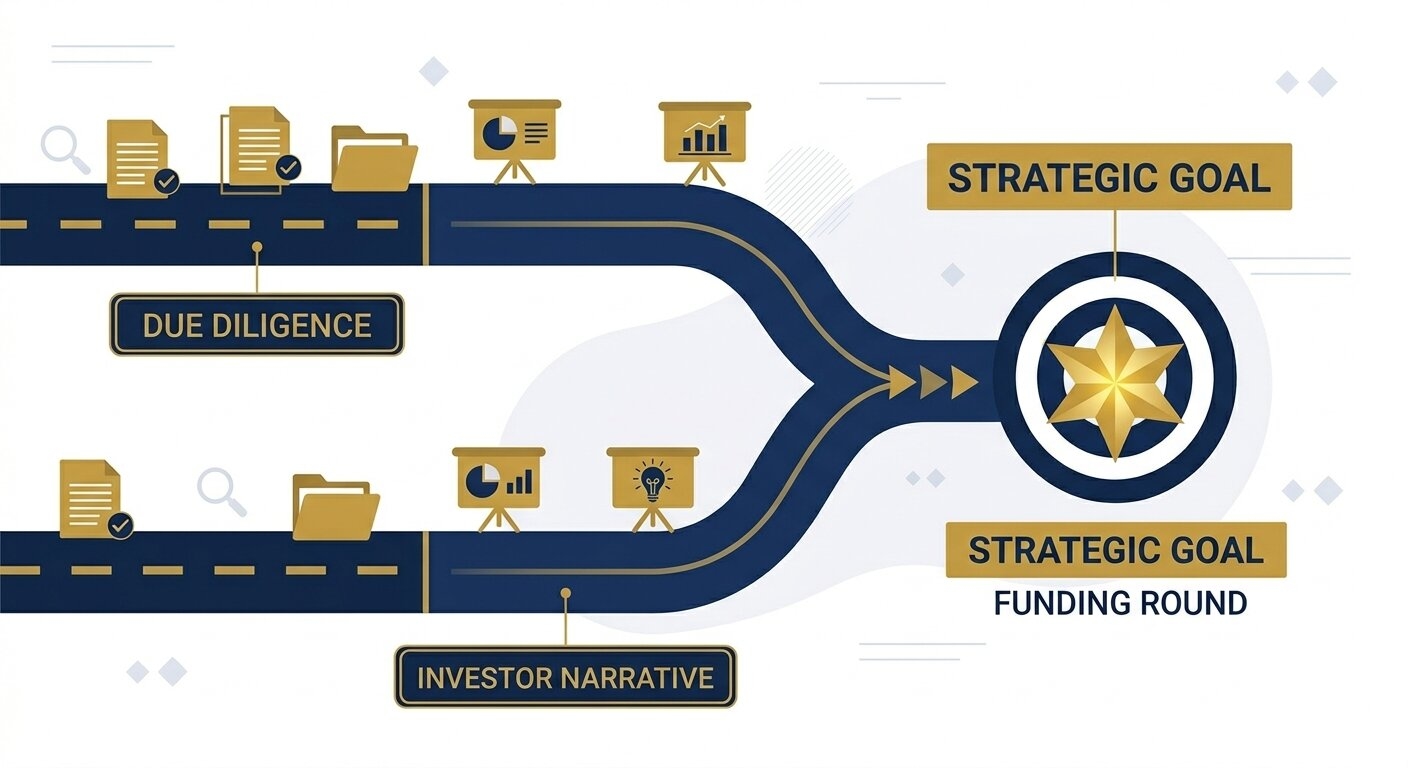
Investment readiness advisory is not a single activity—it is a multi-dimensional transformation process.
It helps businesses structure:
- financial systems
- compliance frameworks
- valuation narratives
- investor communication
So they can effectively attract and secure funding.
Key Components of Investment Readiness Advisory
Financial Modeling & Valuation
- Development of realistic projections.
- Validation of key metrics.
- Application of valuation methods to determine corporate valuation and investment valuation benchmarks.
Due Diligence Readiness
- Preparation of audit-ready financials.
- Creation of structured data rooms.
- Alignment with due diligence & transactional services requirements.
Pitch Deck & Narrative Construction
Translation of financial data into a compelling narrative.
Definition of:
- investment value proposition
- total value proposition
- financial advisor value proposition
Growth Strategy & Operations
- Alignment of financial planning with operational execution.
- Identification of scalable milestones and efficiency improvements.
Fundraising Structuring
- Understanding investor expectations.
- Structuring funding rounds.
- Managing term sheet evaluation and negotiation frameworks.
Benefits of Investment Readiness Advisory
Increased Credibility
Before APCALLP’s intervention, the client faced difficulty presenting financials in a way that stakeholders could trust. The absence of a structured, assumption-driven model meant that projections appeared inconsistent and lacked professional depth. Through the implementation of an integrated financial model and aligned financial advisor compliance services in India, the business was able to present:
- clearly linked assumptions and outputs
- audit-ready financial statements
- a defined financial advisor value proposition
This significantly improved how investors and lenders perceived the business, shifting conversations from validation of numbers to evaluation of growth potential.
Faster Closing Time
During early stakeholder discussions, the client experienced delays due to incomplete financial information and the inability to respond quickly to investor queries. Without a structured model, every revision required manual effort and rework. APCALLP addressed this by building a transparent, Excel-based model aligned with due diligence & transactional services expectations, which included:
- ready-to-use financial projections
- scenario-based outputs for quick comparisons
- structured data suitable for investor review
As a result, the client was able to respond faster during discussions, reduce back-and-forth communication, and move stakeholder conversations forward with greater efficiency.
Optimal Valuation
Initially, the client lacked clarity on how to evaluate business performance under different growth scenarios, making it difficult to justify valuation expectations. With APCALLP’s structured financial modelling approach, the business gained a clearer understanding of its financial position through:
- IRR and return evaluation frameworks
- scenario-based investment valuation analysis
- alignment with corporate valuation and financial planning value proposition
This allowed the client to approach investor discussions with data-backed confidence, ensuring that valuation was supported by realistic assumptions rather than estimates, thereby improving negotiation strength.
Gap Identification
One of the key challenges before the engagement was the lack of visibility into financial and operational gaps. Without structured modelling, issues such as cash flow inefficiencies, cost assumptions, and working capital constraints remained hidden. Through the development of a detailed financial architecture and scenario analysis, APCALLP enabled early identification of:
- working capital gaps and liquidity risks
- cost structure inefficiencies
- unrealistic growth assumptions
This proactive insight, supported by strategic consulting and financial diagnostics, allowed the client to address internal weaknesses before presenting the business to investors, resulting in stronger and more reliable stakeholder discussions.
Structured Financial Planning | Driving Decision Clarity
Structured planning transforms finance from reporting to strategy.
Key Elements of Structured Financial Planning
Centralized Assumptions
Dedicated input systems reduce errors and improve model flexibility.
Cash Flow Systems
Clear tracking of inflows and outflows enables liquidity management and capital planning.
Scenario Planning & Forecasting
Multi-path modelling prepares businesses for uncertainty and volatility.
Supporting Schedules
Detailed schedules for revenue, debt, and capital expenditure improve accuracy and traceability.
Driving Decision Clarity
Prioritizing Structure Over Volume
Before engaging APCALLP, the client had access to financial data but lacked structure, which made decision-making slow and inconsistent. Large volumes of disconnected reports did not translate into actionable insights. Through structured financial modelling and CFO consulting, APCALLP introduced an assumption-driven architecture where every number was linked to a defined business driver. This approach, aligned with financial advisor compliance services in India, ensured that management no longer relied on scattered spreadsheets. Instead, they worked with a centralized, auditable model that improved clarity, reduced data overload, and enabled faster, more confident business decisions.
Focus on Performance Drivers
One of the major gaps in the client’s earlier approach was the inability to identify what was actually driving profitability and growth. APCALLP addressed this through detailed financial modelling and strategic financial consultancy, breaking down revenue streams, cost structures, and working capital cycles into measurable components. By integrating investment valuation logic and corporate valuation perspectives into the model, the company could clearly see how specific variables—such as pricing, customer acquisition, and operating costs—impacted outcomes. This level of insight strengthened the financial planning value proposition and allowed leadership to focus on high-impact decisions rather than broad assumptions.
Reducing Emotional Decisions
In the absence of structured financial planning, the client’s decisions were often influenced by short-term pressures and incomplete visibility, particularly during periods of uncertainty. APCALLP introduced scenario-based sensitivity analysis, including conservative, base, and aggressive cases, allowing the business to evaluate outcomes before making commitments. Supported by CFO services for startups in India and aligned with due diligence & transactional services expectations, this framework replaced reactive decision-making with data-backed evaluation. As a result, leadership could confidently assess risks, avoid over-optimistic projections, and make balanced decisions grounded in financial reality rather than intuition.
Strategic Alignment
Prior to the engagement, different teams within the organization operated with varying assumptions and expectations, leading to misaligned planning and execution. APCALLP’s integrated three-statement financial model created a single source of truth, aligning financial projections with operational goals. This approach, consistent with strategic consulting in India and consulting and advisory services, ensured that leadership, finance teams, and stakeholders worked from the same framework. By linking long-term strategy with financial outputs, the company achieved stronger alignment in budgeting, forecasting, and growth planning—ultimately improving its readiness for engagement with fundraising consultants in India and investor stakeholders.
Benefits and Impact
Enhanced Risk Management
Early identification of financial risks.
Increased Confidence
Transparent systems improve internal and external trust.
Improved Efficiency
Finance teams move from reporting to strategic advisory roles.
Sustainable Growth
Growth is supported by structured capital allocation and financial discipline.
Results | Measurable Business Impact
The engagement delivered measurable transformation:
- Investor-ready financial model aligned with due diligence transaction advisory standards
- Clear visibility into profitability, cash flows, and financial position
- Improved corporate valuation and investment readiness index positioning
- Reduced compliance risks through integrated frameworks
- Enhanced decision-making through structured scenario analysis
- Scalable financial system supporting long-term growth
Conclusion | Strategic Role of APCALLP
This case study demonstrates that financial advisor compliance services in India are no longer operational functions.
They are strategic capabilities that influence:
- valuation
- investor confidence
- decision-making quality
- long-term business sustainability
APCALLP delivered a holistic financial transformation, combining:
- CFO consulting
- financial modelling
- compliance structuring
- valuation frameworks
- investment readiness advisory
The outcome was Financial Clarity Through Structured Planning—a system that continues to guide the business toward sustainable growth and successful capital engagement.
FAQs
1. What is investment readiness assessment?
Investment readiness assessment evaluates a company’s financial, operational, and compliance preparedness for funding. It includes financial modelling for business growth, valuation, due diligence readiness, and investor communication frameworks.
2. What is investment readiness meaning?
Investment readiness refers to a company’s ability to attract and secure funding by demonstrating financial clarity, compliance, scalability, and a strong value proposition.
3. What is investment readiness index?
It is a benchmark framework used to assess how prepared a business is for investment across financial, operational, and governance parameters.
4. What is an investor readiness program?
A structured advisory program that prepares businesses for fundraising through financial modelling, compliance alignment, valuation, and pitch development.
5. What is investment readiness level?
It indicates the stage at which a business is prepared to engage investors, ranging from early-stage awareness to fully investor-ready.
6. What are the 5 stages of financial planning?
Goal setting, data gathering, analysis, strategy development, and monitoring.
7. What are the 4 types of financing?
Debt, equity, hybrid financing, and internal accruals, evaluated using business valuation methods in India.
8. What are the 4 pillars of finance?
Liquidity, profitability, solvency, and efficiency.
9. What are the 7 key components of financial planning?
Income, expenses, savings, investments, taxes, insurance, and estate planning.
10. What is CRR and SLR with example?
CRR is the reserve banks maintain with RBI, while SLR is the liquid assets they hold to ensure stability and liquidity in the financial system.