CFO vs Financial Controller: Understanding the Difference
 General
Founders often use the terms CFO and financial controller interchangeably, but the two roles sit at different levels within a finance function and answer different questions. This guide breaks down what each role actually covers, where they overlap, and how a growing business should think about hiring for one, both, or neither just yet.
Key Takeaways
- A financial controller focuses on accurate books, timely statutory filings, and the mechanics of the monthly close process.
- A CFO, whether in house or a cfo consultant engaged on a virtual basis, focuses on strategy, forecasting, and communicating financial performance to the board or investors.
- Many growing businesses need both functions eventually, but rarely need to hire for both at the same time.
What Does a Financial Controller Do?
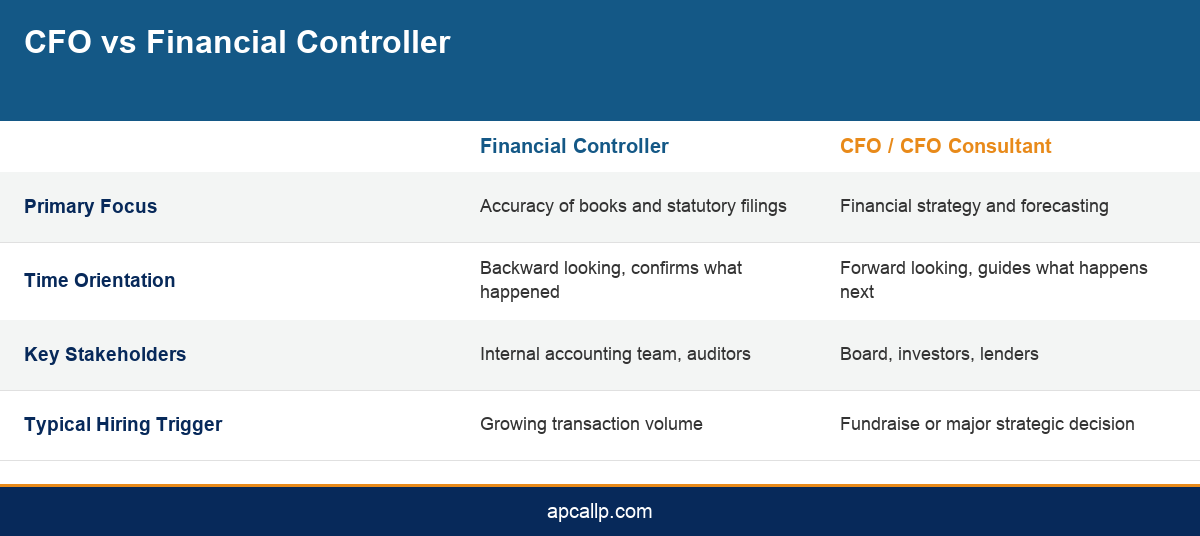
A financial controller owns the accuracy and timeliness of a company's financial records. This includes managing the monthly close process, reconciling accounts, overseeing accounts payable and receivable, and ensuring statutory filings such as GST returns and TDS go out correctly and on schedule. The controller's work is largely backward looking: it confirms what already happened and ensures it is recorded correctly.
In a growing business, the financial controller often manages a small team of accountants or bookkeepers and answers directly to whoever holds ultimate financial responsibility, whether that is a founder, a full time CFO, or an outsourced virtual CFO. This reporting relationship matters because it defines how information flows from the transactional level up to strategic decision making.
Professionals filling this role frequently hold or are working toward a chartered accountant qualification through bodies such as the Institute of Chartered Accountants of India, since the role requires strong technical grounding in accounting standards and statutory compliance requirements.
What Does a CFO Do Differently?
A CFO, whether a full time hire or a cfo consultant engaged through a virtual arrangement, sits a level above the controller function and is responsible for financial strategy rather than bookkeeping accuracy. This includes financial planning and forecasting, capital allocation decisions, fundraising strategy, and communicating financial performance and risk to the board or investors in a way that supports major business decisions.
Where a controller confirms that last month's numbers are correct, a CFO uses those same numbers to answer forward looking questions: should the business raise a funding round now or in six months, is a particular product line actually profitable once fully loaded costs are considered, and what does the cash position suggest about hiring plans for the next two quarters. Our guide to what a virtual CFO is covers this forward looking scope in more detail.
A CFO also typically owns the relationship with external stakeholders on financial matters, including investors, lenders, and auditors, representing the business in conversations that require both technical accuracy and strategic judgment about what to emphasize or disclose.
This strategic layer is precisely what makes the virtual CFO model work well as an outsourced service, since strategy and judgment can be delivered effectively on a part time or fractional basis in a way that daily bookkeeping generally cannot, because bookkeeping needs continuous, ongoing attention rather than periodic strategic input.
Where the Two Roles Overlap
The clearest overlap sits around financial reporting itself. A controller produces the underlying numbers, and a CFO interprets and presents them, which means the two roles need to work closely together regardless of whether both are internal hires, both are outsourced, or one of each. Miscommunication between these two functions is a common source of reporting errors that only surface once a board or investor asks a pointed question.
Compliance is another shared zone. While a controller typically handles the mechanics of filing, a CFO usually needs enough visibility into compliance status to flag risk at a strategic level, particularly ahead of a fundraise or transaction where outstanding compliance issues can materially affect a deal. APCALLP's compliance support services often work alongside both functions for exactly this reason.
Smaller businesses frequently blur this overlap further out of necessity, with one person handling a hybrid of both roles until the company reaches a size where splitting them cleanly becomes worthwhile.
Budgeting is a third area where responsibilities intertwine. A controller often assembles the detailed data behind a budget, tracking actual spend against plan month by month, while a CFO sets the assumptions driving that budget and decides how to respond when actual results diverge meaningfully from what was originally planned.
Do You Need Both, One, or Neither?
Very early stage businesses typically need neither role in a dedicated capacity, relying instead on a founder handling basic bookkeeping with support from an external accountant. As revenue and transaction volume grow, a financial controller function, whether an internal hire or an outsourced service, usually becomes necessary before a CFO does, simply because accurate books are a prerequisite for any meaningful financial strategy work.
A CFO, often engaged first as a virtual CFO rather than a full time hire, typically becomes necessary once a business faces a specific strategic inflection point: preparing for a fundraise, evaluating a major expansion decision, or needing board level financial reporting for the first time. Our comparison of virtual CFO services in India looks at this progression across a broader range of Indian business contexts.
A useful practical test is to ask what happens if a specific financial question comes up unexpectedly. If the honest answer is that nobody in the business can currently produce a confident, well supported response within a day or two, that is usually a sign the business needs CFO level input in some form, whether that means a full time hire, a virtual CFO, or a controller stretched temporarily into a broader advisory role.
How to Structure Both Roles as You Grow
A common and effective structure pairs an internal or outsourced financial controller handling day to day bookkeeping and compliance with a virtual CFO layered on top for strategy and investor communication. This lets a business access CFO level judgment without paying for full time CFO capacity before it is needed, while still ensuring the books underneath that judgment are accurate.
As the business scales further, the controller function often becomes an internal hire first, since day to day bookkeeping benefits from someone embedded in daily operations, while the CFO function may remain outsourced longer if the business does not yet have enough strategic workload to justify a full time senior salary. Our detailed comparison of outsourced versus in house CFO services walks through exactly this kind of staged transition.
Getting the sequencing right matters. Businesses that hire a full time CFO before establishing reliable financial controller level accuracy often find their expensive new CFO spending most of their time fixing basic bookkeeping problems instead of doing the strategic work the hire was actually made for.
Job descriptions are worth revisiting once this structure is in place. A business that continues advertising a single combined CFO and controller role after the two functions have genuinely diverged will struggle to attract strong candidates for either, since few professionals excel equally at deep, detailed bookkeeping accuracy and high level strategic forecasting at the same time.
Conclusion
A financial controller and a CFO answer different questions: one confirms the numbers are right, the other decides what to do based on them. Most growing businesses need both eventually, but rarely need to hire for both at the same time, and getting the sequencing right avoids paying for strategic capacity a company cannot yet use well. Talk to APCALLP's team about structuring both functions as your business grows.
Frequently Asked Questions
Is a CFO the same as a financial controller?

Which role should a growing business hire first, a CFO or a controller?
Can one person do both the CFO and financial controller job?
What qualifications does a financial controller typically have?
Does a virtual CFO replace the need for a financial controller?
How do a CFO and financial controller typically work together?
When should a business promote a controller into a CFO role?
Is a cfo consultant a good substitute for a full time CFO?