Chartered Accountant and Tax Consultant Services in Kochi, Kozhikode and Bengaluru
 General
Choosing between chartered accountants is harder than it looks, because most firms describe themselves identically. The differences that matter are practical. Which services the firm delivers in house, whether it can support you in more than one city, how it prices recurring work, and who actually does the work once you sign. This guide covers all four, with specific notes on Kochi, Kozhikode and Bengaluru, and a checklist you can use before you commit to any firm.
Key Takeaways
- A chartered accountant firm should be judged on delivery capability and continuity of staffing, not on the length of its service list.
- Multi city businesses benefit most from one firm holding every registration, because state level differences surface at exactly the wrong moment.
- Fee structure, scope boundaries and the escalation path should all be agreed in writing before the first filing deadline arrives.
What Chartered Accountants Actually Do for Businesses
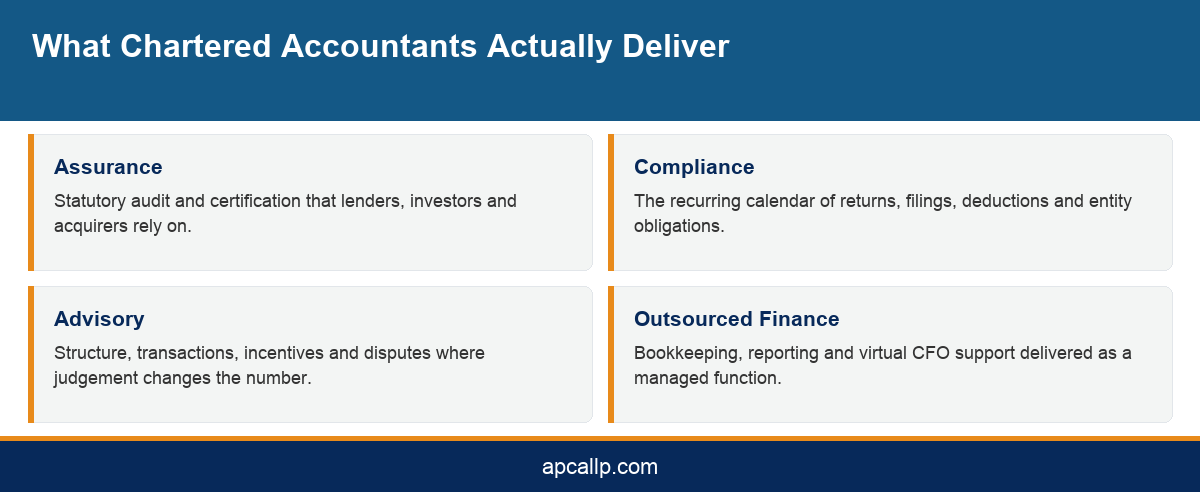
The profession covers far more than annual accounts. A working relationship with a chartered accountancy firm usually spans statutory audit, tax compliance across direct and indirect heads, entity filings, and advisory on transactions and structure. Some firms add outsourced finance functions on top of that.
The mistake many businesses make is buying only the compliance layer and then asking for advisory judgement for free when something goes wrong. Advisory work needs context, and context comes from someone who has been reading your numbers monthly rather than annually.
The reverse mistake is buying an expensive advisory relationship while the basic compliance calendar is handled by somebody unsupervised. Neither arrangement works well. The strongest relationships pair a reliable compliance routine with named partner access when a decision matters.
There is a third layer that businesses discover later, which is representation. When an assessment notice arrives, somebody has to draft the reply, assemble the evidence and appear if a hearing is called. That work is skilled, time consuming and quite different from filing returns. Firms vary enormously in how much of it they actually do, and the difference only becomes visible under pressure.
Ask any prospective firm how many assessments and appeals it handled last year and in which forums. A firm that files well but has never argued a position will be learning on your matter, which our note on tax audit readiness explains in practical terms. That is survivable for a small case and expensive for a significant one, so it is worth knowing before you appoint rather than afterwards.
Assurance and Statutory Audit
Audit is a legal requirement above certain thresholds and a commercial asset well before that. Lenders, investors and acquirers all read audited statements differently from management accounts. Independence rules mean the audit firm cannot also perform certain other services for the same client, which is why larger groups often split audit and advisory between two firms. Smaller companies rarely need that separation, but they should understand where the boundary sits before appointing.
Compliance Support and Advisory
Compliance support covers the recurring calendar: returns, filings, deductions and certifications. Advisory covers the decisions that change the numbers: structure, transactions, incentives and disputes. The two are delivered by different people even inside the same firm, and clients should know which of them they are talking to. Our tax consulting service deliberately names both an engagement manager and a reviewing partner for this reason.
Why Multi City Coverage Matters More Than It Sounds
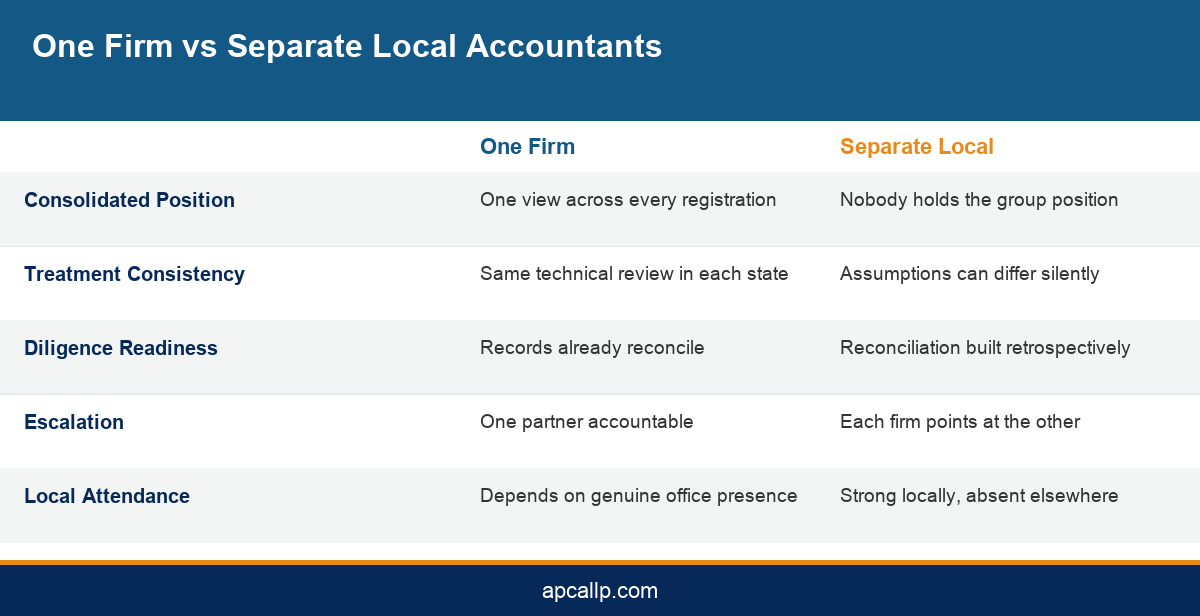
A business operating in Kerala and Karnataka holds separate GST registrations, deals with different jurisdictional offices, and often finds that a position accepted in one state is questioned in the other. Handling that with two unconnected local accountants means nobody holds the consolidated view.
The failure usually appears during a funding round or an audit, when the two sets of records turn out to have been built on different assumptions. Reconciling them retrospectively is expensive and rarely complete.
One firm holding every registration solves this cheaply. The same team applies the same treatment across states, flags where local practice genuinely differs, and produces one consolidated position for the group.
The same argument applies to entity filings and to payroll where employees sit in more than one state. Professional tax, labour registrations and state specific obligations all vary, and each one is small enough to be forgotten individually. Collected together on one calendar, they are trivial to manage. Scattered across local providers, they are the items that surface in a due diligence report.
Businesses sometimes worry that a single firm will be less responsive locally than a small local practice. That is a fair concern and it is answered by asking who sits in each office rather than by accepting the arrangement on trust. A firm with genuine delivery capacity in your city gives you both the local response and the consolidated view.
Kerala and Karnataka Are Not Interchangeable
Kerala businesses often deal with trading, services and export flows with their own classification history. Bengaluru operations skew towards technology and services with employee equity, cross border customers and faster growth. The compliance work is nominally the same and practically quite different. A firm that works across both, as ours does from offices in Kochi, Kozhikode and Bengaluru, carries the comparison rather than learning it on your file.
Who Actually Sits in Each Office
Ask which of the firm's offices is a genuine delivery centre and which is a nameplate. A local address that routes all work to another city is fine if the firm is honest about it, and a problem if you were promised local attendance during an assessment. Ask specifically who would attend a hearing in your city and how often they do so.
How to Read a Firm's Credentials
Every practising chartered accountant in India is a member of the Institute of Chartered Accountants of India, and firms carry a registration number. That is the baseline, not a differentiator.
What differentiates is depth in the specific thing you need. A firm with genuine transaction experience will be able to describe deals it has worked on. A firm with real assessment experience will describe hearings, not just filings.
Ask for two references from clients of similar size in your sector, and ask those references one specific question: what happened the last time something went wrong. The answer tells you more than any credential list.
Sector familiarity matters more than most buyers expect. A firm that already understands construction retention, software revenue recognition or export incentives will ask better questions in the first meeting. You can test this directly by describing an ordinary complication from your business and listening to whether the response is specific.
Size is worth thinking about honestly in both directions. A very large firm may deliver your work through junior staff with limited partner involvement. A very small practice may lack the bench to cover an absence during filing week. The right answer depends on your complexity rather than on a general preference for big or small.
Signals Worth Taking Seriously
Continuity of the engagement team over several years. Published technical writing that is specific rather than generic. A named partner who joins quarterly reviews without being chased. Willingness to say plainly that something is outside the firm's competence. That last one is the strongest signal available, and the rarest.
Signals That Mean Very Little
A long list of services with no evidence of delivery in each. Awards from bodies nobody in the profession recognises. Claims about turnaround time that are not written into the engagement letter. Large client logos where the actual work was a single small assignment years ago.
Understanding How CA Firms Price Their Work
Recurring compliance is usually priced as an annual retainer billed monthly or quarterly, scoped by entity count, transaction volume and the number of registrations involved. Audit is priced separately as an annual engagement.
Advisory and transaction work is generally hourly or fixed fee per assignment, and this is where scope disputes arise. The retainer covers the calendar. It does not cover a three week response to an assessment notice.
Clarify three things before you sign. What is inside the retainer, what triggers a separate fee, and how out of scope work gets approved. A firm that answers these clearly is easier to work with for the next five years than one that quotes ten percent lower and stays vague.
Expect the fee to move as the business grows, and agree in advance what triggers a review. Entity count, registration count, transaction volume and headcount are the usual drivers. A retainer priced for a business half your current size will be renegotiated eventually, and it is easier to agree the mechanism up front than to argue about it later.
Be cautious about very low quotes for recurring compliance. The work has a genuine cost floor, and a fee well below it usually means the work will be delegated to somebody inexperienced and unsupervised. The saving is real and small. The exposure created by an unreviewed position is neither.
What Usually Sits Inside a Retainer
Monthly or quarterly return preparation and filing, routine reconciliations, standard certifications, annual filings for the entity, and a defined amount of adviser time each month. Some firms include bookkeeping, most do not. Clarify this specifically, because bookkeeping volume is the item most likely to make a retainer uneconomic for the firm and therefore renegotiated at renewal.
What Usually Sits Outside It
Representation before authorities, transaction support, valuation, due diligence, restructuring advice, and any work arising from a period before the engagement began. Historical clean up in particular should be quoted separately and honestly, because its scope is genuinely unknown until the records have been examined.
Local Trust Signals and What They Are Worth
Reviews and local reputation matter more in professional services than in most sectors, because the product is unobservable before purchase. A firm with consistent reviews over several years is telling you something real about continuity.
Review volume alone is weak evidence. Read the content instead. Reviews describing responsiveness during a difficult period are worth more than a hundred generic five star entries.
Physical presence still matters in India, because assessments, hearings and departmental correspondence often benefit from someone attending in person. A firm with an office in your city has a practical advantage that no amount of remote efficiency fully replaces.
Longevity is another signal that is easy to check and hard to fake. A practice that has served the same market for many years has a reputation it cannot afford to damage, and it has usually seen your particular problem several times before, as our published case studies show.
Referrals from your banker, your lawyer or another business owner in the same sector carry more weight than any public listing. Those referrers deal with the consequences of poor accounting work directly, so their recommendations tend to be conservative and well informed. Ask at least one of them before you shortlist.
Questions Worth Asking a Reference
How long has the same person handled your file. What happened when a deadline was at risk. Did the fee change materially after the first year, and why. Would you appoint them again for a transaction, not just for compliance. Four questions, and the answers separate firms far more reliably than a proposal document does.
Why Turnover in the Engagement Team Costs You
Every handover loses context that was never written down. The new manager re asks questions you answered two years ago and misses the history behind a position. Firms with low turnover deliver noticeably better advisory work for the same fee, which is why continuity is worth asking about directly before appointment.
Services Snapshot by Office
Our Kochi office at JJ Square in Jawahar Nagar, Ernakulam, handles the largest share of compliance and virtual CFO work for Kerala based businesses, alongside transaction support for deals with a Kerala nexus.
The Kozhikode office at Jawahar Nagar Avenue Road, Eranhipaalam, serves the Malabar region, where trading, manufacturing and family owned businesses dominate and succession planning comes up more often than elsewhere.
The Bengaluru office at Hustlehub Tech Park in HSR Layout works largely with technology companies, funded startups and foreign owned subsidiaries, where equity structuring, cross border compliance and investor reporting are the recurring needs. All three draw on the same technical review process, so a client moving between cities keeps the same treatment.
Clients frequently start in one city and expand into another, and the transition is the point where most arrangements break. A Kochi trading business opening a Bengaluru sales office suddenly needs a second GST registration, professional tax in a new state and a view on where profit is being earned. Our note on choosing accountants in Bangalore covers what changes at that point.
Handled in advance, that is a short conversation and a handful of registrations. Handled after the first Bengaluru invoice has gone out, it becomes a correction exercise with interest attached. The value of one firm across all three cities is mostly the ability to have that conversation before it becomes urgent.
Kerala Businesses: Common Needs
Multi state GST positions arising from trading, tax audit readiness, family business succession, and advisory around bringing an unstructured business into a form that a lender or investor will fund. Our Kochi virtual CFO work frequently starts from exactly that point, with a profitable business that has never produced numbers anyone outside the family could rely on.
Bengaluru Businesses: Common Needs
Employee equity, revenue recognition for subscription models, transfer pricing where a foreign parent exists, and investor reporting that survives a diligence process. The compliance calendar is often simpler than in a trading business, and the advisory content is considerably heavier. Our Bengaluru virtual CFO service is built around that difference.
When to Change Your Chartered Accountant
Changing firms is disruptive, so the bar should be high. There are four situations where it is usually justified anyway.
First, repeated missed deadlines. Second, an inability to answer a straightforward question about your own numbers without a week's delay. Third, discovering that work you believed was being done was not. Fourth, growth into an area the firm genuinely cannot serve.
None of those are about fees. A firm that is materially cheaper and reliably late costs far more than the saving. If you do change, do it immediately after a filing deadline rather than before one, and get the handover list in writing.
There is a fifth situation worth naming, which is a loss of independence in practice rather than in form. If your accountant has become so close to the business that they no longer challenge anything, you have lost the outside view you were paying for. That is a difficult conversation and usually a genuine reason to move.
Whatever the reason, tell the outgoing firm plainly and in writing. Professional obligations govern the handover, and a courteous exit usually produces a complete one. An acrimonious exit produces a slow drip of missing documents at exactly the moment your new firm needs them.
How to Run a Clean Handover
Request the full working papers, the login inventory, the position history and any open correspondence with authorities. Professional courtesy between firms usually makes this straightforward, and the outgoing firm has an obligation to cooperate reasonably. Give the incoming firm one clear period to review everything before they take responsibility for a filing, because inheriting an unexamined position is how avoidable problems become somebody else's.
What to Keep Yourself
Never let the only copy of your records sit with your adviser. Keep your own archive of filed returns, financial statements, key correspondence and login credentials. Businesses that do this can change firms in a week. Businesses that do not are effectively locked in, which weakens every fee conversation they will ever have.
A Practical Checklist Before You Appoint
Confirm the firm's registration and the identity of the partner who will sign your work. Ask who the day to day contact will be and how long they have been with the firm. Get the scope, the fee and the exclusions in one written engagement letter.
Test responsiveness before signing rather than after. Send a genuine question and see how long a considered answer takes. Ask how they would handle a specific scenario relevant to your business and listen for whether the answer is specific or generic.
Finally, ask what they would need from you each month and whether your current records can produce it. A firm that describes the input requirement precisely is a firm that has run the process many times. If you want to compare that against how we work, our contact page lists all three offices.
Agree the reporting rhythm at the same time. Decide what you will receive monthly, what you will receive quarterly, and who attends each review. Relationships that drift into annual contact do so because nobody set a rhythm at the start, not because either side intended it.
Finally, write down what success looks like for the first year. Filings on time, no unexplained reconciling items, one strategic review each quarter and a clean audit is a reasonable baseline. Reviewing against that at renewal turns a vague relationship into a manageable one.
Documents to Have Ready
Incorporation documents, previous years' financial statements and returns, registration certificates across every applicable law, the current chart of accounts and a list of open matters with authorities. Having these assembled shortens onboarding considerably and gives the incoming firm an accurate basis for quoting.
Red Flags During the Sales Process
A fee quoted without asking about transaction volume. A promise to reduce your tax without seeing your numbers. Reluctance to name the signing partner. Vague answers about who will actually do the work. Any of these predicts the working relationship better than the proposal document does.

Conclusion
Choosing between chartered accountants comes down to delivery capability, continuity and clarity about scope. Check the credential, then check who actually does the work and how long they have been doing it. Agree the fee boundary before the first deadline rather than after a dispute. If your business operates across Kerala and Karnataka, one firm holding every registration will save you a reconciliation you cannot afford later. To compare our Kochi, Kozhikode and Bengaluru offices against your current arrangement, Talk To Us.