Indian Subsidiary Annual Compliance Calendar: Key Deadlines

Indian subsidiary company registration is the start of the compliance cycle, not the end of the project. Once the company is incorporated, it carries recurring obligations under company law, exchange control rules, income tax, GST and labour law, and most of them run to fixed dates. Foreign parents are often surprised by how many there are. This guide sets out an annual calendar for a typical Indian subsidiary with a financial year ending 31 March, and explains what happens when a deadline is missed.
Key Takeaways
- After Indian subsidiary company registration, the main annual milestones are the AGM by 30 September, ROC filings after it, the FLA return by 15 July and tax filings through October and November.
- Monthly and quarterly cycles for TDS, GST and advance tax run alongside the annual dates and cause most penalties.
- Event triggered filings, such as FC-GPR after a capital infusion, sit outside the calendar and need their own tracker.
Why a Calendar Matters After Indian Subsidiary Company Registration
Foreign groups usually plan carefully for Indian subsidiary company registration and then underestimate what follows. The subsidiary is a separate Indian company with its own directors, auditors, tax registrations and reporting duties. Its obligations do not follow the parent's calendar or the parent's financial year.
A missed deadline rarely causes a crisis on its own, but penalties accumulate, late fees compound and, in some cases, directors become disqualified. The bigger cost appears later, when an investor, buyer or auditor asks for clean records and the gaps take months to fix.
A written calendar with owners for each filing is the simplest control. Our note on board and ROC compliance explains the company law layer, and this guide brings all the layers onto one timeline.
The calendar below assumes a company with a financial year ending 31 March, a statutory auditor already appointed and registrations for GST and TDS in place. Subsidiaries with a different profile, such as a liaison office conversion or a manufacturing unit, will have additional items, but the structure stays the same.
Company Law: Board Meetings, AGM and ROC Filings
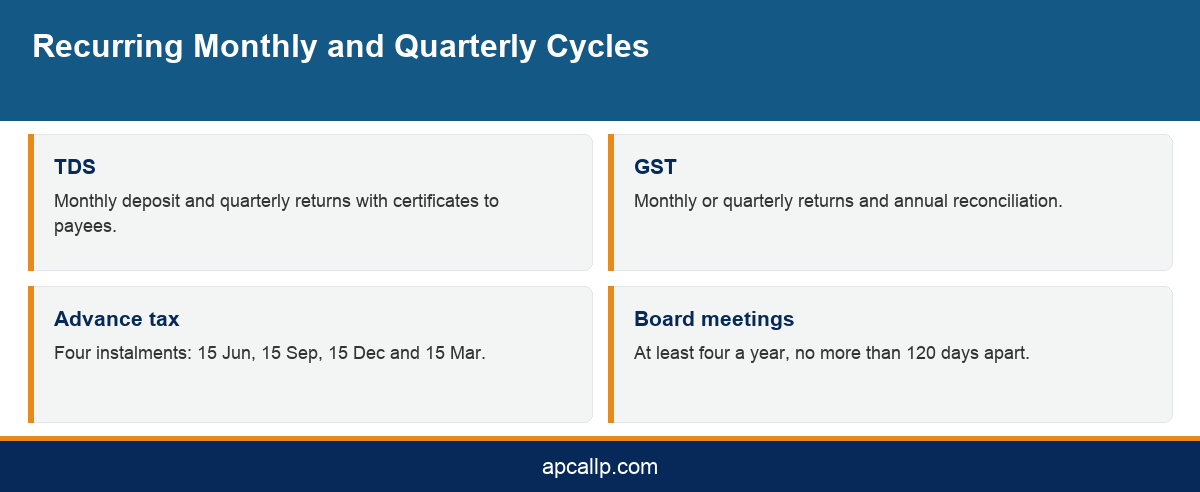
Every company must hold at least four board meetings a year, with no more than 120 days between two meetings, and must have at least one director who stayed in India for at least 182 days in the previous calendar year. Foreign groups sometimes overlook the resident director rule.
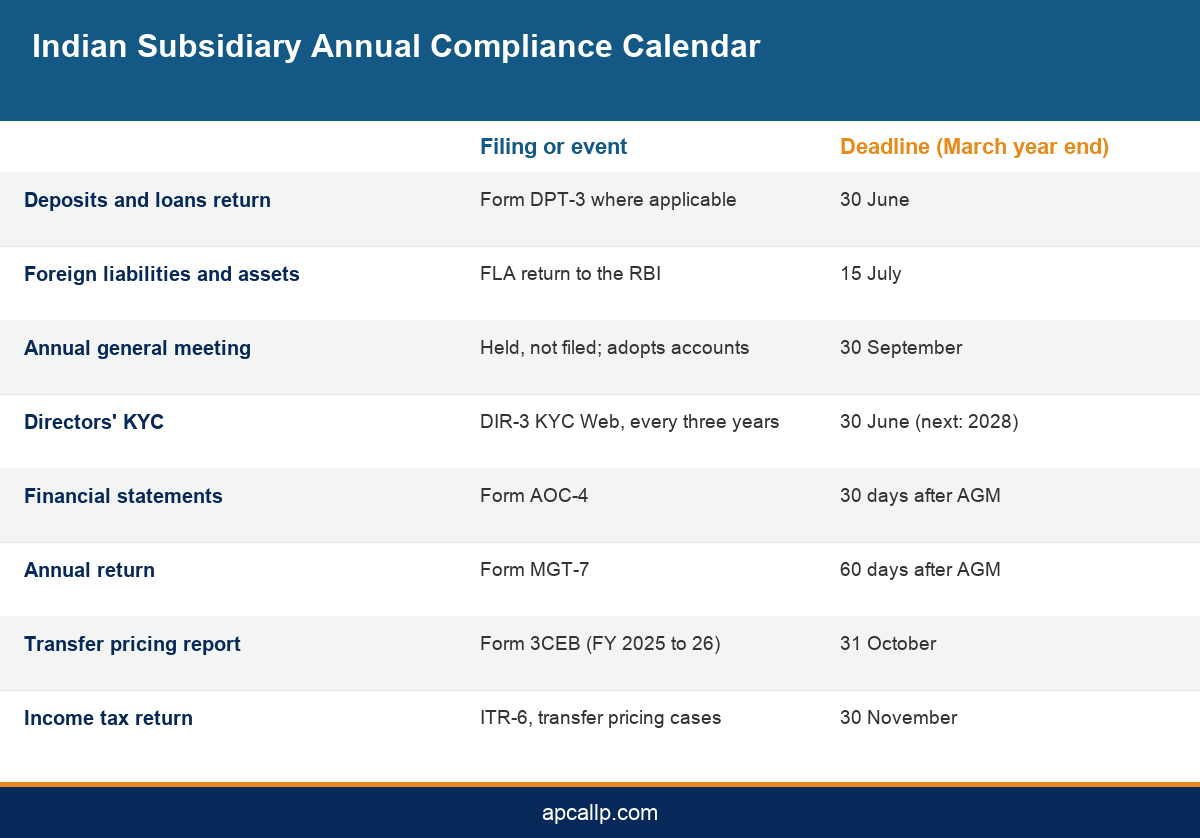
The annual general meeting must be held within six months of the financial year end, so by 30 September for a March year end. The financial statements are filed with the registrar in Form AOC-4 within 30 days of the AGM, and the annual return in Form MGT-7 within 60 days.
Directors' KYC changed from 31 March 2026: the annual filing was replaced by a KYC intimation once every three years by 30 June, with changes in contact details reported within 30 days. Other recurring items include the return of deposits and outstanding loans by 30 June where applicable, and the half yearly return on payments overdue to micro and small enterprises where such dues exist. The auditor's appointment is also filed after the AGM at which it is made.
Statutory registers, minutes and the register of significant beneficial owners must also be kept current. Changes in shareholding, directors or registered office each trigger their own filing within a fixed period, so record them in the event tracker as they happen.
FEMA and RBI: Annual and Event Triggered Reporting
Every Indian company that has received foreign direct investment must file the annual return on foreign liabilities and assets by 15 July, based on the previous year's figures. It applies every year, even when the parent made no new investment.
Event triggered filings sit outside the annual cycle. A capital infusion needs Form FC-GPR within 30 days of allotment, a share transfer needs Form FC-TRS within 60 days, and a downstream investment needs Form DI within 30 days. The detailed rules are in the RBI Master Direction on Foreign Investment.
Keep a separate tracker for these events and reconcile it to the share register every year before the FLA return is filed. Our guide on RBI and FEMA compliance for startups covers the most common gaps.
Changes to the parent's own shareholding can also trigger Indian reporting, so share group restructuring plans with the Indian team early.
Income Tax, Transfer Pricing, TDS and GST
Advance tax is paid in instalments by 15 June, 15 September, 15 December and 15 March. TDS is deposited monthly and reported quarterly, and GST returns run monthly or quarterly depending on the registration. These cycles generate most of the interest and late fees subsidiaries pay. Our note on TDS compliance points every business must know covers the essentials.
Subsidiaries with international transactions with group companies need a transfer pricing study and an accountant's report. For financial year 2025 to 26, governed by the Income tax Act, 1961, the report in Form 3CEB is due by 31 October 2026 and the return by 30 November 2026, subject to any extension notified. Transfer pricing itself is summarised in the Wikipedia overview of transfer pricing.
The Income tax Act, 2025 applies from 1 April 2026, so filings for financial year 2026 to 27 onwards will use renumbered sections and forms. Check the current form references on the income tax e filing portal before each deadline.
Payments to the parent for services, royalties or reimbursements also need withholding tax at the right rate, supported by the parent's tax residency certificate where treaty benefits are claimed. Errors here are a frequent finding in tax audits and in buyer diligence.
Labour Law and State Level Obligations
Subsidiaries with employees carry monthly labour law obligations as well. Provident fund and employees' state insurance contributions are deposited monthly, with returns filed on the respective portals. Missing them attracts interest and damages, and employees notice quickly.
State laws add another layer. Professional tax applies in states such as Karnataka and Kerala, with its own registration, payment schedule and returns. Shops and establishments registrations, labour welfare fund contributions and trade licences also vary by state and by city.
A subsidiary with offices in Bengaluru and Kochi therefore follows two sets of state rules. Map them during setup, add them to the calendar and confirm them each year, because state procedures and rates change more often than central ones. Our list of common compliance gaps during expansion shows where multi state companies usually slip.
Putting the Calendar to Work
A calendar only helps if someone owns it. Assign each filing to a named person, either in house or at your advisers, with a reminder two weeks before the deadline and a confirmation when the filing is made. Store acknowledgements in a structure that mirrors the calendar.
For groups with several Indian entities, a single consolidated calendar with entity columns is easier to manage than separate lists. It also shows when several entities share a deadline, so work can be planned and resourced in advance.
Review the calendar at every board meeting. A one page status report showing filings due, made and overdue keeps directors informed and protects them personally. Parents should also include the subsidiary's calendar in group reporting, so that regional finance teams see the Indian deadlines alongside their own.
Finally, plan the year end. The audit, the AGM, the ROC filings, the FLA return and the tax filings all depend on closed books. A subsidiary that closes its March accounts by the end of May has a comfortable year. Our multi entity compliance case study shows how groups keep several entities on the same rhythm.
Conclusion
Indian subsidiary company registration starts a cycle of company law, FEMA, income tax, TDS and GST obligations that repeats every year. Build one calendar, assign an owner to each filing, track event triggered reports separately, and review status at every board meeting. Close the books early so the annual sequence of audit, AGM, ROC filings, FLA return and tax filings runs smoothly. To set up or review a calendar for your Indian entity, speak with APCALLP in Bengaluru.
Frequently Asked Questions
When must an Indian subsidiary hold its AGM?

Does an Indian subsidiary need a resident director?
What is the FLA return and when is it due?
When is the transfer pricing report due?
Which filings follow a capital infusion from the parent?
What happens if a subsidiary misses ROC deadlines?
Does the Income tax Act, 2025 change the calendar?
Can APCALLP manage compliance for an Indian subsidiary?