Investment Compliance Services in India: FEMA, FDI and RBI Reporting
 investment readiness services
Foreign money arrives with paperwork attached. Every rupee of foreign investment into an Indian company triggers pricing rules, bank formalities and reports to the Reserve Bank of India, each with its own deadline. Investment compliance services exist because these obligations are easy to miss and costly to repair. This guide explains what investment compliance covers, which filings each event triggers, how pricing and valuation fit in, what happens when deadlines are missed, and how Bengaluru, Kochi and Kozhikode companies can stay audit ready.
Key Takeaways
- Investment compliance services cover inbound foreign investment, transfers of shares, downstream investment, NRI capital and overseas investment.
- Most obligations are event triggered: an allotment, a transfer or a downstream investment starts a clock of 30 or 60 days.
- Late filings can usually be regularised with a late submission fee or compounding, but they delay deals and fundraises until they are.
What Investment Compliance Covers
Investment compliance is the set of legal and reporting obligations that apply when money crosses the border into or out of an Indian business. The main framework is the Foreign Exchange Management Act and the rules made under it, with operational detail in the RBI Master Direction on Foreign Investment in India.
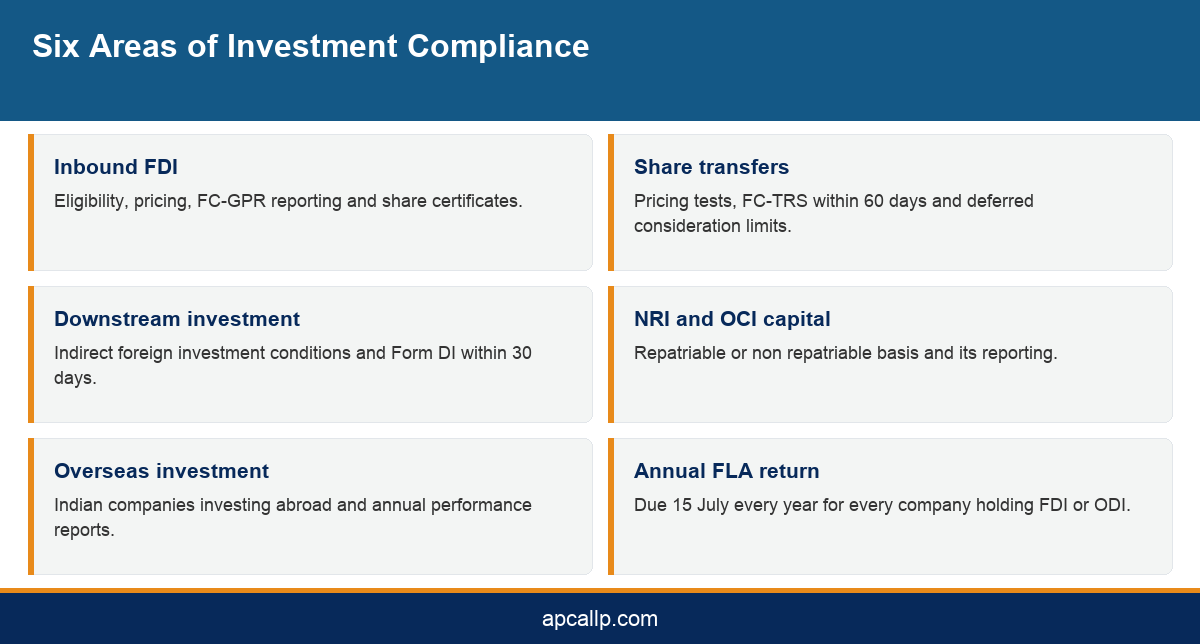
For most companies the obligations fall into five groups: inbound foreign direct investment, transfers of shares between residents and non residents, downstream investment by foreign owned companies, investment by NRIs and overseas citizens, and overseas investment by Indian companies. Company law and income tax rules apply alongside.
Investment compliance services bring these obligations onto one calendar. The work includes checking eligibility and sector caps before money arrives, arranging pricing certificates, filing reports on the RBI portal, maintaining registers and preparing the annual return on foreign liabilities and assets.
The obligations also change over time. The RBI updates its master directions, the government revises sector policy, and portal procedures evolve. Investment compliance services track these changes so that a filing prepared on last year's template is not rejected by the bank, and so that new rules are applied from their effective date.
Good records also make annual audits smoother, because auditors test share capital movements against the same filings.
Who Needs It
Any company with foreign shareholders, any startup raising from foreign funds or angels, any Indian subsidiary of a foreign group, any company issuing ESOPs to non residents, and any Indian business investing abroad. In Bengaluru that describes a large share of funded technology companies.
Why It Matters to Founders
Investors and acquirers check these filings in every diligence exercise. A missing report or an unsupported price does not usually stop a deal, but it delays it until the position is regularised. Founders who keep compliance current close rounds faster.
Entry Routes, Sector Caps and Eligibility
Before any money moves, the company must confirm that foreign investment is permitted in its sector and under which route. Most sectors allow investment under the automatic route without prior approval. Some sectors carry caps, conditions or require government approval.
Investment from entities in countries that share a land border with India, or where the beneficial owner is situated in such a country, needs government approval regardless of sector. This rule catches more fundraises than founders expect, because beneficial ownership is traced through funds and holding companies.
The instrument matters too. Equity shares, compulsorily convertible preference shares and compulsorily convertible debentures count as foreign direct investment. Instruments that are optionally convertible or redeemable are treated as debt and follow different rules. Invest India's foreign investment overview is a helpful starting point for sector policy.
Investment compliance services should record the eligibility analysis in writing for every round: the sector, the applicable cap, the route, the beneficial ownership check and the conclusion. That note becomes the first document an investor's lawyer asks for.
Checking Beneficial Ownership
Ask every foreign investor for its ownership chain and the identity of its ultimate beneficial owners before the term sheet is signed. If any owner falls within the land border rule, the approval timeline must be built into the round.
Startups and Convertible Notes
Recognised startups can issue convertible notes to non residents, subject to conditions and reporting. Notes are a quick way to raise bridge money, but they still need a report within the prescribed period after issue.
Getting the Bank Ready Early
Inward remittances are received through an authorised dealer bank, which collects KYC documents on the foreign investor and issues the foreign inward remittance certificate. Agreeing the document list with the bank before the money arrives avoids delays that can push an allotment past its 60 day window.
Pricing Guidelines and Valuation Certificates
Shares issued to non residents cannot be priced below fair value. Fair value is determined using an internationally accepted pricing methodology on an arm's length basis and certified by a chartered accountant, a SEBI registered merchant banker or a practising cost accountant. Listed companies follow SEBI pricing rules instead.
The same logic applies to transfers. A resident selling to a non resident cannot sell below fair value, and a non resident selling to a resident cannot sell above it. The certificate should be close to the transaction date, because an old valuation is a common diligence finding.
Company law and income tax may require their own valuations for the same allotment, sometimes by a different class of valuer and on a different basis. Investment compliance services plan these together, so that one transaction does not end up with three inconsistent numbers.
Where the investor is a foreign venture fund, its own counsel will usually review the certificate, so prepare it with that reader in mind: a clear method, a stated date and the assumptions set out in plain terms.
Why Valuations Get Challenged
Valuations are questioned when the method does not match the business, when projections are unsupported, or when the report is dated months before allotment. A short, well reasoned report prepared for the actual transaction date is far stronger than a long generic one.
Rights Issues, Bonus Shares and Swaps
Not every issue involves fresh cash. Rights issues to existing foreign shareholders, bonus issues and share swaps all have their own pricing and reporting conditions. Swaps in particular need valuation of both sides of the exchange and may need approval depending on the sector and the parties involved.
The Filings Each Event Triggers
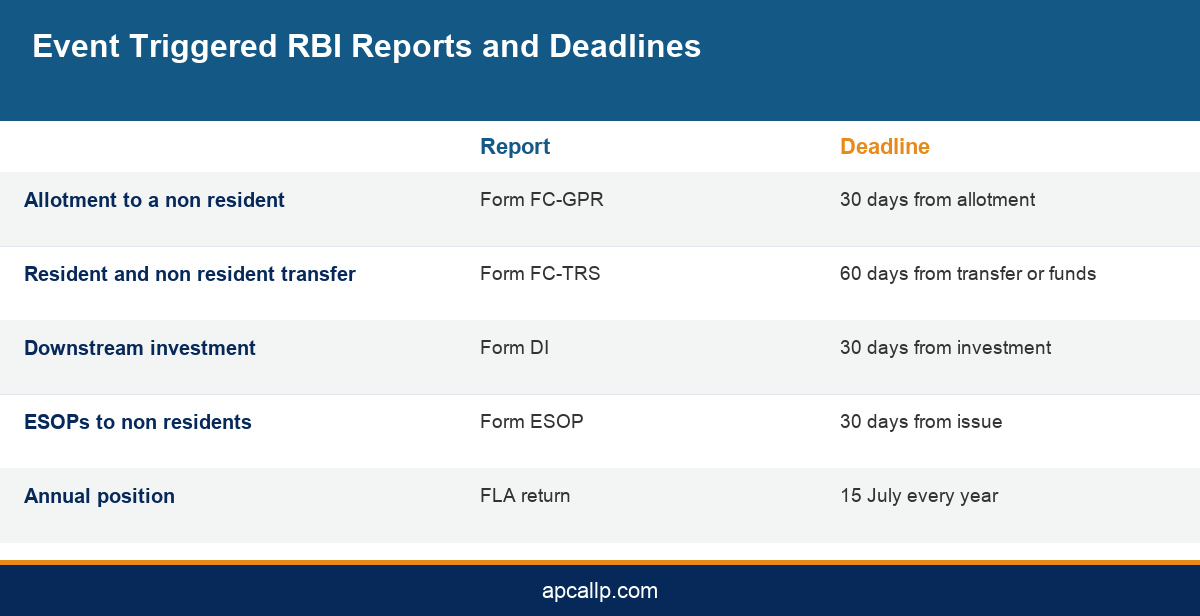
Most investment compliance obligations are event triggered. The event starts a clock, and the report must be filed on the RBI's FIRMS portal through the authorised dealer bank within the prescribed period. The company must first register on the RBI FIRMS portal using the Entity Master Form.
On an allotment of shares to a non resident, the company must allot within 60 days of receiving the money, or refund it within the following 15 days, and must file Form FC-GPR within 30 days of allotment. On a transfer between a resident and a non resident, Form FC-TRS must be filed within 60 days of the transfer or the receipt of funds, whichever is earlier.
Downstream investment by a foreign owned company must be reported in Form DI within 30 days. ESOPs issued to non resident employees need Form ESOP within 30 days, and convertible notes need Form CN within 30 days. LLPs use their own forms for receipt of foreign investment and for transfers.
Each report needs supporting documents: the board resolution, the valuation certificate, the foreign inward remittance certificate, KYC of the investor and a declaration on sector compliance. Keeping a standard pack ready for each event cuts preparation time and reduces the chance of the bank returning the form.
The Annual Return on Foreign Liabilities and Assets
Every Indian company and LLP that has received foreign direct investment or made overseas investment must file the annual FLA return by 15 July each year, based on the previous financial year's figures. It is required even if no new investment arrived during the year, which is why it is so often missed.
Company Law Filings Alongside
Allotments also need company law filings, such as the return of allotment within the prescribed time and the private placement records. Our note on board and ROC compliance explains how these fit together with exchange control reporting.
Transfers, Exits and Deferred Consideration
Share transfers between residents and non residents are where investment compliance services and deal work meet. Secondary sales to new investors, founder exits, buybacks and acquisitions by foreign groups all involve FC-TRS reporting and pricing tests.
Exchange control rules allow part of the price to be deferred, held in escrow or paid as an indemnity: up to 25 percent of the total consideration, for no more than 18 months from the date of the transfer agreement. Earn outs that run longer or pay more need careful structuring, and the reporting must reflect each payment.
The resident party is generally responsible for filing FC-TRS. In practice the buyer, the seller and the company should agree in the transaction documents who files, who provides the documents and what happens if a filing is rejected. Our cross border share transfer case study shows how this sequencing works.
Buybacks and Capital Reductions
When a company buys back shares from a non resident or reduces capital, pricing and reporting rules apply in the same way as for a transfer. The tax treatment of buybacks has also changed in recent years, so model the shareholder's tax position before choosing the exit route.
Downstream Investment, NRI Capital and Overseas Investment
When an Indian company that is owned or controlled by non residents invests in another Indian company, that investment counts as indirect foreign investment. It must meet the same sector conditions, entry route and pricing rules as direct investment, and it must be reported. Founders with group structures often overlook this.
NRIs and overseas citizens can invest on a repatriable basis, which is treated like foreign investment, or on a non repatriable basis, which is treated much like domestic investment. The choice affects reporting, pricing and the ability to take money out later. Many Kerala companies with Gulf based shareholders have mixed positions that need tidying before a fundraise.
Indian companies investing abroad follow the overseas investment framework, with its own reporting and annual performance reports. Bengaluru startups that set up foreign subsidiaries or flip their holding structure need to plan these filings from the start.
A Common Gap in Founder Holding Structures
Founders sometimes hold their stake through a holding company that later takes foreign investment. From that point the holding company's investments in the operating company may become downstream investment. Check this before every new round.
Flips and Overseas Holding Structures
Some Bengaluru startups move their holding company abroad to suit foreign investors, a process often called a flip. It involves share swaps, overseas investment reporting, valuation and tax analysis for every shareholder. Reversing a flip later is equally complex, so the decision deserves careful advice before the first document is signed.
Kerala Companies with Gulf Based Shareholders
Many companies in Kochi and Kozhikode have shareholders who live and work in the Gulf. Over the years, money has often come in through a mix of routes: personal NRE or NRO accounts, family members in India, and sometimes informal loans later converted into shares. Each route has different exchange control consequences.
Before such a company raises institutional money or sells to a buyer, the history has to be mapped. Which shareholders were non resident when they invested? Was the investment repatriable or non repatriable? Was it priced and reported correctly? Gaps are common and fixable, but they take time to regularise.
Investment compliance services for these companies combine exchange control knowledge with practical family business experience. The aim is a clean cap table, a reconciled register and a clear record of each shareholder's status, so that the next investor or buyer sees no surprises.
When a Shareholder's Residential Status Changes
A shareholder who moves abroad, or returns to India, changes residential status for exchange control purposes. Their holdings may need to be redesignated and bank accounts converted. Track these changes, because they affect future transfers and dividends.
Investment Compliance for Indian Subsidiaries of Foreign Groups
Indian subsidiaries of foreign companies carry a wider set of obligations than startups with a few foreign investors. Exchange control reporting is only one layer. Company law requires a resident director, board meetings, annual filings and statutory registers. Income tax adds transfer pricing documentation on transactions with group companies, withholding tax on payments abroad and, for the parent, permanent establishment risk.
Most of the friction comes from the interaction between these layers. A capital infusion from the parent needs pricing and FC-GPR reporting, a board resolution, a return of allotment and an update to the cap table. A management fee charged by the parent needs a transfer pricing analysis and correct withholding. Investment compliance services coordinate these so that each event is handled once and consistently.
Our note on international tax compliance for SMEs covers the tax side of cross border group transactions in more detail.
Capital Infusions and Intercompany Loans
Parents fund subsidiaries through equity or through external commercial borrowings, and each route has its own rules. Equity needs pricing and reporting. Borrowings need registration, end use compliance and monthly or periodic returns. Choosing the route early avoids restructuring later.
Repatriation of Profits
Dividends, royalties, fees for services and buybacks are the usual ways to send money back to the parent. Each carries tax and documentation requirements, and the bank will ask for evidence that the payment is permitted and that tax has been withheld correctly.
When Deadlines Are Missed: Late Fees and Compounding
Missed deadlines are common and usually fixable. Reporting delays can generally be regularised by paying a late submission fee calculated by formula, provided the filing is made within the permitted period. Substantive contraventions, such as an allotment made below fair value or without the required approval, need compounding.
Compounding is an application to the RBI to settle a contravention by paying an amount determined under the compounding framework. It takes time and needs complete documentation, so it should start as soon as the issue is found rather than during a deal.
The bigger cost is delay. Investors and acquirers will not usually complete until historical gaps are regularised. A clean compliance record is therefore a commercial asset. Our note on compliance gaps found during expansion lists the issues seen most often.
A Practical Remediation Sequence
List every foreign investment event since incorporation, match each one to its filing and acknowledgement, identify the gaps, classify each as a reporting delay or a substantive contravention, then file late submissions and compounding applications in order of materiality.
Building an Audit Ready Investment Compliance Register
The single most useful tool in investment compliance is a register. It lists every foreign investment event since incorporation: the date, the investor, the instrument, the amount, the price, the valuation certificate, the filing, its acknowledgement and any late fee paid. With it, the company can answer any investor or acquirer question in minutes.
The register should reconcile to three other records: the cap table, the statutory register of members and the FLA return. If the four do not agree, something has been missed. Reconciling them once a year, ideally just before the FLA return is filed, catches most gaps early.
Investors increasingly ask for this register as part of diligence. Our note on what investors check before funding shows how exchange control questions sit alongside the financial review.
What to Keep for Each Event
Keep the board and shareholder resolutions, the valuation certificate, the remittance certificate, the investor's KYC, the filed form, the acknowledgement and correspondence with the bank. Store them in a structure that mirrors the register, so the data room builds itself.
Reviewing Before Every Round
Before every fundraise or transaction, review the register against the cap table and the RBI portal. Regularise any gaps before the term sheet stage, while the company still controls the timetable.
Choosing Investment Compliance Services in Bengaluru, Kochi and Mumbai
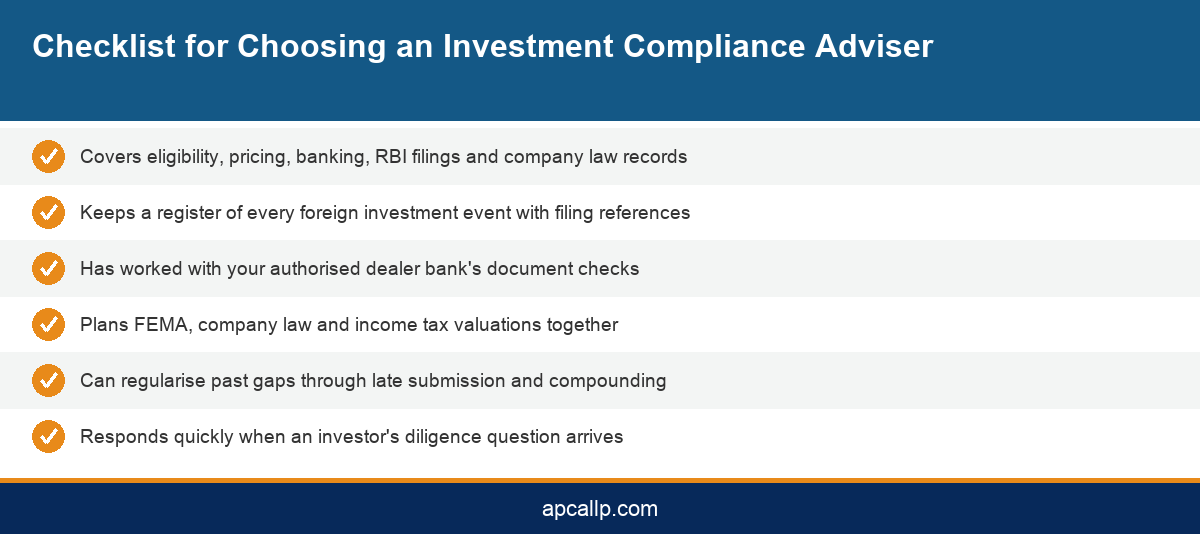
Look for an adviser who handles the whole chain: eligibility, pricing, banking, portal filings, company law records and the annual return. Fragmented support is how gaps appear, because each adviser assumes another has filed.
Ask how the adviser tracks events. Good investment compliance services keep a register of every foreign investment event with its filing reference, so the company can answer a diligence question in minutes rather than weeks. Ask also about experience with the authorised dealer bank you use, since banks apply their own document checks.
Geography matters less than responsiveness. Many companies in Bengaluru have investors managed from Mumbai, and Kerala companies often have Gulf based shareholders. APCALLP supports clients from all three offices. Read what foreign investors check to see how investors assess compliance before they commit.
Questions to Ask a Prospective Adviser
How do you track events and deadlines? Who files on the portal and who liaises with our bank? How do you handle late submissions and compounding? What will you need from our team each month? Specific answers matter more than a long list of services.
Conclusion
Investment compliance services turn a set of scattered deadlines into a routine. Confirm eligibility before money arrives, price every issue and transfer properly, file each event report on time, and keep a register that answers diligence questions instantly. When gaps appear, regularise them early rather than during a deal. If your company has foreign investors, Gulf based shareholders or overseas subsidiaries, speak with APCALLP's compliance team about a review of your filings.
Frequently Asked Questions
What are investment compliance services?

What is the deadline for filing FC-GPR?
Who files FC-TRS on a share transfer?
Is the FLA return required if no new investment came in?
What happens if an RBI filing is filed late?
Do NRI investments need the same compliance as FDI?
Who can certify the price for shares issued to foreign investors?
Does a foreign owned company need approval to invest in another Indian company?
Can APCALLP regularise past FEMA gaps before a fundraise?