CFO Consulting Services in Bangalore: Engagement Models Compared
 Accounting Services
Most growing companies reach a point where the founder can no longer be the finance department. Cash gets tight, investors ask harder questions, and a deal or audit exposes gaps nobody had time to fix. CFO consulting fills that gap without the cost of a full time chief financial officer. In Bengaluru it now comes in several models, from a short project to an interim CFO who runs the function. This guide compares the models, explains what each delivers, and shows how to choose the right one for your stage.
Key Takeaways
- CFO consulting comes in four common models: project consulting, outsourced ongoing support, part time or fractional CFOs, and interim CFOs.
- The right model depends on stage, complexity and the trigger: a fundraise, a deal, an audit, rapid growth or the exit of a finance leader.
- Good CFO consulting builds systems and people the business keeps, rather than creating a permanent dependency on the consultant.
What CFO Consulting Means for a Growing Company
A chief financial officer leads finance strategy, planning, reporting, funding and risk. The general CFO role is well understood in large companies, but most growing businesses do not need or cannot afford it full time. CFO consulting provides the same thinking for the time and scope the business actually needs.
In practice CFO consulting covers forecasting and budgeting, cash and working capital management, management reporting, investor relations, fundraising support, deal readiness, controls and compliance oversight. The consultant works with the founder and the accounts team rather than replacing them.
It differs from bookkeeping and audit. Bookkeepers record transactions and auditors give an opinion on the accounts. A CFO consultant uses those records to make decisions about pricing, hiring, funding and growth, and to explain them to boards and investors.
In Bengaluru the demand comes from funded startups, family businesses moving into a second generation, and Indian subsidiaries of foreign groups. Each needs a different mix: investor reporting for startups, banking and succession for family firms, and group reporting and compliance for subsidiaries.
Signs You Need Finance Leadership
Cash surprises, month end closes that take weeks, investors asking for reports nobody can produce, margins that nobody can explain, and a founder spending evenings on spreadsheets. Our note on signs a business has outgrown basic accounting support covers these in detail.
Controller or CFO?
A financial controller runs accounting, close and controls. A CFO sets strategy and deals with investors and lenders. Many growing companies need a strong controller first and CFO input on top. Our comparison of the CFO and controller roles explains the difference.
The Four CFO Consulting Models Compared
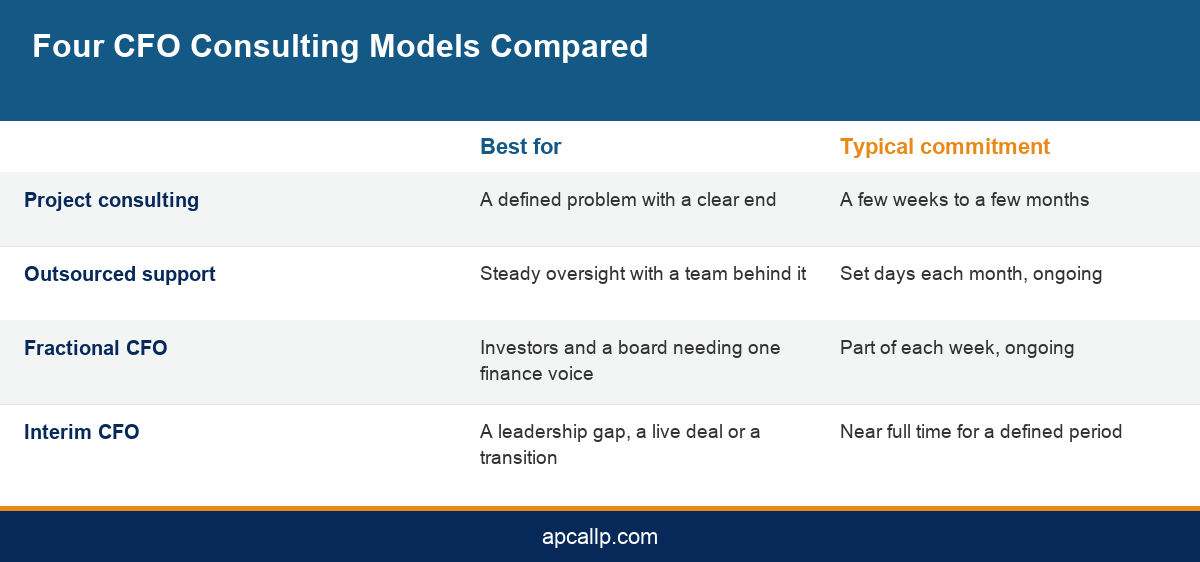
Project consulting addresses a defined problem over a few weeks or months: building a financial model, preparing for a fundraise, redesigning management reporting or fixing a costing system. It ends when the deliverable is done.
Outsourced ongoing support provides a CFO level adviser for a set number of days each month, usually with a team that handles reporting and compliance. It suits companies that need continuous oversight but not a full time leader.
A part time or fractional CFO is a named individual who acts as the company's CFO for a share of the week, attending board meetings and speaking to investors. An interim CFO is a full time or near full time leader for a defined period, often during a transition or a deal.
Each model can be delivered on site, remotely or in a mix. Bengaluru companies often prefer a hybrid: regular on site days around board meetings and month end, with remote work in between. What matters is availability when decisions are made, not the number of hours logged.
How the Models Differ in Practice
Project consulting is outcome based, outsourced support is capacity based, a fractional CFO is role based, and an interim CFO is leadership based. Each carries a different level of commitment, cost and accountability, so match the model to the problem.
Combining Models
Many companies combine models: a project to build the model and reporting, followed by ongoing outsourced support, with an interim leader brought in during a fundraise or acquisition. Our comparison of outsourced and in house finance leadership helps frame the longer term choice.
Cost Structures Across the Models
Project consulting is usually priced per project, outsourced support and fractional CFOs per month, and interim CFOs per month or per day. Compare models on total cost for the outcome you need, not on the monthly figure alone.
Choosing a Model by Stage and Trigger
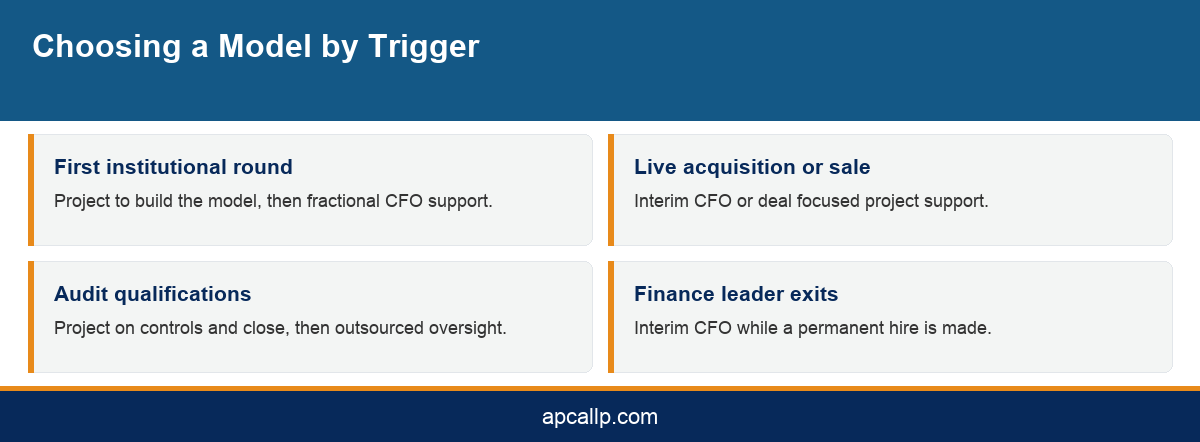
Stage matters. A seed stage startup usually needs a project to build the model and reporting, then light ongoing support. A Series A or growth stage company with investors and a board usually needs a fractional CFO. A company preparing for a large round, an acquisition or an IPO process may need an interim CFO or a full time hire.
Triggers matter too. A fundraise needs a model, a data room and investor reporting. A deal needs diligence readiness and completion support. An audit with qualifications needs controls and close discipline. The exit of a finance leader needs interim cover. CFO consulting should be shaped around the trigger rather than a generic package.
Complexity is the third factor. Multiple entities, foreign investors, ESOP pools, inventory or multi state GST registrations all increase the depth of CFO input required.
Sector matters as well. Healthcare, manufacturing and trading businesses carry inventory, receivables and regulatory exposure that a pure software company does not, and the finance leader needs experience of those dynamics to add value quickly.
A Simple Decision Guide
If the problem has a clear end, choose project consulting. If you need steady oversight, choose outsourced support. If investors and a board need one accountable finance voice, choose a fractional CFO. If a leader has left or a deal is live, choose an interim CFO.
When to Hire a Full Time CFO Instead
A full time CFO makes sense when the finance agenda fills a full week every week: multiple funding relationships, a large team, complex group structures or preparation for a public listing. Many companies use CFO consulting to bridge to that point and to help recruit the hire.
CFO Consulting for Family Businesses and SMEs
Family owned businesses and established SMEs use CFO consulting differently from startups. The priorities are usually bank relationships, working capital, margin, tax efficiency and, increasingly, succession and the entry of outside investors or partners.
Professionalising finance is often the first step. That means separating personal and business finances, formalising related party arrangements, introducing monthly management accounts and budgets, and preparing for governance expectations that come with outside capital.
For companies considering a sale or partnership in the next few years, CFO consulting also prepares the business for diligence. Clean accounts, documented controls and a credible forecast support a better price. Our note on avoiding a critical expansion mistake shows how finance input changes major decisions.
Succession and Governance
When the next generation or professional managers take over, finance must be transparent and documented. Board reporting, clear authority limits and independent review build the confidence that family members, lenders and future investors need.
What CFO Consulting Delivers in Months One, Three and Six
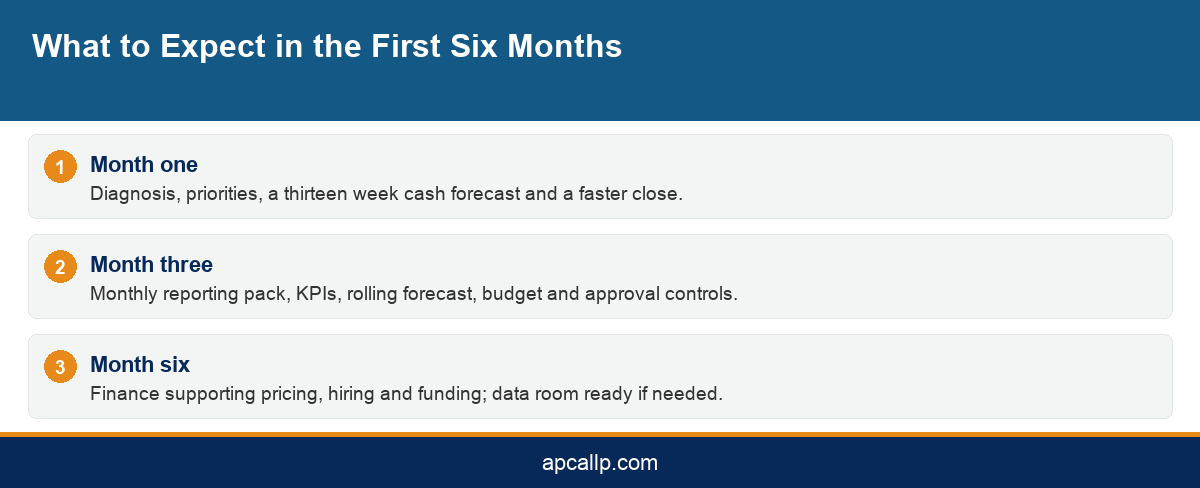
In the first month the consultant diagnoses. Expect a review of the accounts, the close process, cash, controls and compliance, followed by a short list of priorities. Quick wins usually include a thirteen week cash forecast and a cleaner monthly close.
By month three the core systems should be in place: a monthly reporting pack with KPIs, a rolling forecast, a budget, and clear approval controls. Our note on how finance teams handle cash flow monitoring and KPI forecasting shows what good looks like.
By month six the finance function should be supporting decisions: pricing, hiring, capital allocation and funding. If the company is preparing for a round or a deal, the data room and investor reporting should be ready.
Beyond six months, the engagement should settle into a rhythm: monthly reporting and review, quarterly forecasts and board packs, and annual budgets and audit planning. Projects such as a fundraise or an acquisition sit on top of that rhythm rather than replacing it.
Measuring the Engagement
Agree measures at the start: close time, forecast accuracy, cash runway visibility, audit findings and the time the founder spends on finance. CFO consulting that cannot show progress on measures like these is not earning its fee.
Measuring the Return on Finance Leadership
Finance leadership should pay for itself. The most visible returns are in cash: faster collections, better supplier terms, less idle inventory and fewer surprises. Many companies release more working capital in the first year than they spend on the engagement.
Other returns are less visible but just as real. Better pricing decisions improve margin. Reliable reporting shortens fundraises and improves valuations. Strong controls reduce audit findings and diligence adjustments. A founder who spends less time on finance spends more on customers.
Track these returns deliberately. Agree a baseline at the start, such as debtor days, close time, forecast accuracy and audit findings, and review them every quarter. If the measures are not improving, change the scope or the consultant.
A Quarterly Review Format
Each quarter, review progress against the agreed measures, the cash position against forecast, open audit or compliance issues, and the priorities for the next quarter. Keep it to one page so the board actually reads it.
Cash, Working Capital and Funding
Cash is where CFO consulting usually pays for itself first. A reliable cash forecast, disciplined collections, sensible supplier terms and a clear view of inventory can free significant cash without new funding. The concept of working capital is simple; managing it every week is not.
For startups, burn rate and runway drive every decision. Our guide to burn rate, runway and unit economics explains how finance leaders keep these under control. For established SMEs, the focus is often margin, debtor days and bank facilities.
Funding follows. A CFO consultant prepares the model, the reporting history and the narrative investors or lenders need, and manages the process alongside the founder. Debt, equity and structured instruments each need a different preparation.
The discipline is weekly rather than monthly. A short weekly cash meeting, covering receipts, payments and the forecast for the next thirteen weeks, prevents most cash surprises and gives founders the confidence to make hiring and spending decisions.
Bank Facilities and Lender Reporting
Lenders want timely stock statements, covenant compliance and credible projections. A finance function that meets lender reporting on time gets better terms and faster renewals.
Pricing and Margin Decisions
Margin problems often hide in pricing that was set years ago, discounts nobody tracks and costs that are allocated loosely. A finance leader who analyses margin by product, customer and channel usually finds quick improvements that matter more than cost cutting.
Runway as a Board Metric
Report runway every month in months of cash, with the assumptions behind it. It is the single number boards and investors watch most closely.
Reporting, Controls and Compliance Oversight
Investors and boards expect monthly reporting within a few weeks of month end. That needs a fast close, reconciled accounts and a standard pack covering revenue, margins, cash, KPIs and variances against budget. CFO consulting sets this rhythm and holds the team to it.
Controls protect the business as it grows: approval limits, segregation of duties, vendor onboarding checks and payroll controls. They also matter in diligence, where weak controls lead to price adjustments and indemnities.
Compliance oversight covers GST, TDS, income tax, company law and, for funded companies, exchange control reporting. The CFO consultant does not need to file everything personally, but must know that it is filed. The income tax e filing portal and statutory calendars should be tracked in the monthly pack.
Multi entity groups add consolidation, intercompany reconciliations and transfer pricing to the list. A monthly consolidation, even an informal one, gives the founder a true picture of group cash and profit rather than a set of separate entity reports.
Board Packs That Drive Decisions
A good board pack is short: a one page summary, key metrics against budget, cash and runway, risks and decisions required. Detailed schedules go in an appendix. Boards that receive the same structure every month spend their time on decisions rather than on understanding the numbers.
Building the Finance Team Around CFO Consulting
CFO consulting works best on top of a competent accounts team. The consultant designs processes and reporting, but someone must post entries, reconcile accounts and file returns every day. Many growing companies need to strengthen this layer first.
A practical structure for a company of fifty to two hundred people is an accounts executive or two, a strong accountant or controller, and CFO consulting on top. As the company grows, the controller role becomes critical, because it frees the CFO consultant to focus on strategy, investors and deals.
The consultant should also help hire and develop the team. Clear roles, documented processes and a monthly close checklist turn individual knowledge into a system that survives staff changes. Our note on how founder led finance limits growth explains why this matters for scaling companies.
Tools and Systems
Most growing companies run accounting on a mainstream platform, with payroll, expense and billing tools connected to it. The CFO consultant should rationalise these, automate reconciliations where possible and make sure reports come from one source of truth.
Documenting the Close
A written month end checklist with owners and deadlines is the foundation of reliable reporting. It also makes onboarding new staff faster and gives auditors and investors confidence in the numbers.
CFO Consulting for Deals and Fundraises
Deals and fundraises are where finance leadership is tested hardest. Buyers and investors ask detailed questions, request historical data and test forecasts. A company with a CFO consultant already in place answers faster and with more credibility.
Before a deal, the consultant prepares normalised financials, reconciles the cap table, resolves compliance gaps and builds the data room. During the deal, they handle diligence questions so the founder can run the business. After completion, they support integration or the new investor reporting.
Our note on CFO support during due diligence explains this role in more detail, and our AI startup case study shows outsourced finance leadership in a funded technology company.
Preparing the Data Room
A data room built by the finance leader is organised around the questions investors ask: financial statements, management accounts, forecasts, cap table, contracts, compliance filings and board minutes. Building it before the round opens means diligence can start the week a term sheet is signed.
After the Deal Closes
New investors bring new reporting requirements, board rhythms and consent rights. The finance leader sets up the reporting calendar, tracks investor consents and makes sure the company meets every information covenant in the shareholders' agreement.
How to Choose CFO Consulting in Bengaluru
Start with experience. Ask for examples of companies at your stage and in your sector, and speak to founders who have used the consultant. Ask who will actually do the work and how often they will be available.
Check the depth behind the individual. A consultant backed by a team can handle reporting and compliance as well as strategy. A solo consultant may be excellent on strategy but stretched on execution. Our Bengaluru finance leadership guide covers the local market in more detail.
Finally, agree scope, measures and an exit. Good CFO consulting builds systems and people the company keeps. A clear plan for handing over to an in house finance leader, when the time comes, is a sign of a consultant focused on your interests. Companies in Hyderabad and other metros use the same criteria, and APCALLP supports clients across India from Bengaluru.
Trial periods help. A short initial project, such as a cash forecast and reporting pack, shows how the consultant works with your team before you commit to a longer engagement.
Questions to Ask Before You Sign
Who exactly will work with us, and for how many days? What will you deliver in the first ninety days? How will you measure progress? How do you work with our accounts team and auditors? What happens when we are ready to hire a full time CFO?
Common Mistakes When Engaging a Finance Leader
The first mistake is engaging too late. Companies often look for finance leadership only when a crisis arrives, such as a cash shortfall, a failed audit or a diligence request they cannot answer. By then the options are narrower and the work is more expensive.
The second is an unclear scope. Without agreed deliverables and measures, the engagement drifts into ad hoc firefighting. The third is expecting the consultant to fix everything without a capable accounts team underneath. The fourth is keeping the consultant away from the board and investors, which wastes the very credibility the company is paying for.
Avoiding these mistakes is simple in principle: start early, agree scope and measures, invest in the accounts team, and give the finance leader a seat in the conversations where decisions are made. Our guide to when growing businesses should bring in finance leadership covers the timing question for Bengaluru companies.
Conclusion
CFO consulting gives growing companies finance leadership in the shape they need: a project, ongoing support, a fractional CFO or an interim leader. Choose the model by stage, trigger and complexity, agree clear measures, and expect the work to leave behind stronger systems and people. Whether you are preparing a fundraise, a deal or simply want reliable numbers, speak with APCALLP's Bengaluru team about the right engagement.
Frequently Asked Questions
What is CFO consulting?

What is the difference between a fractional CFO and an interim CFO?
When should a startup bring in CFO level support?
Does CFO consulting replace the accounts team?
How quickly does CFO consulting show results?
Can a CFO consultant help with fundraising?
How is CFO consulting different from an audit?
Is CFO consulting suitable for family owned SMEs?
Does APCALLP offer CFO consulting outside Bengaluru?